{"title":"基于修饰铂纳米粒子的先进过氧化氢传感器方波伏安法","authors":"Weilong Bao , Hang Lu , Fei Li , Siyuan Lu","doi":"10.1016/j.materresbull.2026.114031","DOIUrl":null,"url":null,"abstract":"<div><div>Morphological and size control of Pt nanoparticles (PtNPs) has long been pursued to improve the catalytic performance of Pt-based electrochemical sensors during recent decades. In this study, a high‑performance hydrogen peroxide sensor was developed by electrochemically depositing PtNPs onto a polyaniline‑modified glassy carbon electrode (PANI/GCE). Subsequently, the PtNPs/PANI/GCE electrode was separately subjected to two distinct methods, namely square wave (SW) treatment and square wave voltammetry (SWV). It was found that SWV was able to alter the exposed surface of platinum nanoparticles from (111) to (200), which leads to the formation of the angular nano-edges on the original Pt nanospheres. This structural transformation effectively increased the number of active sites and enlarged the effective surface area for the catalytic redox reaction of hydrogen peroxide. Owing to such advantages, the prepared PtNPs/PANI/GCE-SWV electrode exhibits a wide linear range from 50 μM to 30 mM and an excellent sensitivity of 294.90 μA·mM<sup>−1</sup>·cm<sup>−2</sup> for H<sub>2</sub>O<sub>2</sub> detection. In addition, SWV endowed the fabricated sensor with superior stability and reproducibility, thereby demonstrating promising prospects in the commercialization of stretchable and wearable biosensors.</div></div>","PeriodicalId":18265,"journal":{"name":"Materials Research Bulletin","volume":"199 ","pages":"Article 114031"},"PeriodicalIF":5.7000,"publicationDate":"2026-06-01","publicationTypes":"Journal Article","fieldsOfStudy":null,"isOpenAccess":false,"openAccessPdf":"","citationCount":"0","resultStr":"{\"title\":\"Advanced hydrogen peroxide sensor based on modified platinum nanoparticles through square wave voltammetry\",\"authors\":\"Weilong Bao , Hang Lu , Fei Li , Siyuan Lu\",\"doi\":\"10.1016/j.materresbull.2026.114031\",\"DOIUrl\":null,\"url\":null,\"abstract\":\"<div><div>Morphological and size control of Pt nanoparticles (PtNPs) has long been pursued to improve the catalytic performance of Pt-based electrochemical sensors during recent decades. In this study, a high‑performance hydrogen peroxide sensor was developed by electrochemically depositing PtNPs onto a polyaniline‑modified glassy carbon electrode (PANI/GCE). Subsequently, the PtNPs/PANI/GCE electrode was separately subjected to two distinct methods, namely square wave (SW) treatment and square wave voltammetry (SWV). It was found that SWV was able to alter the exposed surface of platinum nanoparticles from (111) to (200), which leads to the formation of the angular nano-edges on the original Pt nanospheres. This structural transformation effectively increased the number of active sites and enlarged the effective surface area for the catalytic redox reaction of hydrogen peroxide. Owing to such advantages, the prepared PtNPs/PANI/GCE-SWV electrode exhibits a wide linear range from 50 μM to 30 mM and an excellent sensitivity of 294.90 μA·mM<sup>−1</sup>·cm<sup>−2</sup> for H<sub>2</sub>O<sub>2</sub> detection. In addition, SWV endowed the fabricated sensor with superior stability and reproducibility, thereby demonstrating promising prospects in the commercialization of stretchable and wearable biosensors.</div></div>\",\"PeriodicalId\":18265,\"journal\":{\"name\":\"Materials Research Bulletin\",\"volume\":\"199 \",\"pages\":\"Article 114031\"},\"PeriodicalIF\":5.7000,\"publicationDate\":\"2026-06-01\",\"publicationTypes\":\"Journal Article\",\"fieldsOfStudy\":null,\"isOpenAccess\":false,\"openAccessPdf\":\"\",\"citationCount\":\"0\",\"resultStr\":null,\"platform\":\"Semanticscholar\",\"paperid\":null,\"PeriodicalName\":\"Materials Research Bulletin\",\"FirstCategoryId\":\"88\",\"ListUrlMain\":\"https://www.sciencedirect.com/science/article/pii/S0025540826000425\",\"RegionNum\":3,\"RegionCategory\":\"材料科学\",\"ArticlePicture\":[],\"TitleCN\":null,\"AbstractTextCN\":null,\"PMCID\":null,\"EPubDate\":\"2026/1/29 0:00:00\",\"PubModel\":\"Epub\",\"JCR\":\"Q2\",\"JCRName\":\"MATERIALS SCIENCE, MULTIDISCIPLINARY\",\"Score\":null,\"Total\":0}","platform":"Semanticscholar","paperid":null,"PeriodicalName":"Materials Research Bulletin","FirstCategoryId":"88","ListUrlMain":"https://www.sciencedirect.com/science/article/pii/S0025540826000425","RegionNum":3,"RegionCategory":"材料科学","ArticlePicture":[],"TitleCN":null,"AbstractTextCN":null,"PMCID":null,"EPubDate":"2026/1/29 0:00:00","PubModel":"Epub","JCR":"Q2","JCRName":"MATERIALS SCIENCE, MULTIDISCIPLINARY","Score":null,"Total":0}
Advanced hydrogen peroxide sensor based on modified platinum nanoparticles through square wave voltammetry
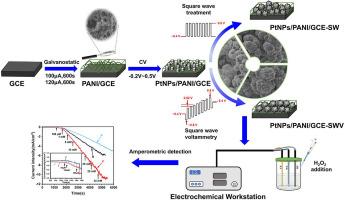
Morphological and size control of Pt nanoparticles (PtNPs) has long been pursued to improve the catalytic performance of Pt-based electrochemical sensors during recent decades. In this study, a high‑performance hydrogen peroxide sensor was developed by electrochemically depositing PtNPs onto a polyaniline‑modified glassy carbon electrode (PANI/GCE). Subsequently, the PtNPs/PANI/GCE electrode was separately subjected to two distinct methods, namely square wave (SW) treatment and square wave voltammetry (SWV). It was found that SWV was able to alter the exposed surface of platinum nanoparticles from (111) to (200), which leads to the formation of the angular nano-edges on the original Pt nanospheres. This structural transformation effectively increased the number of active sites and enlarged the effective surface area for the catalytic redox reaction of hydrogen peroxide. Owing to such advantages, the prepared PtNPs/PANI/GCE-SWV electrode exhibits a wide linear range from 50 μM to 30 mM and an excellent sensitivity of 294.90 μA·mM−1·cm−2 for H2O2 detection. In addition, SWV endowed the fabricated sensor with superior stability and reproducibility, thereby demonstrating promising prospects in the commercialization of stretchable and wearable biosensors.
期刊介绍:
Materials Research Bulletin is an international journal reporting high-impact research on processing-structure-property relationships in functional materials and nanomaterials with interesting electronic, magnetic, optical, thermal, mechanical or catalytic properties. Papers purely on thermodynamics or theoretical calculations (e.g., density functional theory) do not fall within the scope of the journal unless they also demonstrate a clear link to physical properties. Topics covered include functional materials (e.g., dielectrics, pyroelectrics, piezoelectrics, ferroelectrics, relaxors, thermoelectrics, etc.); electrochemistry and solid-state ionics (e.g., photovoltaics, batteries, sensors, and fuel cells); nanomaterials, graphene, and nanocomposites; luminescence and photocatalysis; crystal-structure and defect-structure analysis; novel electronics; non-crystalline solids; flexible electronics; protein-material interactions; and polymeric ion-exchange membranes.