{"title":"优化肝胆外科标准化培训的mini-CEX和OSCE综合评估模型","authors":"Hucheng Ma MD , Haozhen Ren MD , Xingyu Wu MD , Decai Yu MD","doi":"10.1016/j.sopen.2026.01.008","DOIUrl":null,"url":null,"abstract":"<div><h3>Background</h3><div>Standardized residency training in China requires robust evaluation mechanisms, yet significant disparities exist due to lacking standardized criteria. Current tools like OSCE (simulation-based) and Mini-CEX (workplace-based) have limitations: Mini-CEX excludes surgical skills, while OSCE lacks authentic clinical context. Combining them offers holistic assessment potential but is understudied in hepatobiliary surgery.</div></div><div><h3>Methods</h3><div>A prospective cohort study randomized 36 hepatobiliary surgery residents into: Experimental group (<em>n</em> = 18): Monthly Mini-CEX assessments (evaluating medical interviewing, physical exam, clinical judgment, communication, treatment planning, patient-centered care, and overall competence via 9-point scale) followed by final OSCE. Control group (<em>n</em> = 18): Monthly traditional written/procedural assessments followed by final OSCE.</div><div>The OSCE (100-point max) comprised stations for history-taking, physical exam, hepatobiliary procedural skills, case analysis and doctor-patient communication. Intergroup comparisons used Student's <em>t</em>-tests and chi-square tests (SPSS 26.0, <em>p</em> < 0.05 significant).</div></div><div><h3>Results</h3><div>Baseline characteristics showed no significant differences between groups. The experimental group achieved significantly higher final OSCE total scores (<em>p</em> < 0.05), with notable improvements in physical examination and doctor-patient communication. No significant differences were found in history-taking, hepatobiliary procedural skills, or case analysis. Satisfaction was significantly higher in the experimental group (1/18 vs. 6/18 dissatisfied in controls). Trainees valued Mini-CEX's real-time feedback and competency mapping.</div></div><div><h3>Conclusions</h3><div>Integrating Mini-CEX and OSCE creates an effective dual-modality system for hepatobiliary surgery residents. It significantly enhances overall clinical competency (especially physical exam and communication) and trainee satisfaction compared to traditional methods. This combined approach provide both formative feedback (Mini-CEX) and summative validation (OSCE), establishing a promising specialty-specific framework. Future multi-center studies are recommended.</div></div>","PeriodicalId":74892,"journal":{"name":"Surgery open science","volume":"30 ","pages":"Pages 41-45"},"PeriodicalIF":1.7000,"publicationDate":"2026-03-01","publicationTypes":"Journal Article","fieldsOfStudy":null,"isOpenAccess":false,"openAccessPdf":"","citationCount":"0","resultStr":"{\"title\":\"An integrated mini-CEX and OSCE assessment model for optimizing standardized training in department of hepatobiliary surgery\",\"authors\":\"Hucheng Ma MD , Haozhen Ren MD , Xingyu Wu MD , Decai Yu MD\",\"doi\":\"10.1016/j.sopen.2026.01.008\",\"DOIUrl\":null,\"url\":null,\"abstract\":\"<div><h3>Background</h3><div>Standardized residency training in China requires robust evaluation mechanisms, yet significant disparities exist due to lacking standardized criteria. Current tools like OSCE (simulation-based) and Mini-CEX (workplace-based) have limitations: Mini-CEX excludes surgical skills, while OSCE lacks authentic clinical context. Combining them offers holistic assessment potential but is understudied in hepatobiliary surgery.</div></div><div><h3>Methods</h3><div>A prospective cohort study randomized 36 hepatobiliary surgery residents into: Experimental group (<em>n</em> = 18): Monthly Mini-CEX assessments (evaluating medical interviewing, physical exam, clinical judgment, communication, treatment planning, patient-centered care, and overall competence via 9-point scale) followed by final OSCE. Control group (<em>n</em> = 18): Monthly traditional written/procedural assessments followed by final OSCE.</div><div>The OSCE (100-point max) comprised stations for history-taking, physical exam, hepatobiliary procedural skills, case analysis and doctor-patient communication. Intergroup comparisons used Student's <em>t</em>-tests and chi-square tests (SPSS 26.0, <em>p</em> < 0.05 significant).</div></div><div><h3>Results</h3><div>Baseline characteristics showed no significant differences between groups. The experimental group achieved significantly higher final OSCE total scores (<em>p</em> < 0.05), with notable improvements in physical examination and doctor-patient communication. No significant differences were found in history-taking, hepatobiliary procedural skills, or case analysis. Satisfaction was significantly higher in the experimental group (1/18 vs. 6/18 dissatisfied in controls). Trainees valued Mini-CEX's real-time feedback and competency mapping.</div></div><div><h3>Conclusions</h3><div>Integrating Mini-CEX and OSCE creates an effective dual-modality system for hepatobiliary surgery residents. It significantly enhances overall clinical competency (especially physical exam and communication) and trainee satisfaction compared to traditional methods. This combined approach provide both formative feedback (Mini-CEX) and summative validation (OSCE), establishing a promising specialty-specific framework. Future multi-center studies are recommended.</div></div>\",\"PeriodicalId\":74892,\"journal\":{\"name\":\"Surgery open science\",\"volume\":\"30 \",\"pages\":\"Pages 41-45\"},\"PeriodicalIF\":1.7000,\"publicationDate\":\"2026-03-01\",\"publicationTypes\":\"Journal Article\",\"fieldsOfStudy\":null,\"isOpenAccess\":false,\"openAccessPdf\":\"\",\"citationCount\":\"0\",\"resultStr\":null,\"platform\":\"Semanticscholar\",\"paperid\":null,\"PeriodicalName\":\"Surgery open science\",\"FirstCategoryId\":\"1085\",\"ListUrlMain\":\"https://www.sciencedirect.com/science/article/pii/S2589845026000096\",\"RegionNum\":0,\"RegionCategory\":null,\"ArticlePicture\":[],\"TitleCN\":null,\"AbstractTextCN\":null,\"PMCID\":null,\"EPubDate\":\"2026/1/31 0:00:00\",\"PubModel\":\"Epub\",\"JCR\":\"Q3\",\"JCRName\":\"SURGERY\",\"Score\":null,\"Total\":0}","platform":"Semanticscholar","paperid":null,"PeriodicalName":"Surgery open science","FirstCategoryId":"1085","ListUrlMain":"https://www.sciencedirect.com/science/article/pii/S2589845026000096","RegionNum":0,"RegionCategory":null,"ArticlePicture":[],"TitleCN":null,"AbstractTextCN":null,"PMCID":null,"EPubDate":"2026/1/31 0:00:00","PubModel":"Epub","JCR":"Q3","JCRName":"SURGERY","Score":null,"Total":0}
An integrated mini-CEX and OSCE assessment model for optimizing standardized training in department of hepatobiliary surgery
Background
Standardized residency training in China requires robust evaluation mechanisms, yet significant disparities exist due to lacking standardized criteria. Current tools like OSCE (simulation-based) and Mini-CEX (workplace-based) have limitations: Mini-CEX excludes surgical skills, while OSCE lacks authentic clinical context. Combining them offers holistic assessment potential but is understudied in hepatobiliary surgery.
Methods
A prospective cohort study randomized 36 hepatobiliary surgery residents into: Experimental group (n = 18): Monthly Mini-CEX assessments (evaluating medical interviewing, physical exam, clinical judgment, communication, treatment planning, patient-centered care, and overall competence via 9-point scale) followed by final OSCE. Control group (n = 18): Monthly traditional written/procedural assessments followed by final OSCE.
The OSCE (100-point max) comprised stations for history-taking, physical exam, hepatobiliary procedural skills, case analysis and doctor-patient communication. Intergroup comparisons used Student's t-tests and chi-square tests (SPSS 26.0, p < 0.05 significant).
Results
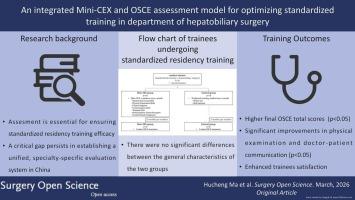
Baseline characteristics showed no significant differences between groups. The experimental group achieved significantly higher final OSCE total scores (p < 0.05), with notable improvements in physical examination and doctor-patient communication. No significant differences were found in history-taking, hepatobiliary procedural skills, or case analysis. Satisfaction was significantly higher in the experimental group (1/18 vs. 6/18 dissatisfied in controls). Trainees valued Mini-CEX's real-time feedback and competency mapping.
Conclusions
Integrating Mini-CEX and OSCE creates an effective dual-modality system for hepatobiliary surgery residents. It significantly enhances overall clinical competency (especially physical exam and communication) and trainee satisfaction compared to traditional methods. This combined approach provide both formative feedback (Mini-CEX) and summative validation (OSCE), establishing a promising specialty-specific framework. Future multi-center studies are recommended.


 求助内容:
求助内容: 应助结果提醒方式:

 京公网安备 11010802042870号


