{"title":"城市矩阵中基于现场的化学战剂取证的关键审查:在可部署的实验室中集成检测,采样和GC-MS鉴定","authors":"Tomas Rozsypal","doi":"10.1016/j.trac.2026.118684","DOIUrl":null,"url":null,"abstract":"<div><div>Recent chemical incidents and the potential misuse of toxic agents in urban areas have renewed the need for rapid, reliable, and defensible field analysis. The forensic investigation of chemical warfare agents (CWAs) under such conditions remains highly challenging. This review critically examines strategies for field detection, sampling, sample preparation, and on-site laboratory identification of urban samples. Across air, liquid, solid, and polymeric matrices, analytical success depends more on sampling design and matrix-aware workflows than on instrumentation alone. Portable spectroscopic systems enable rapid field detection but rarely provide the level required for confirmed identification. GC–MS remains a key tool. Although many advanced laboratory protocols exist, most are impractical for mobile laboratories due to equipment constraints and time-critical conditions. Extraction remains a critical yet insufficiently optimized step. The review identifies these gaps as barriers to forensic validation and highlights the need for harmonized, matrix-specific workflows to strengthen future CWA field forensics.</div></div>","PeriodicalId":439,"journal":{"name":"Trends in Analytical Chemistry","volume":"197 ","pages":"Article 118684"},"PeriodicalIF":12.0000,"publicationDate":"2026-04-01","publicationTypes":"Journal Article","fieldsOfStudy":null,"isOpenAccess":false,"openAccessPdf":"","citationCount":"0","resultStr":"{\"title\":\"Critical review of field-based forensics of chemical warfare agents in urban matrices: Integrating detection, sampling, and GC–MS identification in a deployable laboratory\",\"authors\":\"Tomas Rozsypal\",\"doi\":\"10.1016/j.trac.2026.118684\",\"DOIUrl\":null,\"url\":null,\"abstract\":\"<div><div>Recent chemical incidents and the potential misuse of toxic agents in urban areas have renewed the need for rapid, reliable, and defensible field analysis. The forensic investigation of chemical warfare agents (CWAs) under such conditions remains highly challenging. This review critically examines strategies for field detection, sampling, sample preparation, and on-site laboratory identification of urban samples. Across air, liquid, solid, and polymeric matrices, analytical success depends more on sampling design and matrix-aware workflows than on instrumentation alone. Portable spectroscopic systems enable rapid field detection but rarely provide the level required for confirmed identification. GC–MS remains a key tool. Although many advanced laboratory protocols exist, most are impractical for mobile laboratories due to equipment constraints and time-critical conditions. Extraction remains a critical yet insufficiently optimized step. The review identifies these gaps as barriers to forensic validation and highlights the need for harmonized, matrix-specific workflows to strengthen future CWA field forensics.</div></div>\",\"PeriodicalId\":439,\"journal\":{\"name\":\"Trends in Analytical Chemistry\",\"volume\":\"197 \",\"pages\":\"Article 118684\"},\"PeriodicalIF\":12.0000,\"publicationDate\":\"2026-04-01\",\"publicationTypes\":\"Journal Article\",\"fieldsOfStudy\":null,\"isOpenAccess\":false,\"openAccessPdf\":\"\",\"citationCount\":\"0\",\"resultStr\":null,\"platform\":\"Semanticscholar\",\"paperid\":null,\"PeriodicalName\":\"Trends in Analytical Chemistry\",\"FirstCategoryId\":\"1\",\"ListUrlMain\":\"https://www.sciencedirect.com/science/article/pii/S0165993626000397\",\"RegionNum\":1,\"RegionCategory\":\"化学\",\"ArticlePicture\":[],\"TitleCN\":null,\"AbstractTextCN\":null,\"PMCID\":null,\"EPubDate\":\"2026/2/3 0:00:00\",\"PubModel\":\"Epub\",\"JCR\":\"Q1\",\"JCRName\":\"CHEMISTRY, ANALYTICAL\",\"Score\":null,\"Total\":0}","platform":"Semanticscholar","paperid":null,"PeriodicalName":"Trends in Analytical Chemistry","FirstCategoryId":"1","ListUrlMain":"https://www.sciencedirect.com/science/article/pii/S0165993626000397","RegionNum":1,"RegionCategory":"化学","ArticlePicture":[],"TitleCN":null,"AbstractTextCN":null,"PMCID":null,"EPubDate":"2026/2/3 0:00:00","PubModel":"Epub","JCR":"Q1","JCRName":"CHEMISTRY, ANALYTICAL","Score":null,"Total":0}
Critical review of field-based forensics of chemical warfare agents in urban matrices: Integrating detection, sampling, and GC–MS identification in a deployable laboratory
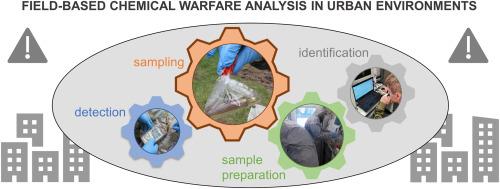
Recent chemical incidents and the potential misuse of toxic agents in urban areas have renewed the need for rapid, reliable, and defensible field analysis. The forensic investigation of chemical warfare agents (CWAs) under such conditions remains highly challenging. This review critically examines strategies for field detection, sampling, sample preparation, and on-site laboratory identification of urban samples. Across air, liquid, solid, and polymeric matrices, analytical success depends more on sampling design and matrix-aware workflows than on instrumentation alone. Portable spectroscopic systems enable rapid field detection but rarely provide the level required for confirmed identification. GC–MS remains a key tool. Although many advanced laboratory protocols exist, most are impractical for mobile laboratories due to equipment constraints and time-critical conditions. Extraction remains a critical yet insufficiently optimized step. The review identifies these gaps as barriers to forensic validation and highlights the need for harmonized, matrix-specific workflows to strengthen future CWA field forensics.
期刊介绍:
TrAC publishes succinct and critical overviews of recent advancements in analytical chemistry, designed to assist analytical chemists and other users of analytical techniques. These reviews offer excellent, up-to-date, and timely coverage of various topics within analytical chemistry. Encompassing areas such as analytical instrumentation, biomedical analysis, biomolecular analysis, biosensors, chemical analysis, chemometrics, clinical chemistry, drug discovery, environmental analysis and monitoring, food analysis, forensic science, laboratory automation, materials science, metabolomics, pesticide-residue analysis, pharmaceutical analysis, proteomics, surface science, and water analysis and monitoring, these critical reviews provide comprehensive insights for practitioners in the field.