{"title":"胸腺瘤相关重症肌无力伴低γ -球蛋白血症患者的免疫缺陷特征:一种与古德综合征相当的病症。","authors":"Saki Nakashima , Kaori Sakuishi , Manato Hara , Reiko Kawasaki , Toshiyuki Kakumoto , Hiroyuki Ishiura , Tatsushi Toda","doi":"10.1016/j.jneuroim.2026.578885","DOIUrl":null,"url":null,"abstract":"<div><div>Good's syndrome (GS) is a rare immunodeficiency disorder associated with thymoma, characterized by hypogammaglobulinemia and recurrent infections; however, its clinical significance in thymoma-associated myasthenia gravis (TAMG) remains unclear. We retrospectively reviewed 30 patients with TAMG admitted to our center between January 2010 and March 2022. We defined GS-like immunodeficiency as serum IgG below the institutional cutoff of 861 mg/dL and a history of two or more infections requiring antimicrobial treatment; 11 patients (36.7%) met this definition. Compared with the remaining patients, the GS-like group had higher incidences of malignancy (45.5% vs. 5.3%, <em>p</em> = 0.016) and autoimmune diseases other than MG (36.4% vs. 5.3%, <em>p</em> = 0.047), lower peripheral lymphocyte counts (median 1100/μL vs. 2200/μL, <em>p</em> = 0.0051), and more frequent airflow obstruction defined by one second to forced vital capacity ratio of less than 70% (60.0% vs. 5.3%, <em>p</em> = 0.0026). Five deaths occurred in the GS-like group, and none in the other; median survival from the first antimicrobial-treated infection was 5.0 years. These findings imply that TAMG patients with GS-like immunodeficiency have a worse prognosis, underscoring the need for close monitoring and timely adjustments of MG management. (189 words).</div></div>","PeriodicalId":16671,"journal":{"name":"Journal of neuroimmunology","volume":"414 ","pages":"Article 578885"},"PeriodicalIF":2.5000,"publicationDate":"2026-05-01","publicationTypes":"Journal Article","fieldsOfStudy":null,"isOpenAccess":false,"openAccessPdf":"","citationCount":"0","resultStr":"{\"title\":\"Immuno-deficient features of thymoma-associated myasthenia gravis patients with hypogammaglobulinemia: A condition comparable to Good's syndrome\",\"authors\":\"Saki Nakashima , Kaori Sakuishi , Manato Hara , Reiko Kawasaki , Toshiyuki Kakumoto , Hiroyuki Ishiura , Tatsushi Toda\",\"doi\":\"10.1016/j.jneuroim.2026.578885\",\"DOIUrl\":null,\"url\":null,\"abstract\":\"<div><div>Good's syndrome (GS) is a rare immunodeficiency disorder associated with thymoma, characterized by hypogammaglobulinemia and recurrent infections; however, its clinical significance in thymoma-associated myasthenia gravis (TAMG) remains unclear. We retrospectively reviewed 30 patients with TAMG admitted to our center between January 2010 and March 2022. We defined GS-like immunodeficiency as serum IgG below the institutional cutoff of 861 mg/dL and a history of two or more infections requiring antimicrobial treatment; 11 patients (36.7%) met this definition. Compared with the remaining patients, the GS-like group had higher incidences of malignancy (45.5% vs. 5.3%, <em>p</em> = 0.016) and autoimmune diseases other than MG (36.4% vs. 5.3%, <em>p</em> = 0.047), lower peripheral lymphocyte counts (median 1100/μL vs. 2200/μL, <em>p</em> = 0.0051), and more frequent airflow obstruction defined by one second to forced vital capacity ratio of less than 70% (60.0% vs. 5.3%, <em>p</em> = 0.0026). Five deaths occurred in the GS-like group, and none in the other; median survival from the first antimicrobial-treated infection was 5.0 years. These findings imply that TAMG patients with GS-like immunodeficiency have a worse prognosis, underscoring the need for close monitoring and timely adjustments of MG management. (189 words).</div></div>\",\"PeriodicalId\":16671,\"journal\":{\"name\":\"Journal of neuroimmunology\",\"volume\":\"414 \",\"pages\":\"Article 578885\"},\"PeriodicalIF\":2.5000,\"publicationDate\":\"2026-05-01\",\"publicationTypes\":\"Journal Article\",\"fieldsOfStudy\":null,\"isOpenAccess\":false,\"openAccessPdf\":\"\",\"citationCount\":\"0\",\"resultStr\":null,\"platform\":\"Semanticscholar\",\"paperid\":null,\"PeriodicalName\":\"Journal of neuroimmunology\",\"FirstCategoryId\":\"3\",\"ListUrlMain\":\"https://www.sciencedirect.com/science/article/pii/S0165572826000330\",\"RegionNum\":4,\"RegionCategory\":\"医学\",\"ArticlePicture\":[],\"TitleCN\":null,\"AbstractTextCN\":null,\"PMCID\":null,\"EPubDate\":\"2026/2/5 0:00:00\",\"PubModel\":\"Epub\",\"JCR\":\"Q3\",\"JCRName\":\"IMMUNOLOGY\",\"Score\":null,\"Total\":0}","platform":"Semanticscholar","paperid":null,"PeriodicalName":"Journal of neuroimmunology","FirstCategoryId":"3","ListUrlMain":"https://www.sciencedirect.com/science/article/pii/S0165572826000330","RegionNum":4,"RegionCategory":"医学","ArticlePicture":[],"TitleCN":null,"AbstractTextCN":null,"PMCID":null,"EPubDate":"2026/2/5 0:00:00","PubModel":"Epub","JCR":"Q3","JCRName":"IMMUNOLOGY","Score":null,"Total":0}
引用次数: 0
摘要
古德氏综合征(GS)是一种罕见的与胸腺瘤相关的免疫缺陷疾病,以低γ球蛋白血症和复发性感染为特征;然而,其在胸腺瘤相关性重症肌无力(TAMG)中的临床意义尚不清楚。我们回顾性分析了2010年1月至2022年3月间本中心收治的30例tam患者。我们将gs样免疫缺陷定义为血清IgG低于861 mg/dL的法定临界值,并且有两次或两次以上需要抗菌药物治疗的感染史;11例患者(36.7%)符合此定义。与其他患者相比,gs样组的恶性肿瘤发生率(45.5% vs. 5.3%, p = 0.016)和MG以外的自身免疫性疾病发生率(36.4% vs. 5.3%, p = 0.047)较高,外周淋巴细胞计数较低(中位数1100/μL vs. 2200/μL, p = 0.0051),气流阻塞发生率较高(1秒与强迫肺活量之比小于70%)(60.0% vs. 5.3%, p = 0.0026)。gs样组有5例死亡,另一组无死亡;首次抗微生物药物治疗感染的中位生存期为5.0年。这些发现提示,伴有gs样免疫缺陷的tmg患者预后较差,强调密切监测和及时调整MG管理的必要性。(189字)。
Immuno-deficient features of thymoma-associated myasthenia gravis patients with hypogammaglobulinemia: A condition comparable to Good's syndrome
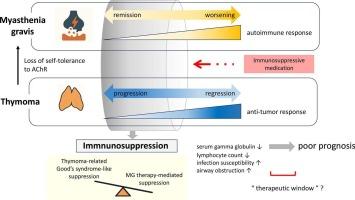
Good's syndrome (GS) is a rare immunodeficiency disorder associated with thymoma, characterized by hypogammaglobulinemia and recurrent infections; however, its clinical significance in thymoma-associated myasthenia gravis (TAMG) remains unclear. We retrospectively reviewed 30 patients with TAMG admitted to our center between January 2010 and March 2022. We defined GS-like immunodeficiency as serum IgG below the institutional cutoff of 861 mg/dL and a history of two or more infections requiring antimicrobial treatment; 11 patients (36.7%) met this definition. Compared with the remaining patients, the GS-like group had higher incidences of malignancy (45.5% vs. 5.3%, p = 0.016) and autoimmune diseases other than MG (36.4% vs. 5.3%, p = 0.047), lower peripheral lymphocyte counts (median 1100/μL vs. 2200/μL, p = 0.0051), and more frequent airflow obstruction defined by one second to forced vital capacity ratio of less than 70% (60.0% vs. 5.3%, p = 0.0026). Five deaths occurred in the GS-like group, and none in the other; median survival from the first antimicrobial-treated infection was 5.0 years. These findings imply that TAMG patients with GS-like immunodeficiency have a worse prognosis, underscoring the need for close monitoring and timely adjustments of MG management. (189 words).
期刊介绍:
The Journal of Neuroimmunology affords a forum for the publication of works applying immunologic methodology to the furtherance of the neurological sciences. Studies on all branches of the neurosciences, particularly fundamental and applied neurobiology, neurology, neuropathology, neurochemistry, neurovirology, neuroendocrinology, neuromuscular research, neuropharmacology and psychology, which involve either immunologic methodology (e.g. immunocytochemistry) or fundamental immunology (e.g. antibody and lymphocyte assays), are considered for publication.