{"title":"肾生理中的自噬:从细胞质量控制到器官代谢。","authors":"Takeshi Yamamoto, Satoshi Minami, Yoshitaka Isaka","doi":"10.1080/27694127.2026.2622228","DOIUrl":null,"url":null,"abstract":"<p><p>Autophagy is a cellular process that maintains kidney physiology by recycling intracellular components to preserve homeostasis. In the kidney, autophagy supports energy metabolism and integrity across multiple cell types. Its regulation is tightly governed by nutrient availability, hormonal cues, and oxygen levels, primarily through signaling pathways such as mechanistic target of rapamycin kinase (mTOR), AMP-activated protein kinase (AMPK), and transcription factor EB (TFEB). Under physiological conditions, autophagy is dynamically regulated to meet metabolic demands. However, aging, obesity, and metabolic stress impair lysosomal function, leading to a pathological state termed autophagic stagnation, in which autophagosomes accumulate but degradative flux is compromised. Rather than being uniformly protective, this stagnation promotes cellular damage and contributes to kidney disease progression. Notably, autophagic stagnation in proximal tubular epithelial cells (PTECs) contributes to acute kidney injury (AKI)-to-chronic kidney disease (CKD) transition and exacerbates lipotoxicity in obesity-related kidney disease. Recent studies highlight the importance of transcriptional regulators - including TFEB and MondoA - in maintaining autophagic activity and mitochondrial homeostasis. Therapeutic strategies aimed at restoring autophagic flux - pharmacologically or through lifestyle interventions such as caloric restriction - hold promise for preserving kidney function. Deeper understanding of cell type - specific autophagy regulation will be critical for developing targeted and context-specific therapies.</p>","PeriodicalId":72341,"journal":{"name":"Autophagy reports","volume":"5 1","pages":"2622228"},"PeriodicalIF":0.0000,"publicationDate":"2026-02-06","publicationTypes":"Journal Article","fieldsOfStudy":null,"isOpenAccess":false,"openAccessPdf":"https://www.ncbi.nlm.nih.gov/pmc/articles/PMC12885429/pdf/","citationCount":"0","resultStr":"{\"title\":\"Autophagy in kidney physiology: from cellular quality control to organ metabolism.\",\"authors\":\"Takeshi Yamamoto, Satoshi Minami, Yoshitaka Isaka\",\"doi\":\"10.1080/27694127.2026.2622228\",\"DOIUrl\":null,\"url\":null,\"abstract\":\"<p><p>Autophagy is a cellular process that maintains kidney physiology by recycling intracellular components to preserve homeostasis. In the kidney, autophagy supports energy metabolism and integrity across multiple cell types. Its regulation is tightly governed by nutrient availability, hormonal cues, and oxygen levels, primarily through signaling pathways such as mechanistic target of rapamycin kinase (mTOR), AMP-activated protein kinase (AMPK), and transcription factor EB (TFEB). Under physiological conditions, autophagy is dynamically regulated to meet metabolic demands. However, aging, obesity, and metabolic stress impair lysosomal function, leading to a pathological state termed autophagic stagnation, in which autophagosomes accumulate but degradative flux is compromised. Rather than being uniformly protective, this stagnation promotes cellular damage and contributes to kidney disease progression. Notably, autophagic stagnation in proximal tubular epithelial cells (PTECs) contributes to acute kidney injury (AKI)-to-chronic kidney disease (CKD) transition and exacerbates lipotoxicity in obesity-related kidney disease. Recent studies highlight the importance of transcriptional regulators - including TFEB and MondoA - in maintaining autophagic activity and mitochondrial homeostasis. Therapeutic strategies aimed at restoring autophagic flux - pharmacologically or through lifestyle interventions such as caloric restriction - hold promise for preserving kidney function. Deeper understanding of cell type - specific autophagy regulation will be critical for developing targeted and context-specific therapies.</p>\",\"PeriodicalId\":72341,\"journal\":{\"name\":\"Autophagy reports\",\"volume\":\"5 1\",\"pages\":\"2622228\"},\"PeriodicalIF\":0.0000,\"publicationDate\":\"2026-02-06\",\"publicationTypes\":\"Journal Article\",\"fieldsOfStudy\":null,\"isOpenAccess\":false,\"openAccessPdf\":\"https://www.ncbi.nlm.nih.gov/pmc/articles/PMC12885429/pdf/\",\"citationCount\":\"0\",\"resultStr\":null,\"platform\":\"Semanticscholar\",\"paperid\":null,\"PeriodicalName\":\"Autophagy reports\",\"FirstCategoryId\":\"1085\",\"ListUrlMain\":\"https://doi.org/10.1080/27694127.2026.2622228\",\"RegionNum\":0,\"RegionCategory\":null,\"ArticlePicture\":[],\"TitleCN\":null,\"AbstractTextCN\":null,\"PMCID\":null,\"EPubDate\":\"2026/1/1 0:00:00\",\"PubModel\":\"eCollection\",\"JCR\":\"\",\"JCRName\":\"\",\"Score\":null,\"Total\":0}","platform":"Semanticscholar","paperid":null,"PeriodicalName":"Autophagy reports","FirstCategoryId":"1085","ListUrlMain":"https://doi.org/10.1080/27694127.2026.2622228","RegionNum":0,"RegionCategory":null,"ArticlePicture":[],"TitleCN":null,"AbstractTextCN":null,"PMCID":null,"EPubDate":"2026/1/1 0:00:00","PubModel":"eCollection","JCR":"","JCRName":"","Score":null,"Total":0}
Autophagy in kidney physiology: from cellular quality control to organ metabolism.
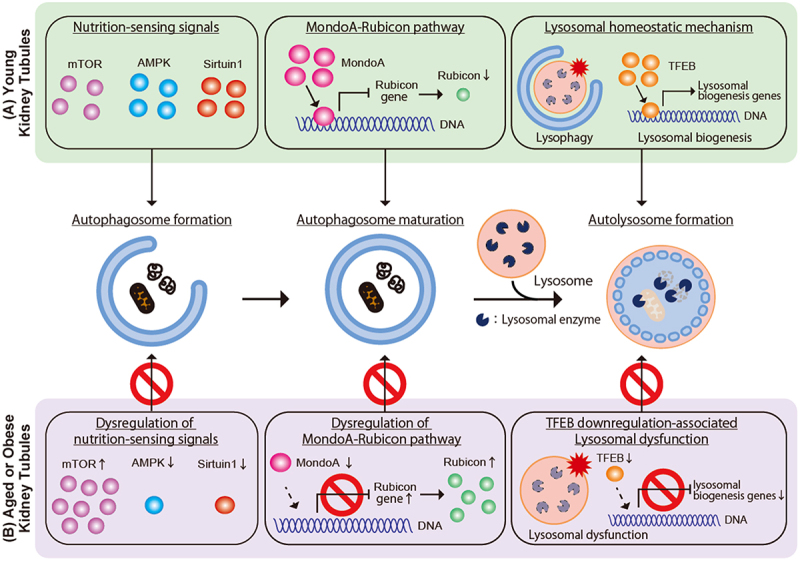
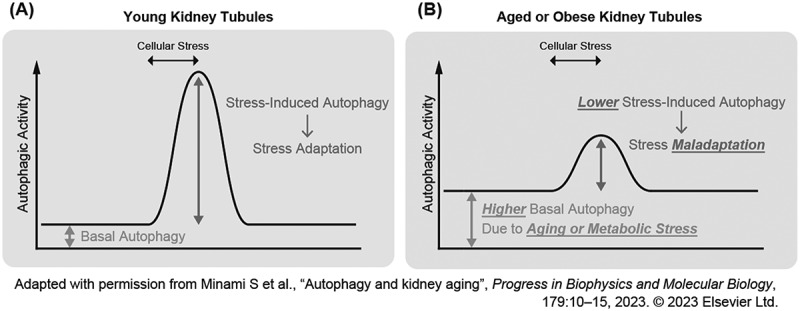
Autophagy is a cellular process that maintains kidney physiology by recycling intracellular components to preserve homeostasis. In the kidney, autophagy supports energy metabolism and integrity across multiple cell types. Its regulation is tightly governed by nutrient availability, hormonal cues, and oxygen levels, primarily through signaling pathways such as mechanistic target of rapamycin kinase (mTOR), AMP-activated protein kinase (AMPK), and transcription factor EB (TFEB). Under physiological conditions, autophagy is dynamically regulated to meet metabolic demands. However, aging, obesity, and metabolic stress impair lysosomal function, leading to a pathological state termed autophagic stagnation, in which autophagosomes accumulate but degradative flux is compromised. Rather than being uniformly protective, this stagnation promotes cellular damage and contributes to kidney disease progression. Notably, autophagic stagnation in proximal tubular epithelial cells (PTECs) contributes to acute kidney injury (AKI)-to-chronic kidney disease (CKD) transition and exacerbates lipotoxicity in obesity-related kidney disease. Recent studies highlight the importance of transcriptional regulators - including TFEB and MondoA - in maintaining autophagic activity and mitochondrial homeostasis. Therapeutic strategies aimed at restoring autophagic flux - pharmacologically or through lifestyle interventions such as caloric restriction - hold promise for preserving kidney function. Deeper understanding of cell type - specific autophagy regulation will be critical for developing targeted and context-specific therapies.



 求助内容:
求助内容: 应助结果提醒方式:

 京公网安备 11010802042870号


