Xueqing Wang , Tingrui Xu , Dijuan Han , Rui Hou , Zhixiang Qi , Yuede Cao , Guang Chen
{"title":"Ti45Al8Nb合金在纯熔盐和混合熔盐体系中的组织演变及热腐蚀机理","authors":"Xueqing Wang , Tingrui Xu , Dijuan Han , Rui Hou , Zhixiang Qi , Yuede Cao , Guang Chen","doi":"10.1016/j.apsusc.2026.166274","DOIUrl":null,"url":null,"abstract":"<div><div>Hot corrosion significantly impacts the service life of TiAl-based components in aero-engine environments. In this work, the hot corrosion behavior of Ti45Al8Nb alloy is systematically and comparatively investigated when exposed to molten Na<sub>2</sub>SO<sub>4</sub> at 900 °C and molten Na<sub>2</sub>SO<sub>4</sub>–NaCl (75:25 wt%) at 700–900 °C. Under identical experimental conditions, the mixed-salt environment causes markedly higher material loss, severe scale spallation, and intensified microstructural damage compared with pure Na<sub>2</sub>SO<sub>4</sub>, and the corrosion severity exhibits a strong temperature dependence. In pure Na<sub>2</sub>SO<sub>4</sub>, a relatively compact multilayer corrosion scale composed of Ti-, Al-, and Nb-rich phases develops, in which Nb promotes stratified oxide formation that suppresses inward diffusion of corrosive species. In contrast, in the NaCl-containing environment, Cl<sup>−</sup> ions trigger chlorine-induced self-sustaining reactions at the metal–scale interface, reducing scale adherence and accelerating degradation. Meanwhile, Nb participates in the acidic dissolution of Al<sub>2</sub>O<sub>3</sub>, while sulfur species contribute to internal sulfidation, primarily through TiS formation, leading to enhanced pit nucleation and deepening. These mechanisms collectively destabilize the corrosion scale, intensify intergranular attack, and result in a significantly higher degradation rate.</div></div>","PeriodicalId":247,"journal":{"name":"Applied Surface Science","volume":"730 ","pages":"Article 166274"},"PeriodicalIF":6.9000,"publicationDate":"2026-06-01","publicationTypes":"Journal Article","fieldsOfStudy":null,"isOpenAccess":false,"openAccessPdf":"","citationCount":"0","resultStr":"{\"title\":\"Microstructural evolution and hot corrosion mechanisms of a TiAl-based alloy exposed to pure and mixed molten salt systems\",\"authors\":\"Xueqing Wang , Tingrui Xu , Dijuan Han , Rui Hou , Zhixiang Qi , Yuede Cao , Guang Chen\",\"doi\":\"10.1016/j.apsusc.2026.166274\",\"DOIUrl\":null,\"url\":null,\"abstract\":\"<div><div>Hot corrosion significantly impacts the service life of TiAl-based components in aero-engine environments. In this work, the hot corrosion behavior of Ti45Al8Nb alloy is systematically and comparatively investigated when exposed to molten Na<sub>2</sub>SO<sub>4</sub> at 900 °C and molten Na<sub>2</sub>SO<sub>4</sub>–NaCl (75:25 wt%) at 700–900 °C. Under identical experimental conditions, the mixed-salt environment causes markedly higher material loss, severe scale spallation, and intensified microstructural damage compared with pure Na<sub>2</sub>SO<sub>4</sub>, and the corrosion severity exhibits a strong temperature dependence. In pure Na<sub>2</sub>SO<sub>4</sub>, a relatively compact multilayer corrosion scale composed of Ti-, Al-, and Nb-rich phases develops, in which Nb promotes stratified oxide formation that suppresses inward diffusion of corrosive species. In contrast, in the NaCl-containing environment, Cl<sup>−</sup> ions trigger chlorine-induced self-sustaining reactions at the metal–scale interface, reducing scale adherence and accelerating degradation. Meanwhile, Nb participates in the acidic dissolution of Al<sub>2</sub>O<sub>3</sub>, while sulfur species contribute to internal sulfidation, primarily through TiS formation, leading to enhanced pit nucleation and deepening. These mechanisms collectively destabilize the corrosion scale, intensify intergranular attack, and result in a significantly higher degradation rate.</div></div>\",\"PeriodicalId\":247,\"journal\":{\"name\":\"Applied Surface Science\",\"volume\":\"730 \",\"pages\":\"Article 166274\"},\"PeriodicalIF\":6.9000,\"publicationDate\":\"2026-06-01\",\"publicationTypes\":\"Journal Article\",\"fieldsOfStudy\":null,\"isOpenAccess\":false,\"openAccessPdf\":\"\",\"citationCount\":\"0\",\"resultStr\":null,\"platform\":\"Semanticscholar\",\"paperid\":null,\"PeriodicalName\":\"Applied Surface Science\",\"FirstCategoryId\":\"88\",\"ListUrlMain\":\"https://www.sciencedirect.com/science/article/pii/S0169433226004782\",\"RegionNum\":2,\"RegionCategory\":\"材料科学\",\"ArticlePicture\":[],\"TitleCN\":null,\"AbstractTextCN\":null,\"PMCID\":null,\"EPubDate\":\"2026/2/9 0:00:00\",\"PubModel\":\"Epub\",\"JCR\":\"Q2\",\"JCRName\":\"CHEMISTRY, PHYSICAL\",\"Score\":null,\"Total\":0}","platform":"Semanticscholar","paperid":null,"PeriodicalName":"Applied Surface Science","FirstCategoryId":"88","ListUrlMain":"https://www.sciencedirect.com/science/article/pii/S0169433226004782","RegionNum":2,"RegionCategory":"材料科学","ArticlePicture":[],"TitleCN":null,"AbstractTextCN":null,"PMCID":null,"EPubDate":"2026/2/9 0:00:00","PubModel":"Epub","JCR":"Q2","JCRName":"CHEMISTRY, PHYSICAL","Score":null,"Total":0}
Microstructural evolution and hot corrosion mechanisms of a TiAl-based alloy exposed to pure and mixed molten salt systems
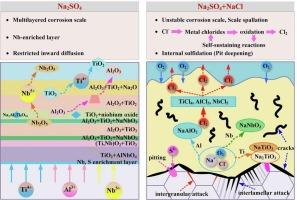
Hot corrosion significantly impacts the service life of TiAl-based components in aero-engine environments. In this work, the hot corrosion behavior of Ti45Al8Nb alloy is systematically and comparatively investigated when exposed to molten Na2SO4 at 900 °C and molten Na2SO4–NaCl (75:25 wt%) at 700–900 °C. Under identical experimental conditions, the mixed-salt environment causes markedly higher material loss, severe scale spallation, and intensified microstructural damage compared with pure Na2SO4, and the corrosion severity exhibits a strong temperature dependence. In pure Na2SO4, a relatively compact multilayer corrosion scale composed of Ti-, Al-, and Nb-rich phases develops, in which Nb promotes stratified oxide formation that suppresses inward diffusion of corrosive species. In contrast, in the NaCl-containing environment, Cl− ions trigger chlorine-induced self-sustaining reactions at the metal–scale interface, reducing scale adherence and accelerating degradation. Meanwhile, Nb participates in the acidic dissolution of Al2O3, while sulfur species contribute to internal sulfidation, primarily through TiS formation, leading to enhanced pit nucleation and deepening. These mechanisms collectively destabilize the corrosion scale, intensify intergranular attack, and result in a significantly higher degradation rate.
期刊介绍:
Applied Surface Science covers topics contributing to a better understanding of surfaces, interfaces, nanostructures and their applications. The journal is concerned with scientific research on the atomic and molecular level of material properties determined with specific surface analytical techniques and/or computational methods, as well as the processing of such structures.