{"title":"在苏云金芽孢杆菌传代过程中,细菌基因型和感染宿主塑造了欺骗和进化毒力的潜力。","authors":"Peter Morwool , Neil Crickmore , Ben Raymond","doi":"10.1016/j.jip.2026.108564","DOIUrl":null,"url":null,"abstract":"<div><div>Understanding the evolution of pathogen host range is a challenging problem but one that is important for emerging infections and for biocontrol. Theory predicts that sequential selection in multiple host species should select for broad host range. Using two genotypes of <em>B. thuringiensis</em> we tested whether selection in alternating host environments would produce bacteria with increased virulence in both hosts, relative to bacteria passaged in single host species (fall armyworm, <em>Spodoptera frugiperda</em> or diamondback moth, <em>Plutella xylostella</em>). Since the Cry toxins of <em>B. thuringiensis</em> are public goods that benefit groups of bacteria, not individual cells, we employed a passage design which provided reproductive benefits to groups of pathogens, based on infectivity. Passage of one bacterial genotype (<em>Bt morrisoni)</em> led to the loss of virulence, while the second genotype (<em>Bt galleriae</em>) evolved virulence that was dependent on selection treatment. In contrast to expectation, selection in <em>P. xylostella</em> produced lineages with increases in virulence in both hosts; selection in <em>S. frugiperda</em> led to very low virulence and the alternating host treatment produced intermediate levels of virulence. Modest increases in virulence were accompanied by a reduction in fitness, consistent with a cost of increased investment in virulence factors. In contrast, infection in <em>S. frugiperda</em> selected for cheaters that had reduced investment in Cry toxins and high competitive fitness within hosts. In conclusion, the selection favouring cheaters depended strongly on both host species and bacterial genotype. Importantly, the host (<em>P. xylostella</em>) that favoured cooperation produced mutants with gains in virulence across multiple hosts.</div></div>","PeriodicalId":16296,"journal":{"name":"Journal of invertebrate pathology","volume":"216 ","pages":"Article 108564"},"PeriodicalIF":2.4000,"publicationDate":"2026-06-01","publicationTypes":"Journal Article","fieldsOfStudy":null,"isOpenAccess":false,"openAccessPdf":"","citationCount":"0","resultStr":"{\"title\":\"Bacterial genotype and infection host shape the potential for cheating and evolution of virulence during passage in Bacillus thuringiensis\",\"authors\":\"Peter Morwool , Neil Crickmore , Ben Raymond\",\"doi\":\"10.1016/j.jip.2026.108564\",\"DOIUrl\":null,\"url\":null,\"abstract\":\"<div><div>Understanding the evolution of pathogen host range is a challenging problem but one that is important for emerging infections and for biocontrol. Theory predicts that sequential selection in multiple host species should select for broad host range. Using two genotypes of <em>B. thuringiensis</em> we tested whether selection in alternating host environments would produce bacteria with increased virulence in both hosts, relative to bacteria passaged in single host species (fall armyworm, <em>Spodoptera frugiperda</em> or diamondback moth, <em>Plutella xylostella</em>). Since the Cry toxins of <em>B. thuringiensis</em> are public goods that benefit groups of bacteria, not individual cells, we employed a passage design which provided reproductive benefits to groups of pathogens, based on infectivity. Passage of one bacterial genotype (<em>Bt morrisoni)</em> led to the loss of virulence, while the second genotype (<em>Bt galleriae</em>) evolved virulence that was dependent on selection treatment. In contrast to expectation, selection in <em>P. xylostella</em> produced lineages with increases in virulence in both hosts; selection in <em>S. frugiperda</em> led to very low virulence and the alternating host treatment produced intermediate levels of virulence. Modest increases in virulence were accompanied by a reduction in fitness, consistent with a cost of increased investment in virulence factors. In contrast, infection in <em>S. frugiperda</em> selected for cheaters that had reduced investment in Cry toxins and high competitive fitness within hosts. In conclusion, the selection favouring cheaters depended strongly on both host species and bacterial genotype. Importantly, the host (<em>P. xylostella</em>) that favoured cooperation produced mutants with gains in virulence across multiple hosts.</div></div>\",\"PeriodicalId\":16296,\"journal\":{\"name\":\"Journal of invertebrate pathology\",\"volume\":\"216 \",\"pages\":\"Article 108564\"},\"PeriodicalIF\":2.4000,\"publicationDate\":\"2026-06-01\",\"publicationTypes\":\"Journal Article\",\"fieldsOfStudy\":null,\"isOpenAccess\":false,\"openAccessPdf\":\"\",\"citationCount\":\"0\",\"resultStr\":null,\"platform\":\"Semanticscholar\",\"paperid\":null,\"PeriodicalName\":\"Journal of invertebrate pathology\",\"FirstCategoryId\":\"99\",\"ListUrlMain\":\"https://www.sciencedirect.com/science/article/pii/S0022201126000352\",\"RegionNum\":3,\"RegionCategory\":\"生物学\",\"ArticlePicture\":[],\"TitleCN\":null,\"AbstractTextCN\":null,\"PMCID\":null,\"EPubDate\":\"2026/2/3 0:00:00\",\"PubModel\":\"Epub\",\"JCR\":\"Q1\",\"JCRName\":\"ZOOLOGY\",\"Score\":null,\"Total\":0}","platform":"Semanticscholar","paperid":null,"PeriodicalName":"Journal of invertebrate pathology","FirstCategoryId":"99","ListUrlMain":"https://www.sciencedirect.com/science/article/pii/S0022201126000352","RegionNum":3,"RegionCategory":"生物学","ArticlePicture":[],"TitleCN":null,"AbstractTextCN":null,"PMCID":null,"EPubDate":"2026/2/3 0:00:00","PubModel":"Epub","JCR":"Q1","JCRName":"ZOOLOGY","Score":null,"Total":0}
Bacterial genotype and infection host shape the potential for cheating and evolution of virulence during passage in Bacillus thuringiensis
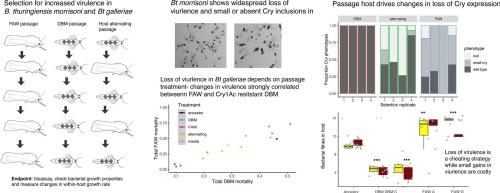
Understanding the evolution of pathogen host range is a challenging problem but one that is important for emerging infections and for biocontrol. Theory predicts that sequential selection in multiple host species should select for broad host range. Using two genotypes of B. thuringiensis we tested whether selection in alternating host environments would produce bacteria with increased virulence in both hosts, relative to bacteria passaged in single host species (fall armyworm, Spodoptera frugiperda or diamondback moth, Plutella xylostella). Since the Cry toxins of B. thuringiensis are public goods that benefit groups of bacteria, not individual cells, we employed a passage design which provided reproductive benefits to groups of pathogens, based on infectivity. Passage of one bacterial genotype (Bt morrisoni) led to the loss of virulence, while the second genotype (Bt galleriae) evolved virulence that was dependent on selection treatment. In contrast to expectation, selection in P. xylostella produced lineages with increases in virulence in both hosts; selection in S. frugiperda led to very low virulence and the alternating host treatment produced intermediate levels of virulence. Modest increases in virulence were accompanied by a reduction in fitness, consistent with a cost of increased investment in virulence factors. In contrast, infection in S. frugiperda selected for cheaters that had reduced investment in Cry toxins and high competitive fitness within hosts. In conclusion, the selection favouring cheaters depended strongly on both host species and bacterial genotype. Importantly, the host (P. xylostella) that favoured cooperation produced mutants with gains in virulence across multiple hosts.
期刊介绍:
The Journal of Invertebrate Pathology presents original research articles and notes on the induction and pathogenesis of diseases of invertebrates, including the suppression of diseases in beneficial species, and the use of diseases in controlling undesirable species. In addition, the journal publishes the results of physiological, morphological, genetic, immunological and ecological studies as related to the etiologic agents of diseases of invertebrates.
The Journal of Invertebrate Pathology is the adopted journal of the Society for Invertebrate Pathology, and is available to SIP members at a special reduced price.