Zhen Hu , Jingchun Huang , Yuhao Zhong , Xiaolong An , Pengfei Qin , Maolong Zhang , Qianshi Song , Yu Qiao
{"title":"食物垃圾与煤气化渣共阴燃:对反应特性和燃料气体特性的协同效应。","authors":"Zhen Hu , Jingchun Huang , Yuhao Zhong , Xiaolong An , Pengfei Qin , Maolong Zhang , Qianshi Song , Yu Qiao","doi":"10.1016/j.jenvman.2026.128790","DOIUrl":null,"url":null,"abstract":"<div><div>Co-smouldering is a promising way to improve the value of products and smouldering performance, while the detailed synergistic effects between various feedstocks are still unknown. This study provides novel insights into the synergistic effects on reaction characteristics and gas production during the co-smouldering of food waste and gasification slag, which have contrasting volatile and fixed carbon contents. The results demonstrated that blending 30 % gasification slag with food waste increased the maximum allowable moisture content to 75 %. For feedstocks with comparable low heating value (6.67–6.85 MJ/kg), high fixed carbon to volatile matter ratio significantly elevated the average peak temperature from 691.0 °C to 992.6 °C and increased the CO yield from 1.00 % to 6.87 %. Volatile-derived radicals from food waste promoted the formation of disordered carbon structures and C–O functional groups on the surface of gasification slag, leading to the enhancement formation of CO and the reduction of heavy condensable components (e.g., heterocyclic compounds). Additionally, catalytically active calcium species from food waste formed oxygen-containing complexes (e.g., C–O–M) with the gasification slag char matrix, which facilitated the gasification reactions (e.g., the Boudouard reaction) and increased smouldering velocity by 24.46 %–64.23 % compared to gasification slag alone. These findings provide valuable insights for developing efficient waste-to-energy strategies, highlighting the potential of co-smouldering for fuel gas production.</div></div>","PeriodicalId":356,"journal":{"name":"Journal of Environmental Management","volume":"400 ","pages":"Article 128790"},"PeriodicalIF":8.4000,"publicationDate":"2026-02-15","publicationTypes":"Journal Article","fieldsOfStudy":null,"isOpenAccess":false,"openAccessPdf":"","citationCount":"0","resultStr":"{\"title\":\"Co-smouldering combustion of food waste and coal gasification slag: Synergistic effects on reaction characteristics and fuel gas properties\",\"authors\":\"Zhen Hu , Jingchun Huang , Yuhao Zhong , Xiaolong An , Pengfei Qin , Maolong Zhang , Qianshi Song , Yu Qiao\",\"doi\":\"10.1016/j.jenvman.2026.128790\",\"DOIUrl\":null,\"url\":null,\"abstract\":\"<div><div>Co-smouldering is a promising way to improve the value of products and smouldering performance, while the detailed synergistic effects between various feedstocks are still unknown. This study provides novel insights into the synergistic effects on reaction characteristics and gas production during the co-smouldering of food waste and gasification slag, which have contrasting volatile and fixed carbon contents. The results demonstrated that blending 30 % gasification slag with food waste increased the maximum allowable moisture content to 75 %. For feedstocks with comparable low heating value (6.67–6.85 MJ/kg), high fixed carbon to volatile matter ratio significantly elevated the average peak temperature from 691.0 °C to 992.6 °C and increased the CO yield from 1.00 % to 6.87 %. Volatile-derived radicals from food waste promoted the formation of disordered carbon structures and C–O functional groups on the surface of gasification slag, leading to the enhancement formation of CO and the reduction of heavy condensable components (e.g., heterocyclic compounds). Additionally, catalytically active calcium species from food waste formed oxygen-containing complexes (e.g., C–O–M) with the gasification slag char matrix, which facilitated the gasification reactions (e.g., the Boudouard reaction) and increased smouldering velocity by 24.46 %–64.23 % compared to gasification slag alone. These findings provide valuable insights for developing efficient waste-to-energy strategies, highlighting the potential of co-smouldering for fuel gas production.</div></div>\",\"PeriodicalId\":356,\"journal\":{\"name\":\"Journal of Environmental Management\",\"volume\":\"400 \",\"pages\":\"Article 128790\"},\"PeriodicalIF\":8.4000,\"publicationDate\":\"2026-02-15\",\"publicationTypes\":\"Journal Article\",\"fieldsOfStudy\":null,\"isOpenAccess\":false,\"openAccessPdf\":\"\",\"citationCount\":\"0\",\"resultStr\":null,\"platform\":\"Semanticscholar\",\"paperid\":null,\"PeriodicalName\":\"Journal of Environmental Management\",\"FirstCategoryId\":\"93\",\"ListUrlMain\":\"https://www.sciencedirect.com/science/article/pii/S0301479726002501\",\"RegionNum\":2,\"RegionCategory\":\"环境科学与生态学\",\"ArticlePicture\":[],\"TitleCN\":null,\"AbstractTextCN\":null,\"PMCID\":null,\"EPubDate\":\"2026/1/31 0:00:00\",\"PubModel\":\"Epub\",\"JCR\":\"Q1\",\"JCRName\":\"ENVIRONMENTAL SCIENCES\",\"Score\":null,\"Total\":0}","platform":"Semanticscholar","paperid":null,"PeriodicalName":"Journal of Environmental Management","FirstCategoryId":"93","ListUrlMain":"https://www.sciencedirect.com/science/article/pii/S0301479726002501","RegionNum":2,"RegionCategory":"环境科学与生态学","ArticlePicture":[],"TitleCN":null,"AbstractTextCN":null,"PMCID":null,"EPubDate":"2026/1/31 0:00:00","PubModel":"Epub","JCR":"Q1","JCRName":"ENVIRONMENTAL SCIENCES","Score":null,"Total":0}
Co-smouldering combustion of food waste and coal gasification slag: Synergistic effects on reaction characteristics and fuel gas properties
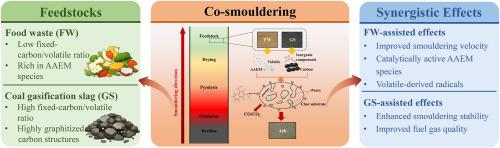
Co-smouldering is a promising way to improve the value of products and smouldering performance, while the detailed synergistic effects between various feedstocks are still unknown. This study provides novel insights into the synergistic effects on reaction characteristics and gas production during the co-smouldering of food waste and gasification slag, which have contrasting volatile and fixed carbon contents. The results demonstrated that blending 30 % gasification slag with food waste increased the maximum allowable moisture content to 75 %. For feedstocks with comparable low heating value (6.67–6.85 MJ/kg), high fixed carbon to volatile matter ratio significantly elevated the average peak temperature from 691.0 °C to 992.6 °C and increased the CO yield from 1.00 % to 6.87 %. Volatile-derived radicals from food waste promoted the formation of disordered carbon structures and C–O functional groups on the surface of gasification slag, leading to the enhancement formation of CO and the reduction of heavy condensable components (e.g., heterocyclic compounds). Additionally, catalytically active calcium species from food waste formed oxygen-containing complexes (e.g., C–O–M) with the gasification slag char matrix, which facilitated the gasification reactions (e.g., the Boudouard reaction) and increased smouldering velocity by 24.46 %–64.23 % compared to gasification slag alone. These findings provide valuable insights for developing efficient waste-to-energy strategies, highlighting the potential of co-smouldering for fuel gas production.
期刊介绍:
The Journal of Environmental Management is a journal for the publication of peer reviewed, original research for all aspects of management and the managed use of the environment, both natural and man-made.Critical review articles are also welcome; submission of these is strongly encouraged.