German David Matos-Paucar , Merita Tafili , Jan Machaček , Torsten Wichtmann
{"title":"广义土壤保水性模型的评价及其在非饱和土壤水力学模拟中的作用","authors":"German David Matos-Paucar , Merita Tafili , Jan Machaček , Torsten Wichtmann","doi":"10.1016/j.gete.2026.100794","DOIUrl":null,"url":null,"abstract":"<div><div>The soil–water retention curve (SWRC) is fundamental in geotechnical engineering, influencing the hydraulic and mechanical response of unsaturated soils. This study evaluates three generalised SWRC models that account for density effects and/or hydraulic hysteresis: the Gallipoli, Sun, and Gao formulations. Their simulation performance is assessed against experimental data from a wide range of soils, including compacted till, Pearl clays, Barcelona silt, and silty sands. The analyses highlight the strengths and limitations of each model in reproducing main wetting and drying branches, scanning curves, and density-dependent shifts of the SWRC. Among the tested formulations, the Gao model demonstrates the most robust capability to represent hysteresis and density effects across broad suction ranges. Finally, selected hydraulic models were coupled with the hypoplastic constitutive model proposed by Tafili and Machaček (2023) to evaluate hydro–mechanical interactions of unsaturated soils under various stress and hydraulic conditions, highlighting that the choice of SWRC formulation strongly influences predictions of volumetric response, stiffness evolution, and suction-dependent strength. This underlines the importance of selecting an appropriate SWRC model for reliable hydro–mechanical modelling of unsaturated soils.</div></div>","PeriodicalId":56008,"journal":{"name":"Geomechanics for Energy and the Environment","volume":"45 ","pages":"Article 100794"},"PeriodicalIF":3.7000,"publicationDate":"2026-03-01","publicationTypes":"Journal Article","fieldsOfStudy":null,"isOpenAccess":false,"openAccessPdf":"","citationCount":"0","resultStr":"{\"title\":\"Evaluation of generalised soil water retention models and their role in hydro–mechanical modelling of unsaturated soils\",\"authors\":\"German David Matos-Paucar , Merita Tafili , Jan Machaček , Torsten Wichtmann\",\"doi\":\"10.1016/j.gete.2026.100794\",\"DOIUrl\":null,\"url\":null,\"abstract\":\"<div><div>The soil–water retention curve (SWRC) is fundamental in geotechnical engineering, influencing the hydraulic and mechanical response of unsaturated soils. This study evaluates three generalised SWRC models that account for density effects and/or hydraulic hysteresis: the Gallipoli, Sun, and Gao formulations. Their simulation performance is assessed against experimental data from a wide range of soils, including compacted till, Pearl clays, Barcelona silt, and silty sands. The analyses highlight the strengths and limitations of each model in reproducing main wetting and drying branches, scanning curves, and density-dependent shifts of the SWRC. Among the tested formulations, the Gao model demonstrates the most robust capability to represent hysteresis and density effects across broad suction ranges. Finally, selected hydraulic models were coupled with the hypoplastic constitutive model proposed by Tafili and Machaček (2023) to evaluate hydro–mechanical interactions of unsaturated soils under various stress and hydraulic conditions, highlighting that the choice of SWRC formulation strongly influences predictions of volumetric response, stiffness evolution, and suction-dependent strength. This underlines the importance of selecting an appropriate SWRC model for reliable hydro–mechanical modelling of unsaturated soils.</div></div>\",\"PeriodicalId\":56008,\"journal\":{\"name\":\"Geomechanics for Energy and the Environment\",\"volume\":\"45 \",\"pages\":\"Article 100794\"},\"PeriodicalIF\":3.7000,\"publicationDate\":\"2026-03-01\",\"publicationTypes\":\"Journal Article\",\"fieldsOfStudy\":null,\"isOpenAccess\":false,\"openAccessPdf\":\"\",\"citationCount\":\"0\",\"resultStr\":null,\"platform\":\"Semanticscholar\",\"paperid\":null,\"PeriodicalName\":\"Geomechanics for Energy and the Environment\",\"FirstCategoryId\":\"5\",\"ListUrlMain\":\"https://www.sciencedirect.com/science/article/pii/S2352380826000092\",\"RegionNum\":2,\"RegionCategory\":\"工程技术\",\"ArticlePicture\":[],\"TitleCN\":null,\"AbstractTextCN\":null,\"PMCID\":null,\"EPubDate\":\"2026/1/27 0:00:00\",\"PubModel\":\"Epub\",\"JCR\":\"Q3\",\"JCRName\":\"ENERGY & FUELS\",\"Score\":null,\"Total\":0}","platform":"Semanticscholar","paperid":null,"PeriodicalName":"Geomechanics for Energy and the Environment","FirstCategoryId":"5","ListUrlMain":"https://www.sciencedirect.com/science/article/pii/S2352380826000092","RegionNum":2,"RegionCategory":"工程技术","ArticlePicture":[],"TitleCN":null,"AbstractTextCN":null,"PMCID":null,"EPubDate":"2026/1/27 0:00:00","PubModel":"Epub","JCR":"Q3","JCRName":"ENERGY & FUELS","Score":null,"Total":0}
Evaluation of generalised soil water retention models and their role in hydro–mechanical modelling of unsaturated soils
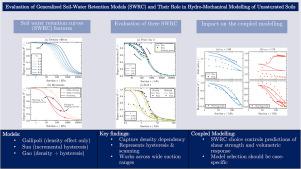
The soil–water retention curve (SWRC) is fundamental in geotechnical engineering, influencing the hydraulic and mechanical response of unsaturated soils. This study evaluates three generalised SWRC models that account for density effects and/or hydraulic hysteresis: the Gallipoli, Sun, and Gao formulations. Their simulation performance is assessed against experimental data from a wide range of soils, including compacted till, Pearl clays, Barcelona silt, and silty sands. The analyses highlight the strengths and limitations of each model in reproducing main wetting and drying branches, scanning curves, and density-dependent shifts of the SWRC. Among the tested formulations, the Gao model demonstrates the most robust capability to represent hysteresis and density effects across broad suction ranges. Finally, selected hydraulic models were coupled with the hypoplastic constitutive model proposed by Tafili and Machaček (2023) to evaluate hydro–mechanical interactions of unsaturated soils under various stress and hydraulic conditions, highlighting that the choice of SWRC formulation strongly influences predictions of volumetric response, stiffness evolution, and suction-dependent strength. This underlines the importance of selecting an appropriate SWRC model for reliable hydro–mechanical modelling of unsaturated soils.
期刊介绍:
The aim of the Journal is to publish research results of the highest quality and of lasting importance on the subject of geomechanics, with the focus on applications to geological energy production and storage, and the interaction of soils and rocks with the natural and engineered environment. Special attention is given to concepts and developments of new energy geotechnologies that comprise intrinsic mechanisms protecting the environment against a potential engineering induced damage, hence warranting sustainable usage of energy resources.
The scope of the journal is broad, including fundamental concepts in geomechanics and mechanics of porous media, the experiments and analysis of novel phenomena and applications. Of special interest are issues resulting from coupling of particular physics, chemistry and biology of external forcings, as well as of pore fluid/gas and minerals to the solid mechanics of the medium skeleton and pore fluid mechanics. The multi-scale and inter-scale interactions between the phenomena and the behavior representations are also of particular interest. Contributions to general theoretical approach to these issues, but of potential reference to geomechanics in its context of energy and the environment are also most welcome.