Xiaohui Ma , Yanhua Wang , Tong Xu , Xiaoyue Wang , Yubin Fu , Lian Zhong
{"title":"Cu2+掺杂NiCo2O4复合改性碳毡阴极用于海洋沉积物微生物燃料电池及其提高溶解氧还原反应动力学以获得更高的功率输出","authors":"Xiaohui Ma , Yanhua Wang , Tong Xu , Xiaoyue Wang , Yubin Fu , Lian Zhong","doi":"10.1016/j.horiz.2025.100173","DOIUrl":null,"url":null,"abstract":"<div><div>The development of efficient and stable non-precious metal cathodes is critical to the practical application of marine sediment microbial fuel cells (MSMFCs). Herein, a series of Cu<sup>2+</sup>-doped NiCo<sub>2</sub>O<sub>4</sub> spinel cathodes were synthesized in-situ on carbon felt (CF) via a hydrothermal growth to enhance the dissolved oxygen reduction reaction (DORR) in seawater. The optimal electrode (CNCO-0.2/CF) exhibited a significantly improved specific capacitance of 180.6 F·m<sup><sup>−</sup>2</sup> and a low charge-transfer resistance of 5.6 Ω. When applied in an MSMFC, the CNCO-0.2/CF cathode delivered a high power density of 1043.8 mW·m<sup>−2</sup>, which was 5.1 times that of the undoped benchmark (NCO/CF), while maintaining stable operation for 45 days. Electrochemical characterizations verified its excellent DORR activity, as demonstrated by a favorable electron transfer number (<em>n</em> ≈ 3.7). The enhanced performance is attributed to the synergistic effects of Cu²⁺ doping, which introduced oxygen vacancies, improved electrical conductivity, and formed a unique nanoneedle array structure. This work offers a promising strategy for designing high-performance, cost-effective cathodes for long-term marine energy conversion.</div></div>","PeriodicalId":101199,"journal":{"name":"Sustainable Horizons","volume":"17 ","pages":"Article 100173"},"PeriodicalIF":0.0000,"publicationDate":"2026-03-01","publicationTypes":"Journal Article","fieldsOfStudy":null,"isOpenAccess":false,"openAccessPdf":"","citationCount":"0","resultStr":"{\"title\":\"Cu2+-doped NiCo2O4 composite modified carbon felt cathode in marine sediment microbial fuel cells and its enhanced dissolved oxygen reduction reaction kinetics for higher power output\",\"authors\":\"Xiaohui Ma , Yanhua Wang , Tong Xu , Xiaoyue Wang , Yubin Fu , Lian Zhong\",\"doi\":\"10.1016/j.horiz.2025.100173\",\"DOIUrl\":null,\"url\":null,\"abstract\":\"<div><div>The development of efficient and stable non-precious metal cathodes is critical to the practical application of marine sediment microbial fuel cells (MSMFCs). Herein, a series of Cu<sup>2+</sup>-doped NiCo<sub>2</sub>O<sub>4</sub> spinel cathodes were synthesized in-situ on carbon felt (CF) via a hydrothermal growth to enhance the dissolved oxygen reduction reaction (DORR) in seawater. The optimal electrode (CNCO-0.2/CF) exhibited a significantly improved specific capacitance of 180.6 F·m<sup><sup>−</sup>2</sup> and a low charge-transfer resistance of 5.6 Ω. When applied in an MSMFC, the CNCO-0.2/CF cathode delivered a high power density of 1043.8 mW·m<sup>−2</sup>, which was 5.1 times that of the undoped benchmark (NCO/CF), while maintaining stable operation for 45 days. Electrochemical characterizations verified its excellent DORR activity, as demonstrated by a favorable electron transfer number (<em>n</em> ≈ 3.7). The enhanced performance is attributed to the synergistic effects of Cu²⁺ doping, which introduced oxygen vacancies, improved electrical conductivity, and formed a unique nanoneedle array structure. This work offers a promising strategy for designing high-performance, cost-effective cathodes for long-term marine energy conversion.</div></div>\",\"PeriodicalId\":101199,\"journal\":{\"name\":\"Sustainable Horizons\",\"volume\":\"17 \",\"pages\":\"Article 100173\"},\"PeriodicalIF\":0.0000,\"publicationDate\":\"2026-03-01\",\"publicationTypes\":\"Journal Article\",\"fieldsOfStudy\":null,\"isOpenAccess\":false,\"openAccessPdf\":\"\",\"citationCount\":\"0\",\"resultStr\":null,\"platform\":\"Semanticscholar\",\"paperid\":null,\"PeriodicalName\":\"Sustainable Horizons\",\"FirstCategoryId\":\"1085\",\"ListUrlMain\":\"https://www.sciencedirect.com/science/article/pii/S2772737825000434\",\"RegionNum\":0,\"RegionCategory\":null,\"ArticlePicture\":[],\"TitleCN\":null,\"AbstractTextCN\":null,\"PMCID\":null,\"EPubDate\":\"2026/1/28 0:00:00\",\"PubModel\":\"Epub\",\"JCR\":\"\",\"JCRName\":\"\",\"Score\":null,\"Total\":0}","platform":"Semanticscholar","paperid":null,"PeriodicalName":"Sustainable Horizons","FirstCategoryId":"1085","ListUrlMain":"https://www.sciencedirect.com/science/article/pii/S2772737825000434","RegionNum":0,"RegionCategory":null,"ArticlePicture":[],"TitleCN":null,"AbstractTextCN":null,"PMCID":null,"EPubDate":"2026/1/28 0:00:00","PubModel":"Epub","JCR":"","JCRName":"","Score":null,"Total":0}
Cu2+-doped NiCo2O4 composite modified carbon felt cathode in marine sediment microbial fuel cells and its enhanced dissolved oxygen reduction reaction kinetics for higher power output
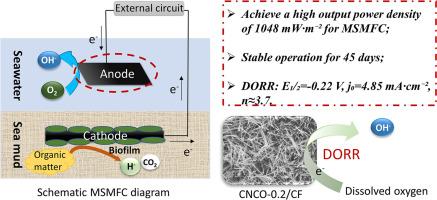
The development of efficient and stable non-precious metal cathodes is critical to the practical application of marine sediment microbial fuel cells (MSMFCs). Herein, a series of Cu2+-doped NiCo2O4 spinel cathodes were synthesized in-situ on carbon felt (CF) via a hydrothermal growth to enhance the dissolved oxygen reduction reaction (DORR) in seawater. The optimal electrode (CNCO-0.2/CF) exhibited a significantly improved specific capacitance of 180.6 F·m−2 and a low charge-transfer resistance of 5.6 Ω. When applied in an MSMFC, the CNCO-0.2/CF cathode delivered a high power density of 1043.8 mW·m−2, which was 5.1 times that of the undoped benchmark (NCO/CF), while maintaining stable operation for 45 days. Electrochemical characterizations verified its excellent DORR activity, as demonstrated by a favorable electron transfer number (n ≈ 3.7). The enhanced performance is attributed to the synergistic effects of Cu²⁺ doping, which introduced oxygen vacancies, improved electrical conductivity, and formed a unique nanoneedle array structure. This work offers a promising strategy for designing high-performance, cost-effective cathodes for long-term marine energy conversion.


 求助内容:
求助内容: 应助结果提醒方式:

 京公网安备 11010802042870号


