Jibin James , Silpa Chandran , Abdulaziz Anas , K. Devika Raj , Nizam Ashraf
{"title":"在3d打印的染料去除支架上,印度希瓦氏菌生物膜产生脓黑素的基因组和功能表征","authors":"Jibin James , Silpa Chandran , Abdulaziz Anas , K. Devika Raj , Nizam Ashraf","doi":"10.1016/j.biteb.2026.102595","DOIUrl":null,"url":null,"abstract":"<div><div>Inspired by the interactions between sponges and bacteria within marine ecosystems, this study presents a scalable platform for the production of pyomelanin utilizing <em>Shewanella indica</em> immobilized on three-dimensional (3D) printed gyroid spheres with a surface area of 1835 mm<sup>2</sup>. The application of five gyroid spheres immobilized with <em>S. indica</em> in 100 ml of growth medium resulted in a yield of 0.937 mg ml<sup>−1</sup> of pyomelanin, which could be enhanced to 3.76 mg ml<sup>−1</sup> when utilizing 20 spheres. The extraction of pyomelanin was accomplished through an alkali-acid treatment, and the gyroid spheres demonstrated reusability over five cycles. Furthermore, the pyomelanin exhibited an adsorption capacity of up to 70% for various textile dyes, including crystal violet and trypan blue, within a three-hour period. Genomic analysis identified genes associated with biofilm formation (lap A, B; lol A, B, D, E; DGC and bdl A) and pyomelanin biosynthesis (hppD, aspC, tyrA, and phhA). These results underscore a sustainable approach for pyomelanin production and its potential applications in bioremediation.</div></div>","PeriodicalId":8947,"journal":{"name":"Bioresource Technology Reports","volume":"33 ","pages":"Article 102595"},"PeriodicalIF":0.0000,"publicationDate":"2026-02-01","publicationTypes":"Journal Article","fieldsOfStudy":null,"isOpenAccess":false,"openAccessPdf":"","citationCount":"0","resultStr":"{\"title\":\"Genomic and functional characterization of pyomelanin production by Shewanella indica biofilms on 3D-printed scaffolds for dye removal\",\"authors\":\"Jibin James , Silpa Chandran , Abdulaziz Anas , K. Devika Raj , Nizam Ashraf\",\"doi\":\"10.1016/j.biteb.2026.102595\",\"DOIUrl\":null,\"url\":null,\"abstract\":\"<div><div>Inspired by the interactions between sponges and bacteria within marine ecosystems, this study presents a scalable platform for the production of pyomelanin utilizing <em>Shewanella indica</em> immobilized on three-dimensional (3D) printed gyroid spheres with a surface area of 1835 mm<sup>2</sup>. The application of five gyroid spheres immobilized with <em>S. indica</em> in 100 ml of growth medium resulted in a yield of 0.937 mg ml<sup>−1</sup> of pyomelanin, which could be enhanced to 3.76 mg ml<sup>−1</sup> when utilizing 20 spheres. The extraction of pyomelanin was accomplished through an alkali-acid treatment, and the gyroid spheres demonstrated reusability over five cycles. Furthermore, the pyomelanin exhibited an adsorption capacity of up to 70% for various textile dyes, including crystal violet and trypan blue, within a three-hour period. Genomic analysis identified genes associated with biofilm formation (lap A, B; lol A, B, D, E; DGC and bdl A) and pyomelanin biosynthesis (hppD, aspC, tyrA, and phhA). These results underscore a sustainable approach for pyomelanin production and its potential applications in bioremediation.</div></div>\",\"PeriodicalId\":8947,\"journal\":{\"name\":\"Bioresource Technology Reports\",\"volume\":\"33 \",\"pages\":\"Article 102595\"},\"PeriodicalIF\":0.0000,\"publicationDate\":\"2026-02-01\",\"publicationTypes\":\"Journal Article\",\"fieldsOfStudy\":null,\"isOpenAccess\":false,\"openAccessPdf\":\"\",\"citationCount\":\"0\",\"resultStr\":null,\"platform\":\"Semanticscholar\",\"paperid\":null,\"PeriodicalName\":\"Bioresource Technology Reports\",\"FirstCategoryId\":\"1085\",\"ListUrlMain\":\"https://www.sciencedirect.com/science/article/pii/S2589014X26000538\",\"RegionNum\":0,\"RegionCategory\":null,\"ArticlePicture\":[],\"TitleCN\":null,\"AbstractTextCN\":null,\"PMCID\":null,\"EPubDate\":\"2026/1/26 0:00:00\",\"PubModel\":\"Epub\",\"JCR\":\"Q1\",\"JCRName\":\"Environmental Science\",\"Score\":null,\"Total\":0}","platform":"Semanticscholar","paperid":null,"PeriodicalName":"Bioresource Technology Reports","FirstCategoryId":"1085","ListUrlMain":"https://www.sciencedirect.com/science/article/pii/S2589014X26000538","RegionNum":0,"RegionCategory":null,"ArticlePicture":[],"TitleCN":null,"AbstractTextCN":null,"PMCID":null,"EPubDate":"2026/1/26 0:00:00","PubModel":"Epub","JCR":"Q1","JCRName":"Environmental Science","Score":null,"Total":0}
Genomic and functional characterization of pyomelanin production by Shewanella indica biofilms on 3D-printed scaffolds for dye removal
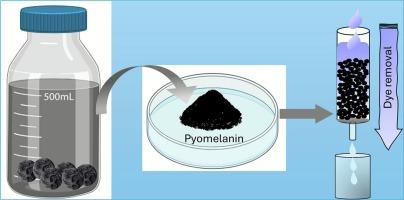
Inspired by the interactions between sponges and bacteria within marine ecosystems, this study presents a scalable platform for the production of pyomelanin utilizing Shewanella indica immobilized on three-dimensional (3D) printed gyroid spheres with a surface area of 1835 mm2. The application of five gyroid spheres immobilized with S. indica in 100 ml of growth medium resulted in a yield of 0.937 mg ml−1 of pyomelanin, which could be enhanced to 3.76 mg ml−1 when utilizing 20 spheres. The extraction of pyomelanin was accomplished through an alkali-acid treatment, and the gyroid spheres demonstrated reusability over five cycles. Furthermore, the pyomelanin exhibited an adsorption capacity of up to 70% for various textile dyes, including crystal violet and trypan blue, within a three-hour period. Genomic analysis identified genes associated with biofilm formation (lap A, B; lol A, B, D, E; DGC and bdl A) and pyomelanin biosynthesis (hppD, aspC, tyrA, and phhA). These results underscore a sustainable approach for pyomelanin production and its potential applications in bioremediation.