孟加拉国棉农对农药的认识、实践和采用Bt棉花的潜力

IF 2.5 2区 农林科学 Q1 AGRONOMY
Crop Protection Pub Date : 2026-05-01 Epub Date: 2026-01-27 DOI:10.1016/j.cropro.2026.107548
Md. Hayder Khan Sujan , Sharif Ahammad , Mohammad Mizanul Haque Kazal , Monira Sultana , Md. Akhteruzzaman
{"title":"孟加拉国棉农对农药的认识、实践和采用Bt棉花的潜力","authors":"Md. Hayder Khan Sujan ,&nbsp;Sharif Ahammad ,&nbsp;Mohammad Mizanul Haque Kazal ,&nbsp;Monira Sultana ,&nbsp;Md. Akhteruzzaman","doi":"10.1016/j.cropro.2026.107548","DOIUrl":null,"url":null,"abstract":"<div><div>Cotton production in Bangladesh faces significant pest management challenges, with farmers relying heavily on chemical pesticides. This study investigated 247 cotton farmers' perceptions and practices regarding pesticide use and their willingness to pay for insect-resistant Bt cotton. Perceptions were assessed using a five-point Likert scale (Cronbach's α = 0.76), complemented by data on pesticide practices and Bt cotton adoption potential, collected in 2022. Results revealed substantial perception-practice gaps: while 96% recognized health risks from excessive pesticide use, only 77% used personal protective equipment. Critical knowledge deficits were evident, with only 68.4% understanding stage-specific application requirements and 53.4% aware that insect-resistant varieties reduce pesticide costs. Most farmers (55%) relied on peer consultation rather than extension services for pesticide application decisions. Concerning disposal practices prevailed, with 39.7% burying containers and 30% leaving them in fields. Despite chemical reliance, farmers demonstrated high adoption of nature-based practices, particularly pheromone traps (89.5%) and removal of affected parts (84.6%). Regarding Bt cotton, 86% expressed willingness to adopt at current prices, declining to 52.5% at 50% premium, revealing severe price sensitivity. Findings highlight critical gaps between risk awareness and safety practices. Realizing Bt cotton adoption potential requires intensive extension programming addressing knowledge deficits, improved waste management infrastructure, and financial support for resource-constrained smallholder farmers.</div></div>","PeriodicalId":10785,"journal":{"name":"Crop Protection","volume":"203 ","pages":"Article 107548"},"PeriodicalIF":2.5000,"publicationDate":"2026-05-01","publicationTypes":"Journal Article","fieldsOfStudy":null,"isOpenAccess":false,"openAccessPdf":"","citationCount":"0","resultStr":"{\"title\":\"Pesticide perceptions, practices, and Bt cotton adoption potential among Bangladeshi cotton farmers\",\"authors\":\"Md. Hayder Khan Sujan ,&nbsp;Sharif Ahammad ,&nbsp;Mohammad Mizanul Haque Kazal ,&nbsp;Monira Sultana ,&nbsp;Md. Akhteruzzaman\",\"doi\":\"10.1016/j.cropro.2026.107548\",\"DOIUrl\":null,\"url\":null,\"abstract\":\"<div><div>Cotton production in Bangladesh faces significant pest management challenges, with farmers relying heavily on chemical pesticides. This study investigated 247 cotton farmers' perceptions and practices regarding pesticide use and their willingness to pay for insect-resistant Bt cotton. Perceptions were assessed using a five-point Likert scale (Cronbach's α = 0.76), complemented by data on pesticide practices and Bt cotton adoption potential, collected in 2022. Results revealed substantial perception-practice gaps: while 96% recognized health risks from excessive pesticide use, only 77% used personal protective equipment. Critical knowledge deficits were evident, with only 68.4% understanding stage-specific application requirements and 53.4% aware that insect-resistant varieties reduce pesticide costs. Most farmers (55%) relied on peer consultation rather than extension services for pesticide application decisions. Concerning disposal practices prevailed, with 39.7% burying containers and 30% leaving them in fields. Despite chemical reliance, farmers demonstrated high adoption of nature-based practices, particularly pheromone traps (89.5%) and removal of affected parts (84.6%). Regarding Bt cotton, 86% expressed willingness to adopt at current prices, declining to 52.5% at 50% premium, revealing severe price sensitivity. Findings highlight critical gaps between risk awareness and safety practices. Realizing Bt cotton adoption potential requires intensive extension programming addressing knowledge deficits, improved waste management infrastructure, and financial support for resource-constrained smallholder farmers.</div></div>\",\"PeriodicalId\":10785,\"journal\":{\"name\":\"Crop Protection\",\"volume\":\"203 \",\"pages\":\"Article 107548\"},\"PeriodicalIF\":2.5000,\"publicationDate\":\"2026-05-01\",\"publicationTypes\":\"Journal Article\",\"fieldsOfStudy\":null,\"isOpenAccess\":false,\"openAccessPdf\":\"\",\"citationCount\":\"0\",\"resultStr\":null,\"platform\":\"Semanticscholar\",\"paperid\":null,\"PeriodicalName\":\"Crop Protection\",\"FirstCategoryId\":\"97\",\"ListUrlMain\":\"https://www.sciencedirect.com/science/article/pii/S0261219426000141\",\"RegionNum\":2,\"RegionCategory\":\"农林科学\",\"ArticlePicture\":[],\"TitleCN\":null,\"AbstractTextCN\":null,\"PMCID\":null,\"EPubDate\":\"2026/1/27 0:00:00\",\"PubModel\":\"Epub\",\"JCR\":\"Q1\",\"JCRName\":\"AGRONOMY\",\"Score\":null,\"Total\":0}","platform":"Semanticscholar","paperid":null,"PeriodicalName":"Crop Protection","FirstCategoryId":"97","ListUrlMain":"https://www.sciencedirect.com/science/article/pii/S0261219426000141","RegionNum":2,"RegionCategory":"农林科学","ArticlePicture":[],"TitleCN":null,"AbstractTextCN":null,"PMCID":null,"EPubDate":"2026/1/27 0:00:00","PubModel":"Epub","JCR":"Q1","JCRName":"AGRONOMY","Score":null,"Total":0}
引用次数: 0

摘要

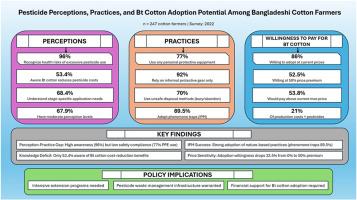
孟加拉国的棉花生产面临着病虫害管理方面的重大挑战,农民严重依赖化学农药。本研究调查了247名棉农对农药使用的认知和做法,以及他们购买抗虫Bt棉花的意愿。使用五点李克特量表(Cronbach's α = 0.76)对认知进行评估,并辅以2022年收集的农药使用和Bt棉花应用潜力数据。结果显示认知与实践之间存在巨大差距:96%的人认识到过度使用农药会带来健康风险,但只有77%的人使用了个人防护装备。关键知识缺失很明显,只有68.4%的人了解特定阶段的施用要求,53.4%的人知道抗虫品种可以降低农药成本。大多数农民(55%)依靠同行咨询而不是推广服务来决定农药的施用。在处理方式方面,39.7%的人将容器掩埋,30%的人将其留在田间。尽管依赖化学药品,但农民仍高度采用基于自然的做法,特别是信息素陷阱(89.5%)和去除受影响部位(84.6%)。对于Bt棉,86%的人表示愿意采用当前价格,而在溢价50%的情况下,这一比例降至52.5%,显示出严重的价格敏感性。调查结果强调了风险意识和安全实践之间的重大差距。实现Bt棉花的应用潜力需要强化推广规划,解决知识短缺问题,改善废物管理基础设施,并为资源受限的小农提供资金支持。
本文章由计算机程序翻译,如有差异,请以英文原文为准。

Pesticide perceptions, practices, and Bt cotton adoption potential among Bangladeshi cotton farmers

Pesticide perceptions, practices, and Bt cotton adoption potential among Bangladeshi cotton farmers
Cotton production in Bangladesh faces significant pest management challenges, with farmers relying heavily on chemical pesticides. This study investigated 247 cotton farmers' perceptions and practices regarding pesticide use and their willingness to pay for insect-resistant Bt cotton. Perceptions were assessed using a five-point Likert scale (Cronbach's α = 0.76), complemented by data on pesticide practices and Bt cotton adoption potential, collected in 2022. Results revealed substantial perception-practice gaps: while 96% recognized health risks from excessive pesticide use, only 77% used personal protective equipment. Critical knowledge deficits were evident, with only 68.4% understanding stage-specific application requirements and 53.4% aware that insect-resistant varieties reduce pesticide costs. Most farmers (55%) relied on peer consultation rather than extension services for pesticide application decisions. Concerning disposal practices prevailed, with 39.7% burying containers and 30% leaving them in fields. Despite chemical reliance, farmers demonstrated high adoption of nature-based practices, particularly pheromone traps (89.5%) and removal of affected parts (84.6%). Regarding Bt cotton, 86% expressed willingness to adopt at current prices, declining to 52.5% at 50% premium, revealing severe price sensitivity. Findings highlight critical gaps between risk awareness and safety practices. Realizing Bt cotton adoption potential requires intensive extension programming addressing knowledge deficits, improved waste management infrastructure, and financial support for resource-constrained smallholder farmers.
求助全文
通过发布文献求助,成功后即可免费获取论文全文。 去求助
来源期刊
Crop Protection
Crop Protection 农林科学-农艺学
CiteScore
6.10
自引率
3.60%
发文量
200
审稿时长
29 days
期刊介绍: The Editors of Crop Protection especially welcome papers describing an interdisciplinary approach showing how different control strategies can be integrated into practical pest management programs, covering high and low input agricultural systems worldwide. Crop Protection particularly emphasizes the practical aspects of control in the field and for protected crops, and includes work which may lead in the near future to more effective control. The journal does not duplicate the many existing excellent biological science journals, which deal mainly with the more fundamental aspects of plant pathology, applied zoology and weed science. Crop Protection covers all practical aspects of pest, disease and weed control, including the following topics: -Abiotic damage- Agronomic control methods- Assessment of pest and disease damage- Molecular methods for the detection and assessment of pests and diseases- Biological control- Biorational pesticides- Control of animal pests of world crops- Control of diseases of crop plants caused by microorganisms- Control of weeds and integrated management- Economic considerations- Effects of plant growth regulators- Environmental benefits of reduced pesticide use- Environmental effects of pesticides- Epidemiology of pests and diseases in relation to control- GM Crops, and genetic engineering applications- Importance and control of postharvest crop losses- Integrated control- Interrelationships and compatibility among different control strategies- Invasive species as they relate to implications for crop protection- Pesticide application methods- Pest management- Phytobiomes for pest and disease control- Resistance management- Sampling and monitoring schemes for diseases, nematodes, pests and weeds.

×
引用
GB/T 7714-2015
复制
MLA
复制
APA
复制
导出至
BibTeX EndNote RefMan NoteFirst NoteExpress
×
提示
您的信息不完整,为了账户安全,请先补充。
现在去补充
×
提示
您因"违规操作"
具体请查看互助需知
我知道了
×
提示
确定
请完成安全验证×
copy
已复制链接
快去分享给好友吧!
我知道了
右上角分享
点击右上角分享
0
联系我们:info@booksci.cn Book学术提供免费学术资源搜索服务,方便国内外学者检索中英文文献。致力于提供最便捷和优质的服务体验。 Copyright © 2023 布克学术 All rights reserved.
京ICP备2023020795号-1
ghs 京公网安备 11010802042870号
Book学术文献互助
Book学术文献互助群
群 号:604180095
Book学术官方微信
小红书