Georgia K. Kosmala, Enore A. Massoni, Denis V. Andrade
{"title":"难以测量的利力浦特人:小型两栖动物体温测量误差及避免方法。","authors":"Georgia K. Kosmala, Enore A. Massoni, Denis V. Andrade","doi":"10.1016/j.jtherbio.2026.104391","DOIUrl":null,"url":null,"abstract":"<div><div>Accurate measurement of body temperature (T<sub>b</sub>) is essential for understanding the physiological ecology of ectothermic organisms. However, in small-bodied amphibians, heat exchange during handling and intrinsic limitations of measuring devices and/or protocols can introduce substantial error in T<sub>b</sub> measurements. Here, we first estimated the magnitude of such an error for methodological approaches commonly adopted in the measurement of T<sub>b</sub> in small ectothermic organisms in the field. We then propose a novel, low-cost restraint method, using a modified Foerster forceps, aimed at reducing heat transfer during handling. Accordingly, we compared the short-term changes (<2 min) in the T<sub>b</sub> of frogs restrained with bare or gloved hands with those measured under the new proposed restraint method. We performed all tests using the Hylidae treefrog <em>Dendropsophus nanus</em>, whose small size made it perfectly suited to our goals, and we also repeated the experiments at three ambient temperatures (15 °C, 25 °C, and 35 °C), which allowed us to evaluate the influence of this variable on the measurement error. Our results clearly demonstrate that heat transfer from the researcher's hand to a small-bodied frog causes large deviations in the measured T<sub>b</sub> and that those changes happen at an amazingly fast pace (within seconds) and are most prominent at lower ambient temperatures. The largely preconized use of gloves during measurements indeed reduced the error in T<sub>b</sub> measurements to a moderate extent; however, the novel Foerster method herein proposed resulted in minimal change in frog's T<sub>b</sub> and proved to be a superior and viable alternative to improve the accuracy of T<sub>b</sub> measurement in small-bodied ectotherms.</div></div>","PeriodicalId":17428,"journal":{"name":"Journal of thermal biology","volume":"136 ","pages":"Article 104391"},"PeriodicalIF":2.9000,"publicationDate":"2026-02-01","publicationTypes":"Journal Article","fieldsOfStudy":null,"isOpenAccess":false,"openAccessPdf":"","citationCount":"0","resultStr":"{\"title\":\"Hard to measure Lilliputians: Error in the measurement of body temperature of small amphibians and a method to avoid it\",\"authors\":\"Georgia K. Kosmala, Enore A. Massoni, Denis V. Andrade\",\"doi\":\"10.1016/j.jtherbio.2026.104391\",\"DOIUrl\":null,\"url\":null,\"abstract\":\"<div><div>Accurate measurement of body temperature (T<sub>b</sub>) is essential for understanding the physiological ecology of ectothermic organisms. However, in small-bodied amphibians, heat exchange during handling and intrinsic limitations of measuring devices and/or protocols can introduce substantial error in T<sub>b</sub> measurements. Here, we first estimated the magnitude of such an error for methodological approaches commonly adopted in the measurement of T<sub>b</sub> in small ectothermic organisms in the field. We then propose a novel, low-cost restraint method, using a modified Foerster forceps, aimed at reducing heat transfer during handling. Accordingly, we compared the short-term changes (<2 min) in the T<sub>b</sub> of frogs restrained with bare or gloved hands with those measured under the new proposed restraint method. We performed all tests using the Hylidae treefrog <em>Dendropsophus nanus</em>, whose small size made it perfectly suited to our goals, and we also repeated the experiments at three ambient temperatures (15 °C, 25 °C, and 35 °C), which allowed us to evaluate the influence of this variable on the measurement error. Our results clearly demonstrate that heat transfer from the researcher's hand to a small-bodied frog causes large deviations in the measured T<sub>b</sub> and that those changes happen at an amazingly fast pace (within seconds) and are most prominent at lower ambient temperatures. The largely preconized use of gloves during measurements indeed reduced the error in T<sub>b</sub> measurements to a moderate extent; however, the novel Foerster method herein proposed resulted in minimal change in frog's T<sub>b</sub> and proved to be a superior and viable alternative to improve the accuracy of T<sub>b</sub> measurement in small-bodied ectotherms.</div></div>\",\"PeriodicalId\":17428,\"journal\":{\"name\":\"Journal of thermal biology\",\"volume\":\"136 \",\"pages\":\"Article 104391\"},\"PeriodicalIF\":2.9000,\"publicationDate\":\"2026-02-01\",\"publicationTypes\":\"Journal Article\",\"fieldsOfStudy\":null,\"isOpenAccess\":false,\"openAccessPdf\":\"\",\"citationCount\":\"0\",\"resultStr\":null,\"platform\":\"Semanticscholar\",\"paperid\":null,\"PeriodicalName\":\"Journal of thermal biology\",\"FirstCategoryId\":\"99\",\"ListUrlMain\":\"https://www.sciencedirect.com/science/article/pii/S0306456526000240\",\"RegionNum\":2,\"RegionCategory\":\"生物学\",\"ArticlePicture\":[],\"TitleCN\":null,\"AbstractTextCN\":null,\"PMCID\":null,\"EPubDate\":\"2026/1/20 0:00:00\",\"PubModel\":\"Epub\",\"JCR\":\"Q2\",\"JCRName\":\"BIOLOGY\",\"Score\":null,\"Total\":0}","platform":"Semanticscholar","paperid":null,"PeriodicalName":"Journal of thermal biology","FirstCategoryId":"99","ListUrlMain":"https://www.sciencedirect.com/science/article/pii/S0306456526000240","RegionNum":2,"RegionCategory":"生物学","ArticlePicture":[],"TitleCN":null,"AbstractTextCN":null,"PMCID":null,"EPubDate":"2026/1/20 0:00:00","PubModel":"Epub","JCR":"Q2","JCRName":"BIOLOGY","Score":null,"Total":0}
Hard to measure Lilliputians: Error in the measurement of body temperature of small amphibians and a method to avoid it
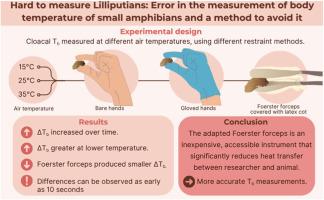
Accurate measurement of body temperature (Tb) is essential for understanding the physiological ecology of ectothermic organisms. However, in small-bodied amphibians, heat exchange during handling and intrinsic limitations of measuring devices and/or protocols can introduce substantial error in Tb measurements. Here, we first estimated the magnitude of such an error for methodological approaches commonly adopted in the measurement of Tb in small ectothermic organisms in the field. We then propose a novel, low-cost restraint method, using a modified Foerster forceps, aimed at reducing heat transfer during handling. Accordingly, we compared the short-term changes (<2 min) in the Tb of frogs restrained with bare or gloved hands with those measured under the new proposed restraint method. We performed all tests using the Hylidae treefrog Dendropsophus nanus, whose small size made it perfectly suited to our goals, and we also repeated the experiments at three ambient temperatures (15 °C, 25 °C, and 35 °C), which allowed us to evaluate the influence of this variable on the measurement error. Our results clearly demonstrate that heat transfer from the researcher's hand to a small-bodied frog causes large deviations in the measured Tb and that those changes happen at an amazingly fast pace (within seconds) and are most prominent at lower ambient temperatures. The largely preconized use of gloves during measurements indeed reduced the error in Tb measurements to a moderate extent; however, the novel Foerster method herein proposed resulted in minimal change in frog's Tb and proved to be a superior and viable alternative to improve the accuracy of Tb measurement in small-bodied ectotherms.
期刊介绍:
The Journal of Thermal Biology publishes articles that advance our knowledge on the ways and mechanisms through which temperature affects man and animals. This includes studies of their responses to these effects and on the ecological consequences. Directly relevant to this theme are:
• The mechanisms of thermal limitation, heat and cold injury, and the resistance of organisms to extremes of temperature
• The mechanisms involved in acclimation, acclimatization and evolutionary adaptation to temperature
• Mechanisms underlying the patterns of hibernation, torpor, dormancy, aestivation and diapause
• Effects of temperature on reproduction and development, growth, ageing and life-span
• Studies on modelling heat transfer between organisms and their environment
• The contributions of temperature to effects of climate change on animal species and man
• Studies of conservation biology and physiology related to temperature
• Behavioural and physiological regulation of body temperature including its pathophysiology and fever
• Medical applications of hypo- and hyperthermia
Article types:
• Original articles
• Review articles