Hongqin Chen , Xinshuo Li , Min Ling , Xuehui Gao , Dian Zhao , Zhongwei Chen
{"title":"致密的纳米尖端使锂沉积均匀","authors":"Hongqin Chen , Xinshuo Li , Min Ling , Xuehui Gao , Dian Zhao , Zhongwei Chen","doi":"10.1016/j.apmate.2026.100401","DOIUrl":null,"url":null,"abstract":"<div><div>Lithium metal batteries (LMBs) offer high energy density but suffer from dendrite growth and interfacial instability, hindering practical application. We present a novel strategy that repurposes the “tip effect” to achieve uniform lithium deposition and suppress dendrite formation. By designing a three-dimensional Cu/Fe<sub>3</sub>O<sub>4</sub> Mott-Schottky heterojunction array with a high-density nano-tip structure, we homogenize the surface charge distribution, preventing current hotspots that induce dendrite growth. The Mott-Schottky heterojunction generates a robust built-in electric field that enriches Li<sup>+</sup> concentration at the electrode surface, mitigates Li<sup>+</sup> depletion, and homogenizes the electric field distribution. Simultaneously, the ferromagnetic Fe<sub>3</sub>O<sub>4</sub> induces an internal magnetic fields, utilizing the magnetohydrodynamic effect, redirects Li<sup>+</sup> trajectories away from surface protrusions, thereby suppressing dendritic nucleation. Experimental and computational analysis confirm that this beneficial tip effect and coupled dual-field mechanism can effectively promote uniform lithium deposition, achieving a plating and stripping Coulombic efficiency of 99.2%. Consequently, the symmetric cell achieves an ultralong cycle life of over 3000 h at 1 mA cm<sup>−2</sup> with an ultralow overpotential of 12 mV. When paired with a high-loading LiFePO<sub>4</sub> cathode (11.25 mg cm<sup>−2</sup>), the full cell maintains 95% of its initial capacity after 200 cycles, demonstrating exceptional rate capability and interfacial stability. For high-voltage cathode LiNi<sub>0.8</sub>Co<sub>0.1</sub>Mn<sub>0.1</sub>O<sub>2</sub> (NCM811), Li-Cu/Fe<sub>3</sub>O<sub>4</sub>||NCM811 cell achieves a capacity retention rate of 94.8% after 150 cycles at 2 C. This work provides an innovative solution for controlling lithium deposition, offering a promising strategy for high-performance LMBs.</div></div>","PeriodicalId":7283,"journal":{"name":"Advanced Powder Materials","volume":"5 4","pages":"Article 100401"},"PeriodicalIF":0.0000,"publicationDate":"2026-08-01","publicationTypes":"Journal Article","fieldsOfStudy":null,"isOpenAccess":false,"openAccessPdf":"","citationCount":"0","resultStr":"{\"title\":\"Dense nano-tips homogenize lithium deposition\",\"authors\":\"Hongqin Chen , Xinshuo Li , Min Ling , Xuehui Gao , Dian Zhao , Zhongwei Chen\",\"doi\":\"10.1016/j.apmate.2026.100401\",\"DOIUrl\":null,\"url\":null,\"abstract\":\"<div><div>Lithium metal batteries (LMBs) offer high energy density but suffer from dendrite growth and interfacial instability, hindering practical application. We present a novel strategy that repurposes the “tip effect” to achieve uniform lithium deposition and suppress dendrite formation. By designing a three-dimensional Cu/Fe<sub>3</sub>O<sub>4</sub> Mott-Schottky heterojunction array with a high-density nano-tip structure, we homogenize the surface charge distribution, preventing current hotspots that induce dendrite growth. The Mott-Schottky heterojunction generates a robust built-in electric field that enriches Li<sup>+</sup> concentration at the electrode surface, mitigates Li<sup>+</sup> depletion, and homogenizes the electric field distribution. Simultaneously, the ferromagnetic Fe<sub>3</sub>O<sub>4</sub> induces an internal magnetic fields, utilizing the magnetohydrodynamic effect, redirects Li<sup>+</sup> trajectories away from surface protrusions, thereby suppressing dendritic nucleation. Experimental and computational analysis confirm that this beneficial tip effect and coupled dual-field mechanism can effectively promote uniform lithium deposition, achieving a plating and stripping Coulombic efficiency of 99.2%. Consequently, the symmetric cell achieves an ultralong cycle life of over 3000 h at 1 mA cm<sup>−2</sup> with an ultralow overpotential of 12 mV. When paired with a high-loading LiFePO<sub>4</sub> cathode (11.25 mg cm<sup>−2</sup>), the full cell maintains 95% of its initial capacity after 200 cycles, demonstrating exceptional rate capability and interfacial stability. For high-voltage cathode LiNi<sub>0.8</sub>Co<sub>0.1</sub>Mn<sub>0.1</sub>O<sub>2</sub> (NCM811), Li-Cu/Fe<sub>3</sub>O<sub>4</sub>||NCM811 cell achieves a capacity retention rate of 94.8% after 150 cycles at 2 C. This work provides an innovative solution for controlling lithium deposition, offering a promising strategy for high-performance LMBs.</div></div>\",\"PeriodicalId\":7283,\"journal\":{\"name\":\"Advanced Powder Materials\",\"volume\":\"5 4\",\"pages\":\"Article 100401\"},\"PeriodicalIF\":0.0000,\"publicationDate\":\"2026-08-01\",\"publicationTypes\":\"Journal Article\",\"fieldsOfStudy\":null,\"isOpenAccess\":false,\"openAccessPdf\":\"\",\"citationCount\":\"0\",\"resultStr\":null,\"platform\":\"Semanticscholar\",\"paperid\":null,\"PeriodicalName\":\"Advanced Powder Materials\",\"FirstCategoryId\":\"1085\",\"ListUrlMain\":\"https://www.sciencedirect.com/science/article/pii/S2772834X26000096\",\"RegionNum\":0,\"RegionCategory\":null,\"ArticlePicture\":[],\"TitleCN\":null,\"AbstractTextCN\":null,\"PMCID\":null,\"EPubDate\":\"2026/1/12 0:00:00\",\"PubModel\":\"Epub\",\"JCR\":\"\",\"JCRName\":\"\",\"Score\":null,\"Total\":0}","platform":"Semanticscholar","paperid":null,"PeriodicalName":"Advanced Powder Materials","FirstCategoryId":"1085","ListUrlMain":"https://www.sciencedirect.com/science/article/pii/S2772834X26000096","RegionNum":0,"RegionCategory":null,"ArticlePicture":[],"TitleCN":null,"AbstractTextCN":null,"PMCID":null,"EPubDate":"2026/1/12 0:00:00","PubModel":"Epub","JCR":"","JCRName":"","Score":null,"Total":0}
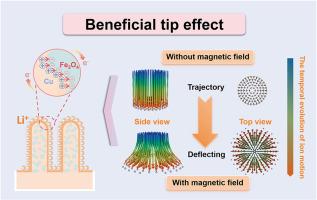
Lithium metal batteries (LMBs) offer high energy density but suffer from dendrite growth and interfacial instability, hindering practical application. We present a novel strategy that repurposes the “tip effect” to achieve uniform lithium deposition and suppress dendrite formation. By designing a three-dimensional Cu/Fe3O4 Mott-Schottky heterojunction array with a high-density nano-tip structure, we homogenize the surface charge distribution, preventing current hotspots that induce dendrite growth. The Mott-Schottky heterojunction generates a robust built-in electric field that enriches Li+ concentration at the electrode surface, mitigates Li+ depletion, and homogenizes the electric field distribution. Simultaneously, the ferromagnetic Fe3O4 induces an internal magnetic fields, utilizing the magnetohydrodynamic effect, redirects Li+ trajectories away from surface protrusions, thereby suppressing dendritic nucleation. Experimental and computational analysis confirm that this beneficial tip effect and coupled dual-field mechanism can effectively promote uniform lithium deposition, achieving a plating and stripping Coulombic efficiency of 99.2%. Consequently, the symmetric cell achieves an ultralong cycle life of over 3000 h at 1 mA cm−2 with an ultralow overpotential of 12 mV. When paired with a high-loading LiFePO4 cathode (11.25 mg cm−2), the full cell maintains 95% of its initial capacity after 200 cycles, demonstrating exceptional rate capability and interfacial stability. For high-voltage cathode LiNi0.8Co0.1Mn0.1O2 (NCM811), Li-Cu/Fe3O4||NCM811 cell achieves a capacity retention rate of 94.8% after 150 cycles at 2 C. This work provides an innovative solution for controlling lithium deposition, offering a promising strategy for high-performance LMBs.


 求助内容:
求助内容: 应助结果提醒方式:

 京公网安备 11010802042870号


