{"title":"电化学膜系统无化学物质pH调节性能限制因素的互补建模分析和实验研究","authors":"Liyue Diao , Wei Long , Hong Li , Qianhong She","doi":"10.1016/j.desal.2026.119850","DOIUrl":null,"url":null,"abstract":"<div><div>pH is critical for optimizing the efficiency during water treatment processes. The electrochemical membrane system (EMS) offers a chemical-free method to adjust pH in situ, where a piece of low-cost filtration membrane is placed between two electrodes and the water electrolysis occurs to generate H<sup>+</sup> and OH<sup>−</sup> ions. In contrast to previous studies that have provided a qualitative understanding on performance-limiting factors of pH regulation in the EMS, this study aims to quantitatively analyze these factors. Herein, we integrate the theoretical modelling with the experimental investigation to quantitatively evaluate how performance-limiting factors affect pH changes and the specific energy consumption (SEC) in the EMS. The effluent pH achieved ∼4.5 and ∼10.0 under a low current density (CD) of 0.5 mA/cm<sup>2</sup> with an extremely low SEC of 0.009–0.011 kWh/m<sup>3</sup> for all the membranes tested under the operating surface loading rate (OSLR) of 1200 LMH. When the CD increased and the OSLR decreased further, the effluent pH finally achieved ∼2.0 and ∼12.0, but with a less energy-efficient level of SEC. Membrane properties insignificantly affected pH changes, while the higher electric resistance of either membranes or electrolyte solutions increased the system's SEC. Moreover, the dissolution of CO<sub>2</sub> from the air into the electrolyte solution exhibited a buffering effect on pH changes. These findings provide practical guidance for the EMS design and operation, contributing to enhancing the performance and the energy efficiency of the EMS in broad water treatment industries.</div></div>","PeriodicalId":299,"journal":{"name":"Desalination","volume":"624 ","pages":"Article 119850"},"PeriodicalIF":9.8000,"publicationDate":"2026-04-15","publicationTypes":"Journal Article","fieldsOfStudy":null,"isOpenAccess":false,"openAccessPdf":"","citationCount":"0","resultStr":"{\"title\":\"Complementary modelling analysis and experimental investigation of performance-limiting factors of electrochemical membrane systems for chemical-free pH regulation\",\"authors\":\"Liyue Diao , Wei Long , Hong Li , Qianhong She\",\"doi\":\"10.1016/j.desal.2026.119850\",\"DOIUrl\":null,\"url\":null,\"abstract\":\"<div><div>pH is critical for optimizing the efficiency during water treatment processes. The electrochemical membrane system (EMS) offers a chemical-free method to adjust pH in situ, where a piece of low-cost filtration membrane is placed between two electrodes and the water electrolysis occurs to generate H<sup>+</sup> and OH<sup>−</sup> ions. In contrast to previous studies that have provided a qualitative understanding on performance-limiting factors of pH regulation in the EMS, this study aims to quantitatively analyze these factors. Herein, we integrate the theoretical modelling with the experimental investigation to quantitatively evaluate how performance-limiting factors affect pH changes and the specific energy consumption (SEC) in the EMS. The effluent pH achieved ∼4.5 and ∼10.0 under a low current density (CD) of 0.5 mA/cm<sup>2</sup> with an extremely low SEC of 0.009–0.011 kWh/m<sup>3</sup> for all the membranes tested under the operating surface loading rate (OSLR) of 1200 LMH. When the CD increased and the OSLR decreased further, the effluent pH finally achieved ∼2.0 and ∼12.0, but with a less energy-efficient level of SEC. Membrane properties insignificantly affected pH changes, while the higher electric resistance of either membranes or electrolyte solutions increased the system's SEC. Moreover, the dissolution of CO<sub>2</sub> from the air into the electrolyte solution exhibited a buffering effect on pH changes. These findings provide practical guidance for the EMS design and operation, contributing to enhancing the performance and the energy efficiency of the EMS in broad water treatment industries.</div></div>\",\"PeriodicalId\":299,\"journal\":{\"name\":\"Desalination\",\"volume\":\"624 \",\"pages\":\"Article 119850\"},\"PeriodicalIF\":9.8000,\"publicationDate\":\"2026-04-15\",\"publicationTypes\":\"Journal Article\",\"fieldsOfStudy\":null,\"isOpenAccess\":false,\"openAccessPdf\":\"\",\"citationCount\":\"0\",\"resultStr\":null,\"platform\":\"Semanticscholar\",\"paperid\":null,\"PeriodicalName\":\"Desalination\",\"FirstCategoryId\":\"5\",\"ListUrlMain\":\"https://www.sciencedirect.com/science/article/pii/S0011916426000068\",\"RegionNum\":1,\"RegionCategory\":\"工程技术\",\"ArticlePicture\":[],\"TitleCN\":null,\"AbstractTextCN\":null,\"PMCID\":null,\"EPubDate\":\"2026/1/13 0:00:00\",\"PubModel\":\"Epub\",\"JCR\":\"Q1\",\"JCRName\":\"ENGINEERING, CHEMICAL\",\"Score\":null,\"Total\":0}","platform":"Semanticscholar","paperid":null,"PeriodicalName":"Desalination","FirstCategoryId":"5","ListUrlMain":"https://www.sciencedirect.com/science/article/pii/S0011916426000068","RegionNum":1,"RegionCategory":"工程技术","ArticlePicture":[],"TitleCN":null,"AbstractTextCN":null,"PMCID":null,"EPubDate":"2026/1/13 0:00:00","PubModel":"Epub","JCR":"Q1","JCRName":"ENGINEERING, CHEMICAL","Score":null,"Total":0}
Complementary modelling analysis and experimental investigation of performance-limiting factors of electrochemical membrane systems for chemical-free pH regulation
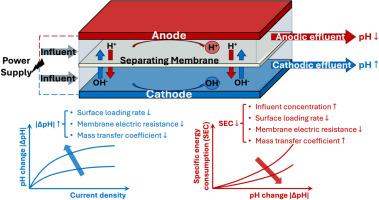
pH is critical for optimizing the efficiency during water treatment processes. The electrochemical membrane system (EMS) offers a chemical-free method to adjust pH in situ, where a piece of low-cost filtration membrane is placed between two electrodes and the water electrolysis occurs to generate H+ and OH− ions. In contrast to previous studies that have provided a qualitative understanding on performance-limiting factors of pH regulation in the EMS, this study aims to quantitatively analyze these factors. Herein, we integrate the theoretical modelling with the experimental investigation to quantitatively evaluate how performance-limiting factors affect pH changes and the specific energy consumption (SEC) in the EMS. The effluent pH achieved ∼4.5 and ∼10.0 under a low current density (CD) of 0.5 mA/cm2 with an extremely low SEC of 0.009–0.011 kWh/m3 for all the membranes tested under the operating surface loading rate (OSLR) of 1200 LMH. When the CD increased and the OSLR decreased further, the effluent pH finally achieved ∼2.0 and ∼12.0, but with a less energy-efficient level of SEC. Membrane properties insignificantly affected pH changes, while the higher electric resistance of either membranes or electrolyte solutions increased the system's SEC. Moreover, the dissolution of CO2 from the air into the electrolyte solution exhibited a buffering effect on pH changes. These findings provide practical guidance for the EMS design and operation, contributing to enhancing the performance and the energy efficiency of the EMS in broad water treatment industries.
期刊介绍:
Desalination is a scholarly journal that focuses on the field of desalination materials, processes, and associated technologies. It encompasses a wide range of disciplines and aims to publish exceptional papers in this area.
The journal invites submissions that explicitly revolve around water desalting and its applications to various sources such as seawater, groundwater, and wastewater. It particularly encourages research on diverse desalination methods including thermal, membrane, sorption, and hybrid processes.
By providing a platform for innovative studies, Desalination aims to advance the understanding and development of desalination technologies, promoting sustainable solutions for water scarcity challenges.