Chun Chen , Yifei Zhang , Linchao Zhang , Israr Ullah , Lei Hang , Yupeng Liu , Jun Yang
{"title":"外泌体功能化光交联GelMA/HAMA水凝胶通过炎症微环境调节促进面神经恢复","authors":"Chun Chen , Yifei Zhang , Linchao Zhang , Israr Ullah , Lei Hang , Yupeng Liu , Jun Yang","doi":"10.1016/j.bioactmat.2026.01.008","DOIUrl":null,"url":null,"abstract":"<div><div>Facial nerve crush injuries frequently lead to incomplete functional restoration owing to constrained regenerative approaches and suboptimal treatment methods. While hydrogel-based systems have emerged as viable alternatives among bioengineered scaffolds, their therapeutic potential remains compromised by inadequate biological activity and unfavorable inflammatory conditions. Our research engineered a photoactivated GelMA/HAMA composite hydrogel incorporating bone marrow mesenchymal stem cell-derived exosomes (BExos), with comprehensive characterization of its material attributes. We systematically assessed the biomaterial's regenerative capacity through in vitro experiments involving BMSCs and RAW264.7 macrophages, complemented by comprehensive in vivo evaluations in a rodent facial nerve injury model incorporating functional restoration metrics, neurophysiological testing, tissue analysis, and biomolecular profiling. The BExos-integrated hydrogel established a favorable niche promoting BMSCs transdifferentiation toward Schwann cell-mimetic lineages while demonstrating marked improvement in neuromuscular functional restoration. Compared to untreated cohorts, the composite hydrogel demonstrated enhanced axonal regrowth, improved remyelination processes, and notably reduced oxidative damage. The biomaterial effectively shifted macrophage differentiation from M1 pro-inflammatory states toward M2 anti-inflammatory phenotypes through modulation of PI3K/NF-κB/P38 signaling cascades, with <em>Neuronatin</em> emerging as a key regulatory element in this pathway. Mechanistic investigations demonstrated that the therapeutic benefits stemmed from synergistic structural reinforcement combined with exosome-mediated immune regulation, positioning this dual-action hydrogel as an innovative solution for facial nerve repair.</div></div>","PeriodicalId":8762,"journal":{"name":"Bioactive Materials","volume":"60 ","pages":"Pages 1-19"},"PeriodicalIF":18.0000,"publicationDate":"2026-06-01","publicationTypes":"Journal Article","fieldsOfStudy":null,"isOpenAccess":false,"openAccessPdf":"","citationCount":"0","resultStr":"{\"title\":\"Exosome-functionalized photocrosslinked GelMA/HAMA hydrogel promotes facial nerve recovery via inflammatory microenvironment regulation\",\"authors\":\"Chun Chen , Yifei Zhang , Linchao Zhang , Israr Ullah , Lei Hang , Yupeng Liu , Jun Yang\",\"doi\":\"10.1016/j.bioactmat.2026.01.008\",\"DOIUrl\":null,\"url\":null,\"abstract\":\"<div><div>Facial nerve crush injuries frequently lead to incomplete functional restoration owing to constrained regenerative approaches and suboptimal treatment methods. While hydrogel-based systems have emerged as viable alternatives among bioengineered scaffolds, their therapeutic potential remains compromised by inadequate biological activity and unfavorable inflammatory conditions. Our research engineered a photoactivated GelMA/HAMA composite hydrogel incorporating bone marrow mesenchymal stem cell-derived exosomes (BExos), with comprehensive characterization of its material attributes. We systematically assessed the biomaterial's regenerative capacity through in vitro experiments involving BMSCs and RAW264.7 macrophages, complemented by comprehensive in vivo evaluations in a rodent facial nerve injury model incorporating functional restoration metrics, neurophysiological testing, tissue analysis, and biomolecular profiling. The BExos-integrated hydrogel established a favorable niche promoting BMSCs transdifferentiation toward Schwann cell-mimetic lineages while demonstrating marked improvement in neuromuscular functional restoration. Compared to untreated cohorts, the composite hydrogel demonstrated enhanced axonal regrowth, improved remyelination processes, and notably reduced oxidative damage. The biomaterial effectively shifted macrophage differentiation from M1 pro-inflammatory states toward M2 anti-inflammatory phenotypes through modulation of PI3K/NF-κB/P38 signaling cascades, with <em>Neuronatin</em> emerging as a key regulatory element in this pathway. Mechanistic investigations demonstrated that the therapeutic benefits stemmed from synergistic structural reinforcement combined with exosome-mediated immune regulation, positioning this dual-action hydrogel as an innovative solution for facial nerve repair.</div></div>\",\"PeriodicalId\":8762,\"journal\":{\"name\":\"Bioactive Materials\",\"volume\":\"60 \",\"pages\":\"Pages 1-19\"},\"PeriodicalIF\":18.0000,\"publicationDate\":\"2026-06-01\",\"publicationTypes\":\"Journal Article\",\"fieldsOfStudy\":null,\"isOpenAccess\":false,\"openAccessPdf\":\"\",\"citationCount\":\"0\",\"resultStr\":null,\"platform\":\"Semanticscholar\",\"paperid\":null,\"PeriodicalName\":\"Bioactive Materials\",\"FirstCategoryId\":\"5\",\"ListUrlMain\":\"https://www.sciencedirect.com/science/article/pii/S2452199X26000083\",\"RegionNum\":1,\"RegionCategory\":\"医学\",\"ArticlePicture\":[],\"TitleCN\":null,\"AbstractTextCN\":null,\"PMCID\":null,\"EPubDate\":\"2026/1/19 0:00:00\",\"PubModel\":\"Epub\",\"JCR\":\"Q1\",\"JCRName\":\"ENGINEERING, BIOMEDICAL\",\"Score\":null,\"Total\":0}","platform":"Semanticscholar","paperid":null,"PeriodicalName":"Bioactive Materials","FirstCategoryId":"5","ListUrlMain":"https://www.sciencedirect.com/science/article/pii/S2452199X26000083","RegionNum":1,"RegionCategory":"医学","ArticlePicture":[],"TitleCN":null,"AbstractTextCN":null,"PMCID":null,"EPubDate":"2026/1/19 0:00:00","PubModel":"Epub","JCR":"Q1","JCRName":"ENGINEERING, BIOMEDICAL","Score":null,"Total":0}
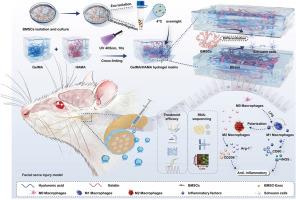
Facial nerve crush injuries frequently lead to incomplete functional restoration owing to constrained regenerative approaches and suboptimal treatment methods. While hydrogel-based systems have emerged as viable alternatives among bioengineered scaffolds, their therapeutic potential remains compromised by inadequate biological activity and unfavorable inflammatory conditions. Our research engineered a photoactivated GelMA/HAMA composite hydrogel incorporating bone marrow mesenchymal stem cell-derived exosomes (BExos), with comprehensive characterization of its material attributes. We systematically assessed the biomaterial's regenerative capacity through in vitro experiments involving BMSCs and RAW264.7 macrophages, complemented by comprehensive in vivo evaluations in a rodent facial nerve injury model incorporating functional restoration metrics, neurophysiological testing, tissue analysis, and biomolecular profiling. The BExos-integrated hydrogel established a favorable niche promoting BMSCs transdifferentiation toward Schwann cell-mimetic lineages while demonstrating marked improvement in neuromuscular functional restoration. Compared to untreated cohorts, the composite hydrogel demonstrated enhanced axonal regrowth, improved remyelination processes, and notably reduced oxidative damage. The biomaterial effectively shifted macrophage differentiation from M1 pro-inflammatory states toward M2 anti-inflammatory phenotypes through modulation of PI3K/NF-κB/P38 signaling cascades, with Neuronatin emerging as a key regulatory element in this pathway. Mechanistic investigations demonstrated that the therapeutic benefits stemmed from synergistic structural reinforcement combined with exosome-mediated immune regulation, positioning this dual-action hydrogel as an innovative solution for facial nerve repair.
Bioactive MaterialsBiochemistry, Genetics and Molecular Biology-Biotechnology
CiteScore
28.00
自引率
6.30%
发文量
436
审稿时长
20 days
期刊介绍:
Bioactive Materials is a peer-reviewed research publication that focuses on advancements in bioactive materials. The journal accepts research papers, reviews, and rapid communications in the field of next-generation biomaterials that interact with cells, tissues, and organs in various living organisms.
The primary goal of Bioactive Materials is to promote the science and engineering of biomaterials that exhibit adaptiveness to the biological environment. These materials are specifically designed to stimulate or direct appropriate cell and tissue responses or regulate interactions with microorganisms.
The journal covers a wide range of bioactive materials, including those that are engineered or designed in terms of their physical form (e.g. particulate, fiber), topology (e.g. porosity, surface roughness), or dimensions (ranging from macro to nano-scales). Contributions are sought from the following categories of bioactive materials:
Bioactive metals and alloys
Bioactive inorganics: ceramics, glasses, and carbon-based materials
Bioactive polymers and gels
Bioactive materials derived from natural sources
Bioactive composites
These materials find applications in human and veterinary medicine, such as implants, tissue engineering scaffolds, cell/drug/gene carriers, as well as imaging and sensing devices.