压力容器用钛/钢双金属板激光焊接强度-延性协同效应研究

IF 3.5 2区 工程技术 Q2 ENGINEERING, MECHANICAL
Dejia Liu , Haitao Xiao , Guodong Lv , Yanchuang Tang , Shanguo Han
{"title":"压力容器用钛/钢双金属板激光焊接强度-延性协同效应研究","authors":"Dejia Liu ,&nbsp;Haitao Xiao ,&nbsp;Guodong Lv ,&nbsp;Yanchuang Tang ,&nbsp;Shanguo Han","doi":"10.1016/j.ijpvp.2026.105758","DOIUrl":null,"url":null,"abstract":"<div><div>The welding of titanium/steel bimetallic sheets exhibits a great challenge owing to the formation of Fe-Ti intermetallic compounds, which can severely degrade the mechanical properties of the welded joint. In this paper, a FeCrNiCu filler metal was used for laser welding TA2/Q235 bimetallic sheets. The strength-ductility synergy and fracture behavior of the welded joint were investigated. A noteworthy finding was that the FeCrNiCu filler metal could generate a high mixing entropy value in the weld seam, which promoted the formation of a primarily face-centered cubic (FCC) phase and coarse grains within the weld seam. The negative enthalpy variation in the transition zones (TZs) on the TA2 layer resulted in phase structures predominantly composed of Fe<sub>2</sub>Ti, FCC, and α-Ti phases, accompanied by fine grains. Consequently, extremely high hardness values, ranging from 600 to 764 HV<sub>0.2</sub> were observed in the TZ. The fragile zones of the welded joint shifted from the weld seam to the TZ, which played a significant role in promoting crack initiation and propagation in the welded joint during mechanical testing. The welded joint fabricated with the FeCrNiCu filler metal exhibited a favorable strength-ductility synergy. The strength coefficient of the welded joint was up to 92.5 %, with a fracture elongation of 6.9 %. Additionally, the welded joint demonstrated promising bending properties. A bending angle of 180° was achieved with no surface cracks observed on the weld seam during root bending tests (compressive stress on the TA2 layer).</div></div>","PeriodicalId":54946,"journal":{"name":"International Journal of Pressure Vessels and Piping","volume":"221 ","pages":"Article 105758"},"PeriodicalIF":3.5000,"publicationDate":"2026-06-01","publicationTypes":"Journal Article","fieldsOfStudy":null,"isOpenAccess":false,"openAccessPdf":"","citationCount":"0","resultStr":"{\"title\":\"Investigation on the strength-ductility synergy in the laser-welded titanium/steel bimetallic sheets used for pressure vessels\",\"authors\":\"Dejia Liu ,&nbsp;Haitao Xiao ,&nbsp;Guodong Lv ,&nbsp;Yanchuang Tang ,&nbsp;Shanguo Han\",\"doi\":\"10.1016/j.ijpvp.2026.105758\",\"DOIUrl\":null,\"url\":null,\"abstract\":\"<div><div>The welding of titanium/steel bimetallic sheets exhibits a great challenge owing to the formation of Fe-Ti intermetallic compounds, which can severely degrade the mechanical properties of the welded joint. In this paper, a FeCrNiCu filler metal was used for laser welding TA2/Q235 bimetallic sheets. The strength-ductility synergy and fracture behavior of the welded joint were investigated. A noteworthy finding was that the FeCrNiCu filler metal could generate a high mixing entropy value in the weld seam, which promoted the formation of a primarily face-centered cubic (FCC) phase and coarse grains within the weld seam. The negative enthalpy variation in the transition zones (TZs) on the TA2 layer resulted in phase structures predominantly composed of Fe<sub>2</sub>Ti, FCC, and α-Ti phases, accompanied by fine grains. Consequently, extremely high hardness values, ranging from 600 to 764 HV<sub>0.2</sub> were observed in the TZ. The fragile zones of the welded joint shifted from the weld seam to the TZ, which played a significant role in promoting crack initiation and propagation in the welded joint during mechanical testing. The welded joint fabricated with the FeCrNiCu filler metal exhibited a favorable strength-ductility synergy. The strength coefficient of the welded joint was up to 92.5 %, with a fracture elongation of 6.9 %. Additionally, the welded joint demonstrated promising bending properties. A bending angle of 180° was achieved with no surface cracks observed on the weld seam during root bending tests (compressive stress on the TA2 layer).</div></div>\",\"PeriodicalId\":54946,\"journal\":{\"name\":\"International Journal of Pressure Vessels and Piping\",\"volume\":\"221 \",\"pages\":\"Article 105758\"},\"PeriodicalIF\":3.5000,\"publicationDate\":\"2026-06-01\",\"publicationTypes\":\"Journal Article\",\"fieldsOfStudy\":null,\"isOpenAccess\":false,\"openAccessPdf\":\"\",\"citationCount\":\"0\",\"resultStr\":null,\"platform\":\"Semanticscholar\",\"paperid\":null,\"PeriodicalName\":\"International Journal of Pressure Vessels and Piping\",\"FirstCategoryId\":\"5\",\"ListUrlMain\":\"https://www.sciencedirect.com/science/article/pii/S0308016126000141\",\"RegionNum\":2,\"RegionCategory\":\"工程技术\",\"ArticlePicture\":[],\"TitleCN\":null,\"AbstractTextCN\":null,\"PMCID\":null,\"EPubDate\":\"2026/1/10 0:00:00\",\"PubModel\":\"Epub\",\"JCR\":\"Q2\",\"JCRName\":\"ENGINEERING, MECHANICAL\",\"Score\":null,\"Total\":0}","platform":"Semanticscholar","paperid":null,"PeriodicalName":"International Journal of Pressure Vessels and Piping","FirstCategoryId":"5","ListUrlMain":"https://www.sciencedirect.com/science/article/pii/S0308016126000141","RegionNum":2,"RegionCategory":"工程技术","ArticlePicture":[],"TitleCN":null,"AbstractTextCN":null,"PMCID":null,"EPubDate":"2026/1/10 0:00:00","PubModel":"Epub","JCR":"Q2","JCRName":"ENGINEERING, MECHANICAL","Score":null,"Total":0}
引用次数: 0

摘要

钛/钢双金属板的焊接是一个很大的挑战,因为铁-钛金属间化合物的形成会严重降低焊接接头的力学性能。本文采用FeCrNiCu填充金属对TA2/Q235双金属薄板进行激光焊接。研究了焊接接头的强度-塑性协同效应和断裂行为。值得注意的是,FeCrNiCu钎料在焊缝中产生较高的混合熵值,促进了焊缝内主要面心立方相(FCC)和粗晶的形成。TA2层过渡区(TZs)的负焓变导致相结构主要由Fe2Ti、FCC和α-Ti相组成,并伴有细小晶粒。因此,在TZ中观察到极高的硬度值,范围从600到764 HV0.2。在力学试验过程中,焊接接头的脆性区域从焊缝向TZ移动,这对焊接接头裂纹的萌生和扩展起着重要的促进作用。用FeCrNiCu填充金属制作的焊接接头表现出良好的强度-塑性协同效应。焊接接头的强度系数高达92.5%,断裂伸长率为6.9%。此外,焊接接头显示出良好的弯曲性能。在根部弯曲试验(TA2层的压应力)中,焊缝的弯曲角度达到180°,未观察到表面裂纹。
本文章由计算机程序翻译,如有差异,请以英文原文为准。

Investigation on the strength-ductility synergy in the laser-welded titanium/steel bimetallic sheets used for pressure vessels

Investigation on the strength-ductility synergy in the laser-welded titanium/steel bimetallic sheets used for pressure vessels
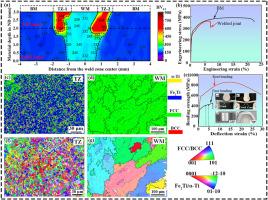
The welding of titanium/steel bimetallic sheets exhibits a great challenge owing to the formation of Fe-Ti intermetallic compounds, which can severely degrade the mechanical properties of the welded joint. In this paper, a FeCrNiCu filler metal was used for laser welding TA2/Q235 bimetallic sheets. The strength-ductility synergy and fracture behavior of the welded joint were investigated. A noteworthy finding was that the FeCrNiCu filler metal could generate a high mixing entropy value in the weld seam, which promoted the formation of a primarily face-centered cubic (FCC) phase and coarse grains within the weld seam. The negative enthalpy variation in the transition zones (TZs) on the TA2 layer resulted in phase structures predominantly composed of Fe2Ti, FCC, and α-Ti phases, accompanied by fine grains. Consequently, extremely high hardness values, ranging from 600 to 764 HV0.2 were observed in the TZ. The fragile zones of the welded joint shifted from the weld seam to the TZ, which played a significant role in promoting crack initiation and propagation in the welded joint during mechanical testing. The welded joint fabricated with the FeCrNiCu filler metal exhibited a favorable strength-ductility synergy. The strength coefficient of the welded joint was up to 92.5 %, with a fracture elongation of 6.9 %. Additionally, the welded joint demonstrated promising bending properties. A bending angle of 180° was achieved with no surface cracks observed on the weld seam during root bending tests (compressive stress on the TA2 layer).
求助全文
通过发布文献求助,成功后即可免费获取论文全文。 去求助
来源期刊
CiteScore
5.30
自引率
13.30%
发文量
208
审稿时长
17 months
期刊介绍: Pressure vessel engineering technology is of importance in many branches of industry. This journal publishes the latest research results and related information on all its associated aspects, with particular emphasis on the structural integrity assessment, maintenance and life extension of pressurised process engineering plants. The anticipated coverage of the International Journal of Pressure Vessels and Piping ranges from simple mass-produced pressure vessels to large custom-built vessels and tanks. Pressure vessels technology is a developing field, and contributions on the following topics will therefore be welcome: • Pressure vessel engineering • Structural integrity assessment • Design methods • Codes and standards • Fabrication and welding • Materials properties requirements • Inspection and quality management • Maintenance and life extension • Ageing and environmental effects • Life management Of particular importance are papers covering aspects of significant practical application which could lead to major improvements in economy, reliability and useful life. While most accepted papers represent the results of original applied research, critical reviews of topical interest by world-leading experts will also appear from time to time. International Journal of Pressure Vessels and Piping is indispensable reading for engineering professionals involved in the energy, petrochemicals, process plant, transport, aerospace and related industries; for manufacturers of pressure vessels and ancillary equipment; and for academics pursuing research in these areas.

×
引用
GB/T 7714-2015
复制
MLA
复制
APA
复制
导出至
BibTeX EndNote RefMan NoteFirst NoteExpress
×
提示
您的信息不完整,为了账户安全,请先补充。
现在去补充
×
提示
您因"违规操作"
具体请查看互助需知
我知道了
×
提示
确定
请完成安全验证×
copy
已复制链接
快去分享给好友吧!
我知道了
右上角分享
点击右上角分享
0
联系我们:info@booksci.cn Book学术提供免费学术资源搜索服务,方便国内外学者检索中英文文献。致力于提供最便捷和优质的服务体验。 Copyright © 2023 布克学术 All rights reserved.
京ICP备2023020795号-1
ghs 京公网安备 11010802042870号
Book学术文献互助
Book学术文献互助群
群 号:604180095
Book学术官方微信
小红书