Li’ang Li , Menghong Hu , Shanza Gul , Yuanxiong Ma , Xinfeng Dai , Qiang Hao , Jinping Zhang , Wei Huang , Youji Wang
{"title":"功能化纳米塑料通过表面电荷效应改变太平洋亚历山大菌的生理和毒素产生","authors":"Li’ang Li , Menghong Hu , Shanza Gul , Yuanxiong Ma , Xinfeng Dai , Qiang Hao , Jinping Zhang , Wei Huang , Youji Wang","doi":"10.1016/j.horiz.2025.100171","DOIUrl":null,"url":null,"abstract":"<div><div>Nanoplastics have emerged as a significant threat to marine ecosystems. Those with functional modifications particularly impact biological processes, as their surface potential governs particle-organism interactions and electron transfer. Here, we evaluated the endpoints related to growth, photosynthesis, antioxidant defence, and paralytic shellfish toxins (PSTs) content in <em>Alexandrium pacificum</em> exposed to 100 nm functionally modified nanoplastics (NP, NP-NH<sub>2</sub> and NP-COOH) of 0, 0.1 and 1 mg/L for 21 days. Our findings indicate that: Exposure to 1 mg/L NP increased microalgae growth by 31.4%, while NP-NH<sub>2</sub> (1 mg/L) promoted growth throughout the experiment. Significant nanoplastics accumulation occurred on microalgae surfaces. NP (1 mg/L) induced a significant increase in photosynthetic activity. Toxicity of nanoplastics exhibited a concentration-dependent increase that was independent of functional modification, which, together with concentration, significantly interacted to affect cell membrane permeability. In addition, NP-NH<sub>2</sub> altered the PSTs composition, increasing C1/C2 levels by 121.2% (1 mg/L) and 159.88% (0.1 mg/L) compared to controls. In summary, NP-NH<sub>2</sub> exhibited higher bioavailability than NP-COOH and NP. Our study underscores the critical role of functional groups in mediating the effects of nanoplastics on harmful microalgae physiology, particularly intracellular PSTs dynamics, which may profoundly impact ecosystems through food chain transfer.</div></div>","PeriodicalId":101199,"journal":{"name":"Sustainable Horizons","volume":"17 ","pages":"Article 100171"},"PeriodicalIF":0.0000,"publicationDate":"2026-03-01","publicationTypes":"Journal Article","fieldsOfStudy":null,"isOpenAccess":false,"openAccessPdf":"","citationCount":"0","resultStr":"{\"title\":\"Functionalized nanoplastics alter physiology and toxin production in Alexandrium pacificum through surface charge effects\",\"authors\":\"Li’ang Li , Menghong Hu , Shanza Gul , Yuanxiong Ma , Xinfeng Dai , Qiang Hao , Jinping Zhang , Wei Huang , Youji Wang\",\"doi\":\"10.1016/j.horiz.2025.100171\",\"DOIUrl\":null,\"url\":null,\"abstract\":\"<div><div>Nanoplastics have emerged as a significant threat to marine ecosystems. Those with functional modifications particularly impact biological processes, as their surface potential governs particle-organism interactions and electron transfer. Here, we evaluated the endpoints related to growth, photosynthesis, antioxidant defence, and paralytic shellfish toxins (PSTs) content in <em>Alexandrium pacificum</em> exposed to 100 nm functionally modified nanoplastics (NP, NP-NH<sub>2</sub> and NP-COOH) of 0, 0.1 and 1 mg/L for 21 days. Our findings indicate that: Exposure to 1 mg/L NP increased microalgae growth by 31.4%, while NP-NH<sub>2</sub> (1 mg/L) promoted growth throughout the experiment. Significant nanoplastics accumulation occurred on microalgae surfaces. NP (1 mg/L) induced a significant increase in photosynthetic activity. Toxicity of nanoplastics exhibited a concentration-dependent increase that was independent of functional modification, which, together with concentration, significantly interacted to affect cell membrane permeability. In addition, NP-NH<sub>2</sub> altered the PSTs composition, increasing C1/C2 levels by 121.2% (1 mg/L) and 159.88% (0.1 mg/L) compared to controls. In summary, NP-NH<sub>2</sub> exhibited higher bioavailability than NP-COOH and NP. Our study underscores the critical role of functional groups in mediating the effects of nanoplastics on harmful microalgae physiology, particularly intracellular PSTs dynamics, which may profoundly impact ecosystems through food chain transfer.</div></div>\",\"PeriodicalId\":101199,\"journal\":{\"name\":\"Sustainable Horizons\",\"volume\":\"17 \",\"pages\":\"Article 100171\"},\"PeriodicalIF\":0.0000,\"publicationDate\":\"2026-03-01\",\"publicationTypes\":\"Journal Article\",\"fieldsOfStudy\":null,\"isOpenAccess\":false,\"openAccessPdf\":\"\",\"citationCount\":\"0\",\"resultStr\":null,\"platform\":\"Semanticscholar\",\"paperid\":null,\"PeriodicalName\":\"Sustainable Horizons\",\"FirstCategoryId\":\"1085\",\"ListUrlMain\":\"https://www.sciencedirect.com/science/article/pii/S2772737825000410\",\"RegionNum\":0,\"RegionCategory\":null,\"ArticlePicture\":[],\"TitleCN\":null,\"AbstractTextCN\":null,\"PMCID\":null,\"EPubDate\":\"2026/1/17 0:00:00\",\"PubModel\":\"Epub\",\"JCR\":\"\",\"JCRName\":\"\",\"Score\":null,\"Total\":0}","platform":"Semanticscholar","paperid":null,"PeriodicalName":"Sustainable Horizons","FirstCategoryId":"1085","ListUrlMain":"https://www.sciencedirect.com/science/article/pii/S2772737825000410","RegionNum":0,"RegionCategory":null,"ArticlePicture":[],"TitleCN":null,"AbstractTextCN":null,"PMCID":null,"EPubDate":"2026/1/17 0:00:00","PubModel":"Epub","JCR":"","JCRName":"","Score":null,"Total":0}
Functionalized nanoplastics alter physiology and toxin production in Alexandrium pacificum through surface charge effects
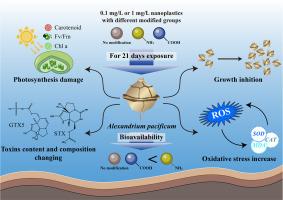
Nanoplastics have emerged as a significant threat to marine ecosystems. Those with functional modifications particularly impact biological processes, as their surface potential governs particle-organism interactions and electron transfer. Here, we evaluated the endpoints related to growth, photosynthesis, antioxidant defence, and paralytic shellfish toxins (PSTs) content in Alexandrium pacificum exposed to 100 nm functionally modified nanoplastics (NP, NP-NH2 and NP-COOH) of 0, 0.1 and 1 mg/L for 21 days. Our findings indicate that: Exposure to 1 mg/L NP increased microalgae growth by 31.4%, while NP-NH2 (1 mg/L) promoted growth throughout the experiment. Significant nanoplastics accumulation occurred on microalgae surfaces. NP (1 mg/L) induced a significant increase in photosynthetic activity. Toxicity of nanoplastics exhibited a concentration-dependent increase that was independent of functional modification, which, together with concentration, significantly interacted to affect cell membrane permeability. In addition, NP-NH2 altered the PSTs composition, increasing C1/C2 levels by 121.2% (1 mg/L) and 159.88% (0.1 mg/L) compared to controls. In summary, NP-NH2 exhibited higher bioavailability than NP-COOH and NP. Our study underscores the critical role of functional groups in mediating the effects of nanoplastics on harmful microalgae physiology, particularly intracellular PSTs dynamics, which may profoundly impact ecosystems through food chain transfer.


 求助内容:
求助内容: 应助结果提醒方式:

 京公网安备 11010802042870号


