{"title":"一个多层,各向异性意识,年龄相关的钉颅骨压痕力学有限元框架与儿童颅骨安全的意义","authors":"Moataz Abdulhafez , Karim Kadry , Mohamed Zaazoue , Mostafa Bedewy","doi":"10.1016/j.jmbbm.2026.107343","DOIUrl":null,"url":null,"abstract":"<div><div>Understanding conical penetration into layered biological materials requires capturing the coupled influences of anisotropy, curvature, layer architecture, and developmental evolution of material properties. However, existing computational studies typically assume adult bone, neglect multilayer skull structure, or simplify cortical anisotropy. Here, we develop a multilayer finite element framework that integrates age-dependent cortical thickness, diploë formation, anisotropic elastic behavior, and Hill-type anisotropic yield to resolve penetration mechanics across developmental stages. A data-driven strategy is used to estimate geometry and material properties by fitting a monomolecular growth model to experimental measurements of thickness, modulus, and strength spanning infancy through adulthood, producing a continuous and physiologically realistic map of skull property evolution. The model is validated against independent wedge-indentation experiments and reference finite element simulations, demonstrating close agreement in force-displacement behavior and subsurface stress distributions. Results reveal that age-driven changes in cortical thickness and stiffness produce more than a three-fold variation in penetration depth and a four-fold variation in penetration depth as a percentage of the outer cortical layer thickness, under identical loading. Marked differences in shear-stress localization and plastic-zone morphology highlight how layer geometry and anisotropic stiffness collectively govern penetration resistance. These findings provide new mechanistic insight into the indentation response and pin slippage of layered cranial bone and underscore the importance of age-specific material modeling. The framework has direct implications for biomechanical safety when using head-immobilization devices, particularly in pediatric neurosurgery, where predictive modeling of tool-bone interaction can inform improved device design, force recommendations, and clinical practice.</div></div>","PeriodicalId":380,"journal":{"name":"Journal of the Mechanical Behavior of Biomedical Materials","volume":"176 ","pages":"Article 107343"},"PeriodicalIF":3.5000,"publicationDate":"2026-04-01","publicationTypes":"Journal Article","fieldsOfStudy":null,"isOpenAccess":false,"openAccessPdf":"","citationCount":"0","resultStr":"{\"title\":\"A multilayer, anisotropy-aware, age-dependent finite element framework for pin-skull indentation mechanics with implications for pediatric cranial safety\",\"authors\":\"Moataz Abdulhafez , Karim Kadry , Mohamed Zaazoue , Mostafa Bedewy\",\"doi\":\"10.1016/j.jmbbm.2026.107343\",\"DOIUrl\":null,\"url\":null,\"abstract\":\"<div><div>Understanding conical penetration into layered biological materials requires capturing the coupled influences of anisotropy, curvature, layer architecture, and developmental evolution of material properties. However, existing computational studies typically assume adult bone, neglect multilayer skull structure, or simplify cortical anisotropy. Here, we develop a multilayer finite element framework that integrates age-dependent cortical thickness, diploë formation, anisotropic elastic behavior, and Hill-type anisotropic yield to resolve penetration mechanics across developmental stages. A data-driven strategy is used to estimate geometry and material properties by fitting a monomolecular growth model to experimental measurements of thickness, modulus, and strength spanning infancy through adulthood, producing a continuous and physiologically realistic map of skull property evolution. The model is validated against independent wedge-indentation experiments and reference finite element simulations, demonstrating close agreement in force-displacement behavior and subsurface stress distributions. Results reveal that age-driven changes in cortical thickness and stiffness produce more than a three-fold variation in penetration depth and a four-fold variation in penetration depth as a percentage of the outer cortical layer thickness, under identical loading. Marked differences in shear-stress localization and plastic-zone morphology highlight how layer geometry and anisotropic stiffness collectively govern penetration resistance. These findings provide new mechanistic insight into the indentation response and pin slippage of layered cranial bone and underscore the importance of age-specific material modeling. The framework has direct implications for biomechanical safety when using head-immobilization devices, particularly in pediatric neurosurgery, where predictive modeling of tool-bone interaction can inform improved device design, force recommendations, and clinical practice.</div></div>\",\"PeriodicalId\":380,\"journal\":{\"name\":\"Journal of the Mechanical Behavior of Biomedical Materials\",\"volume\":\"176 \",\"pages\":\"Article 107343\"},\"PeriodicalIF\":3.5000,\"publicationDate\":\"2026-04-01\",\"publicationTypes\":\"Journal Article\",\"fieldsOfStudy\":null,\"isOpenAccess\":false,\"openAccessPdf\":\"\",\"citationCount\":\"0\",\"resultStr\":null,\"platform\":\"Semanticscholar\",\"paperid\":null,\"PeriodicalName\":\"Journal of the Mechanical Behavior of Biomedical Materials\",\"FirstCategoryId\":\"5\",\"ListUrlMain\":\"https://www.sciencedirect.com/science/article/pii/S1751616126000123\",\"RegionNum\":2,\"RegionCategory\":\"医学\",\"ArticlePicture\":[],\"TitleCN\":null,\"AbstractTextCN\":null,\"PMCID\":null,\"EPubDate\":\"2026/1/8 0:00:00\",\"PubModel\":\"Epub\",\"JCR\":\"Q2\",\"JCRName\":\"ENGINEERING, BIOMEDICAL\",\"Score\":null,\"Total\":0}","platform":"Semanticscholar","paperid":null,"PeriodicalName":"Journal of the Mechanical Behavior of Biomedical Materials","FirstCategoryId":"5","ListUrlMain":"https://www.sciencedirect.com/science/article/pii/S1751616126000123","RegionNum":2,"RegionCategory":"医学","ArticlePicture":[],"TitleCN":null,"AbstractTextCN":null,"PMCID":null,"EPubDate":"2026/1/8 0:00:00","PubModel":"Epub","JCR":"Q2","JCRName":"ENGINEERING, BIOMEDICAL","Score":null,"Total":0}
A multilayer, anisotropy-aware, age-dependent finite element framework for pin-skull indentation mechanics with implications for pediatric cranial safety
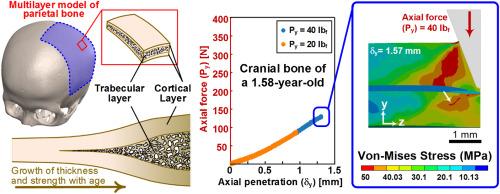
Understanding conical penetration into layered biological materials requires capturing the coupled influences of anisotropy, curvature, layer architecture, and developmental evolution of material properties. However, existing computational studies typically assume adult bone, neglect multilayer skull structure, or simplify cortical anisotropy. Here, we develop a multilayer finite element framework that integrates age-dependent cortical thickness, diploë formation, anisotropic elastic behavior, and Hill-type anisotropic yield to resolve penetration mechanics across developmental stages. A data-driven strategy is used to estimate geometry and material properties by fitting a monomolecular growth model to experimental measurements of thickness, modulus, and strength spanning infancy through adulthood, producing a continuous and physiologically realistic map of skull property evolution. The model is validated against independent wedge-indentation experiments and reference finite element simulations, demonstrating close agreement in force-displacement behavior and subsurface stress distributions. Results reveal that age-driven changes in cortical thickness and stiffness produce more than a three-fold variation in penetration depth and a four-fold variation in penetration depth as a percentage of the outer cortical layer thickness, under identical loading. Marked differences in shear-stress localization and plastic-zone morphology highlight how layer geometry and anisotropic stiffness collectively govern penetration resistance. These findings provide new mechanistic insight into the indentation response and pin slippage of layered cranial bone and underscore the importance of age-specific material modeling. The framework has direct implications for biomechanical safety when using head-immobilization devices, particularly in pediatric neurosurgery, where predictive modeling of tool-bone interaction can inform improved device design, force recommendations, and clinical practice.
期刊介绍:
The Journal of the Mechanical Behavior of Biomedical Materials is concerned with the mechanical deformation, damage and failure under applied forces, of biological material (at the tissue, cellular and molecular levels) and of biomaterials, i.e. those materials which are designed to mimic or replace biological materials.
The primary focus of the journal is the synthesis of materials science, biology, and medical and dental science. Reports of fundamental scientific investigations are welcome, as are articles concerned with the practical application of materials in medical devices. Both experimental and theoretical work is of interest; theoretical papers will normally include comparison of predictions with experimental data, though we recognize that this may not always be appropriate. The journal also publishes technical notes concerned with emerging experimental or theoretical techniques, letters to the editor and, by invitation, review articles and papers describing existing techniques for the benefit of an interdisciplinary readership.