{"title":"B细胞耐受检查点在多发性硬化症和短暂CD52耗竭中的作用","authors":"Anastasia Alexaki , Fotis Baltoumas , Dimitrios Tzanetakos , Chrysoula Zografou , Theodoros Dame , Chrysoula Michaletou , Galini Kyriakaki , Aglaia G. Vakrakou , Maria Anagnostouli , Georgia Karadima , Marianna Tzanoudaki , Marinos C. Dalakas , Leonidas Stefanis , Konstantinos Kilidireas , Kevin C. O'Connor , Georgios Pavlopoulos , Panos Stathopoulos","doi":"10.1016/j.jneuroim.2026.578854","DOIUrl":null,"url":null,"abstract":"<div><div>Transient CD52 immune cell depletion with the monoclonal antibody alemtuzumab is highly effective in treating relapsing-remitting multiple sclerosis but often leads to secondary autoimmunity. Whether these effects are linked to an alteration of B cell tolerance mechanisms is currently not known. To evaluate peripheral B cell tolerance checkpoint integrity in patients and controls, we constructed 138 recombinant mAbs from single mature naïve B cells and tested their poly- and autoreactivity. We examined three healthy donors (HDs), three immunotherapy-naïve MS patients, and six patients treated with alemtuzumab at comparable time points post-treatment (mean ± SD 3.8 ± 0.39 years). Moreover, we investigated B cell receptor (BCR) repertoire parameters associated with tolerance mechanisms in the same subject groups. Polyreactive and autoreactive fraction means did not differ significantly among the three subgroups. Presence of a high or low autoreactive fraction of naïve B cells in patients treated with alemtuzumab did not correlate with secondary autoimmunity at the time of sampling and with future MS activity, and therefore most likely reflects stochastic variation in the context of immune reconstitution. In BCR repertoire analysis, alemtuzumab-treated patients showed lower mean naïve complementarity-determining region 3 (CDR3) net charge compared to HDs (<em>P</em> = 0.0036), an interesting yet isolated finding warranting further investigation. Overall, transient CD52 depletion did not seem to affect major changes in peripheral B cell tolerance checkpoint function as assessed with naïve B cell cloning and BCR NGS, while observations in the described setting may also apply to other immune reconstitution therapies.</div></div>","PeriodicalId":16671,"journal":{"name":"Journal of neuroimmunology","volume":"413 ","pages":"Article 578854"},"PeriodicalIF":2.5000,"publicationDate":"2026-04-01","publicationTypes":"Journal Article","fieldsOfStudy":null,"isOpenAccess":false,"openAccessPdf":"","citationCount":"0","resultStr":"{\"title\":\"B cell tolerance checkpoint function in multiple sclerosis and transient CD52 depletion\",\"authors\":\"Anastasia Alexaki , Fotis Baltoumas , Dimitrios Tzanetakos , Chrysoula Zografou , Theodoros Dame , Chrysoula Michaletou , Galini Kyriakaki , Aglaia G. Vakrakou , Maria Anagnostouli , Georgia Karadima , Marianna Tzanoudaki , Marinos C. Dalakas , Leonidas Stefanis , Konstantinos Kilidireas , Kevin C. O'Connor , Georgios Pavlopoulos , Panos Stathopoulos\",\"doi\":\"10.1016/j.jneuroim.2026.578854\",\"DOIUrl\":null,\"url\":null,\"abstract\":\"<div><div>Transient CD52 immune cell depletion with the monoclonal antibody alemtuzumab is highly effective in treating relapsing-remitting multiple sclerosis but often leads to secondary autoimmunity. Whether these effects are linked to an alteration of B cell tolerance mechanisms is currently not known. To evaluate peripheral B cell tolerance checkpoint integrity in patients and controls, we constructed 138 recombinant mAbs from single mature naïve B cells and tested their poly- and autoreactivity. We examined three healthy donors (HDs), three immunotherapy-naïve MS patients, and six patients treated with alemtuzumab at comparable time points post-treatment (mean ± SD 3.8 ± 0.39 years). Moreover, we investigated B cell receptor (BCR) repertoire parameters associated with tolerance mechanisms in the same subject groups. Polyreactive and autoreactive fraction means did not differ significantly among the three subgroups. Presence of a high or low autoreactive fraction of naïve B cells in patients treated with alemtuzumab did not correlate with secondary autoimmunity at the time of sampling and with future MS activity, and therefore most likely reflects stochastic variation in the context of immune reconstitution. In BCR repertoire analysis, alemtuzumab-treated patients showed lower mean naïve complementarity-determining region 3 (CDR3) net charge compared to HDs (<em>P</em> = 0.0036), an interesting yet isolated finding warranting further investigation. Overall, transient CD52 depletion did not seem to affect major changes in peripheral B cell tolerance checkpoint function as assessed with naïve B cell cloning and BCR NGS, while observations in the described setting may also apply to other immune reconstitution therapies.</div></div>\",\"PeriodicalId\":16671,\"journal\":{\"name\":\"Journal of neuroimmunology\",\"volume\":\"413 \",\"pages\":\"Article 578854\"},\"PeriodicalIF\":2.5000,\"publicationDate\":\"2026-04-01\",\"publicationTypes\":\"Journal Article\",\"fieldsOfStudy\":null,\"isOpenAccess\":false,\"openAccessPdf\":\"\",\"citationCount\":\"0\",\"resultStr\":null,\"platform\":\"Semanticscholar\",\"paperid\":null,\"PeriodicalName\":\"Journal of neuroimmunology\",\"FirstCategoryId\":\"3\",\"ListUrlMain\":\"https://www.sciencedirect.com/science/article/pii/S0165572826000020\",\"RegionNum\":4,\"RegionCategory\":\"医学\",\"ArticlePicture\":[],\"TitleCN\":null,\"AbstractTextCN\":null,\"PMCID\":null,\"EPubDate\":\"2026/1/5 0:00:00\",\"PubModel\":\"Epub\",\"JCR\":\"Q3\",\"JCRName\":\"IMMUNOLOGY\",\"Score\":null,\"Total\":0}","platform":"Semanticscholar","paperid":null,"PeriodicalName":"Journal of neuroimmunology","FirstCategoryId":"3","ListUrlMain":"https://www.sciencedirect.com/science/article/pii/S0165572826000020","RegionNum":4,"RegionCategory":"医学","ArticlePicture":[],"TitleCN":null,"AbstractTextCN":null,"PMCID":null,"EPubDate":"2026/1/5 0:00:00","PubModel":"Epub","JCR":"Q3","JCRName":"IMMUNOLOGY","Score":null,"Total":0}
B cell tolerance checkpoint function in multiple sclerosis and transient CD52 depletion
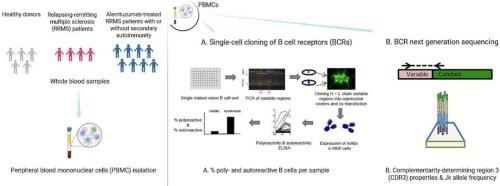
Transient CD52 immune cell depletion with the monoclonal antibody alemtuzumab is highly effective in treating relapsing-remitting multiple sclerosis but often leads to secondary autoimmunity. Whether these effects are linked to an alteration of B cell tolerance mechanisms is currently not known. To evaluate peripheral B cell tolerance checkpoint integrity in patients and controls, we constructed 138 recombinant mAbs from single mature naïve B cells and tested their poly- and autoreactivity. We examined three healthy donors (HDs), three immunotherapy-naïve MS patients, and six patients treated with alemtuzumab at comparable time points post-treatment (mean ± SD 3.8 ± 0.39 years). Moreover, we investigated B cell receptor (BCR) repertoire parameters associated with tolerance mechanisms in the same subject groups. Polyreactive and autoreactive fraction means did not differ significantly among the three subgroups. Presence of a high or low autoreactive fraction of naïve B cells in patients treated with alemtuzumab did not correlate with secondary autoimmunity at the time of sampling and with future MS activity, and therefore most likely reflects stochastic variation in the context of immune reconstitution. In BCR repertoire analysis, alemtuzumab-treated patients showed lower mean naïve complementarity-determining region 3 (CDR3) net charge compared to HDs (P = 0.0036), an interesting yet isolated finding warranting further investigation. Overall, transient CD52 depletion did not seem to affect major changes in peripheral B cell tolerance checkpoint function as assessed with naïve B cell cloning and BCR NGS, while observations in the described setting may also apply to other immune reconstitution therapies.
期刊介绍:
The Journal of Neuroimmunology affords a forum for the publication of works applying immunologic methodology to the furtherance of the neurological sciences. Studies on all branches of the neurosciences, particularly fundamental and applied neurobiology, neurology, neuropathology, neurochemistry, neurovirology, neuroendocrinology, neuromuscular research, neuropharmacology and psychology, which involve either immunologic methodology (e.g. immunocytochemistry) or fundamental immunology (e.g. antibody and lymphocyte assays), are considered for publication.