Patrick Goodley PhD , Haval Balata PhD , Alberto Alonso LMS , Anna Sharman MBChB , Louise Brown MD , Rehan Naseer MBChB , Haider Al-Najjar MBChB , Zoe Merchant MSc , Kath Hewitt RN , Coral Higgins MSc , Richard Booton PhD , Hilary A. Robbins PhD , Matthew Sperrin PhD , Philip A.J. Crosbie PhD
{"title":"基于风险的肺癌筛查对大曼彻斯特地区晚期发病率的人群影响","authors":"Patrick Goodley PhD , Haval Balata PhD , Alberto Alonso LMS , Anna Sharman MBChB , Louise Brown MD , Rehan Naseer MBChB , Haider Al-Najjar MBChB , Zoe Merchant MSc , Kath Hewitt RN , Coral Higgins MSc , Richard Booton PhD , Hilary A. Robbins PhD , Matthew Sperrin PhD , Philip A.J. Crosbie PhD","doi":"10.1016/j.jtho.2025.11.014","DOIUrl":null,"url":null,"abstract":"<div><h3>Introduction</h3><div>Low-dose computed tomography screening reduces lung cancer mortality in clinical trials, but evidence of impact in real-world programs is lacking. Here, we evaluate the impact of screening in a socio-economically deprived area at the population level. We hypothesized that late-stage lung cancer incidence, as a surrogate for lung cancer mortality, would decrease after systematic implementation of screening in a high-risk population.</div></div><div><h3>Methods</h3><div>Late-stage lung cancer incidence among individuals aged 55 to 80 years at the time of screening invitation was compared before and after screening implementation between regions with and without implementation of community-based lung cancer screening (North & East Manchester [screening] versus four neighboring regions [no screening]). The effect of screening was estimated using difference-in-difference modeling.</div></div><div><h3>Results</h3><div>Late-stage lung cancer incidence decreased more steeply in the screening region, such that screening was associated with a 22% reduction in late-stage lung cancer incidence among the invited age range of 55 to 80 years (adjusted incidence rate ratio, 0.78; 95% confidence interval, 0.62–0.99; <em>p</em> = 0.037). Targeted low-dose computed tomography screening of 2.0% of the full North & East Manchester population (n = 4468/221,240) detected 31% of all lung cancers diagnosed since screening commenced (n = 221/722), yielding a number-needed-to-screen of 20 for each cancer detected.</div></div><div><h3>Conclusion</h3><div>Implementation of targeted, community-based lung cancer screening in an area of high socioeconomic deprivation was associated with a significant reduction in late-stage lung cancer incidence. This provides a demonstration of screening effectiveness and public health benefit.</div></div>","PeriodicalId":17515,"journal":{"name":"Journal of Thoracic Oncology","volume":"21 4","pages":"Article 103524"},"PeriodicalIF":20.8000,"publicationDate":"2026-04-01","publicationTypes":"Journal Article","fieldsOfStudy":null,"isOpenAccess":false,"openAccessPdf":"","citationCount":"0","resultStr":"{\"title\":\"Population Impact of Risk-Based Lung Cancer Screening on Late-Stage Incidence in Greater Manchester\",\"authors\":\"Patrick Goodley PhD , Haval Balata PhD , Alberto Alonso LMS , Anna Sharman MBChB , Louise Brown MD , Rehan Naseer MBChB , Haider Al-Najjar MBChB , Zoe Merchant MSc , Kath Hewitt RN , Coral Higgins MSc , Richard Booton PhD , Hilary A. Robbins PhD , Matthew Sperrin PhD , Philip A.J. Crosbie PhD\",\"doi\":\"10.1016/j.jtho.2025.11.014\",\"DOIUrl\":null,\"url\":null,\"abstract\":\"<div><h3>Introduction</h3><div>Low-dose computed tomography screening reduces lung cancer mortality in clinical trials, but evidence of impact in real-world programs is lacking. Here, we evaluate the impact of screening in a socio-economically deprived area at the population level. We hypothesized that late-stage lung cancer incidence, as a surrogate for lung cancer mortality, would decrease after systematic implementation of screening in a high-risk population.</div></div><div><h3>Methods</h3><div>Late-stage lung cancer incidence among individuals aged 55 to 80 years at the time of screening invitation was compared before and after screening implementation between regions with and without implementation of community-based lung cancer screening (North & East Manchester [screening] versus four neighboring regions [no screening]). The effect of screening was estimated using difference-in-difference modeling.</div></div><div><h3>Results</h3><div>Late-stage lung cancer incidence decreased more steeply in the screening region, such that screening was associated with a 22% reduction in late-stage lung cancer incidence among the invited age range of 55 to 80 years (adjusted incidence rate ratio, 0.78; 95% confidence interval, 0.62–0.99; <em>p</em> = 0.037). Targeted low-dose computed tomography screening of 2.0% of the full North & East Manchester population (n = 4468/221,240) detected 31% of all lung cancers diagnosed since screening commenced (n = 221/722), yielding a number-needed-to-screen of 20 for each cancer detected.</div></div><div><h3>Conclusion</h3><div>Implementation of targeted, community-based lung cancer screening in an area of high socioeconomic deprivation was associated with a significant reduction in late-stage lung cancer incidence. This provides a demonstration of screening effectiveness and public health benefit.</div></div>\",\"PeriodicalId\":17515,\"journal\":{\"name\":\"Journal of Thoracic Oncology\",\"volume\":\"21 4\",\"pages\":\"Article 103524\"},\"PeriodicalIF\":20.8000,\"publicationDate\":\"2026-04-01\",\"publicationTypes\":\"Journal Article\",\"fieldsOfStudy\":null,\"isOpenAccess\":false,\"openAccessPdf\":\"\",\"citationCount\":\"0\",\"resultStr\":null,\"platform\":\"Semanticscholar\",\"paperid\":null,\"PeriodicalName\":\"Journal of Thoracic Oncology\",\"FirstCategoryId\":\"3\",\"ListUrlMain\":\"https://www.sciencedirect.com/science/article/pii/S1556086425029089\",\"RegionNum\":1,\"RegionCategory\":\"医学\",\"ArticlePicture\":[],\"TitleCN\":null,\"AbstractTextCN\":null,\"PMCID\":null,\"EPubDate\":\"2025/12/2 0:00:00\",\"PubModel\":\"Epub\",\"JCR\":\"Q1\",\"JCRName\":\"ONCOLOGY\",\"Score\":null,\"Total\":0}","platform":"Semanticscholar","paperid":null,"PeriodicalName":"Journal of Thoracic Oncology","FirstCategoryId":"3","ListUrlMain":"https://www.sciencedirect.com/science/article/pii/S1556086425029089","RegionNum":1,"RegionCategory":"医学","ArticlePicture":[],"TitleCN":null,"AbstractTextCN":null,"PMCID":null,"EPubDate":"2025/12/2 0:00:00","PubModel":"Epub","JCR":"Q1","JCRName":"ONCOLOGY","Score":null,"Total":0}
引用次数: 0
摘要
背景:低剂量CT (LDCT)筛查在临床试验中可降低肺癌死亡率,但在实际项目中缺乏影响的证据。在这里,我们在人口水平上检查筛查在社会经济贫困地区的影响。我们假设,在高危人群中系统实施筛查后,晚期肺癌发病率(作为肺癌死亡率的替代指标)将会下降。方法:在邀请筛查时55-80岁的个体中,比较筛查实施前后有和没有实施社区肺癌筛查的地区之间的晚期肺癌发病率(曼彻斯特北部和东部[筛查]与4个邻近地区[未筛查])。使用差中差模型估计筛选的效果。结果:筛查区域的晚期肺癌发病率下降更明显,筛查与55-80年龄段晚期肺癌发病率降低22%相关(校正发病率比,IRRadj 0.78, 95% CI 0.62-0.99, p=0.037)。有针对性的LDCT筛查占整个北曼彻斯特和东曼彻斯特人口的2.0% (n=4,468/221,240),检测出自筛查开始以来诊断出的所有肺癌的31% (n=221/722),每检测到一种癌症需要筛查的数量为20。结论:在高度社会经济剥夺的地区实施有针对性的、基于社区的肺癌筛查与晚期肺癌发病率的显著降低有关。这证明了筛查的有效性和对公众健康的益处。
Population Impact of Risk-Based Lung Cancer Screening on Late-Stage Incidence in Greater Manchester
Introduction
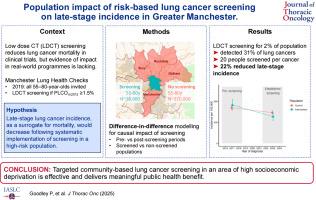
Low-dose computed tomography screening reduces lung cancer mortality in clinical trials, but evidence of impact in real-world programs is lacking. Here, we evaluate the impact of screening in a socio-economically deprived area at the population level. We hypothesized that late-stage lung cancer incidence, as a surrogate for lung cancer mortality, would decrease after systematic implementation of screening in a high-risk population.
Methods
Late-stage lung cancer incidence among individuals aged 55 to 80 years at the time of screening invitation was compared before and after screening implementation between regions with and without implementation of community-based lung cancer screening (North & East Manchester [screening] versus four neighboring regions [no screening]). The effect of screening was estimated using difference-in-difference modeling.
Results
Late-stage lung cancer incidence decreased more steeply in the screening region, such that screening was associated with a 22% reduction in late-stage lung cancer incidence among the invited age range of 55 to 80 years (adjusted incidence rate ratio, 0.78; 95% confidence interval, 0.62–0.99; p = 0.037). Targeted low-dose computed tomography screening of 2.0% of the full North & East Manchester population (n = 4468/221,240) detected 31% of all lung cancers diagnosed since screening commenced (n = 221/722), yielding a number-needed-to-screen of 20 for each cancer detected.
Conclusion
Implementation of targeted, community-based lung cancer screening in an area of high socioeconomic deprivation was associated with a significant reduction in late-stage lung cancer incidence. This provides a demonstration of screening effectiveness and public health benefit.
期刊介绍:
Journal of Thoracic Oncology (JTO), the official journal of the International Association for the Study of Lung Cancer,is the primary educational and informational publication for topics relevant to the prevention, detection, diagnosis, and treatment of all thoracic malignancies.The readship includes epidemiologists, medical oncologists, radiation oncologists, thoracic surgeons, pulmonologists, radiologists, pathologists, nuclear medicine physicians, and research scientists with a special interest in thoracic oncology.