{"title":"诊断延迟和反应及时性对乌干达埃博拉病爆发水平病死率的影响(2000-2023):快速系统评价和荟萃分析","authors":"George Paasi, Sam Okware, Peter Olupot-Olupot","doi":"10.1007/s44197-025-00471-1","DOIUrl":null,"url":null,"abstract":"<p><strong>Background: </strong>Uganda has experienced seven laboratory-confirmed Ebola virus disease (EBOD) outbreaks from 2000 to 2022, with reported case-fatality ratios (CFRs) varying widely. The influence of diagnostic and response delays on outbreak-level mortality has not been systematically assessed. We conducted a rapid systematic review and meta-analysis to quantify the effect of diagnostic and response delays on outbreak-level mortality.</p><p><strong>Methods: </strong>We registered the review on OSF and adhered to PRISMA-2020 guidelines. We searched PubMed, Embase, Scopus, Web of Science, WHO Global Index Medicus, and grey literature through 30 April 2025. Eligible reports described laboratory-confirmed human EBOD in Uganda (2000-2022) and reported case counts, deaths, or quantitative timeliness metrics. Outbreak-level CFRs were meta-analyzed using random-effects models with Freeman-Tukey transformation (metafor package in R). Mixed-effects meta-regression assessed the association between continuous delay metrics and transformed CFR.</p><p><strong>Results: </strong>Fifteen reports met inclusion criteria, spanning 741 confirmed cases and 358 deaths. The pooled CFR was 45.4% (95% CI: 26.2%-65.2%; I² = 87.8%) across seven outbreaks. By species, Sudan ebolavirus outbreaks (n = 5) had a CFR of 44.6% (95% CI: 33.7%-55.6%), Bundibugyo ebolavirus (n = 1) 24.8% (95% CI: 18.2%-32.1%), and Zaire ebolavirus (n = 1) 100% (95% CI: 61.2%-100.0%). In meta-regression, each additional day from first case report to specimen collection was associated with a significant increase in CFR (β = 0.142 on the transformed scale; p = 0.025; R² = 62%), translating to an approximate absolute increase of 3.8% points in CFR per day at a baseline risk of 45%. Conversely, longer delays from symptom onset in the index case to national outbreak declaration were linked to a slight decrease in CFR (β = - 0.00765; p = 0.047).</p><p><strong>Conclusions: </strong>Uganda's EBOD outbreaks exhibit high and variable mortality, with diagnostic delays substantially amplifying case-fatality. Rapid specimen collection and prompt public health responses are critical to reducing EBOD mortality. Strengthening laboratory networks and accelerating declaration protocols should be central to future outbreak preparedness in Uganda and similar contexts.</p>","PeriodicalId":15796,"journal":{"name":"Journal of Epidemiology and Global Health","volume":"15 1","pages":"130"},"PeriodicalIF":3.1000,"publicationDate":"2025-11-11","publicationTypes":"Journal Article","fieldsOfStudy":null,"isOpenAccess":false,"openAccessPdf":"https://www.ncbi.nlm.nih.gov/pmc/articles/PMC12605935/pdf/","citationCount":"0","resultStr":"{\"title\":\"The Impact of Diagnostic Delays and Timeliness of Response on Ebola Disease outbreak-level case-fatality Ratios in Uganda (2000-2023): a Rapid Systematic Review and meta-analysis.\",\"authors\":\"George Paasi, Sam Okware, Peter Olupot-Olupot\",\"doi\":\"10.1007/s44197-025-00471-1\",\"DOIUrl\":null,\"url\":null,\"abstract\":\"<p><strong>Background: </strong>Uganda has experienced seven laboratory-confirmed Ebola virus disease (EBOD) outbreaks from 2000 to 2022, with reported case-fatality ratios (CFRs) varying widely. The influence of diagnostic and response delays on outbreak-level mortality has not been systematically assessed. We conducted a rapid systematic review and meta-analysis to quantify the effect of diagnostic and response delays on outbreak-level mortality.</p><p><strong>Methods: </strong>We registered the review on OSF and adhered to PRISMA-2020 guidelines. We searched PubMed, Embase, Scopus, Web of Science, WHO Global Index Medicus, and grey literature through 30 April 2025. Eligible reports described laboratory-confirmed human EBOD in Uganda (2000-2022) and reported case counts, deaths, or quantitative timeliness metrics. Outbreak-level CFRs were meta-analyzed using random-effects models with Freeman-Tukey transformation (metafor package in R). Mixed-effects meta-regression assessed the association between continuous delay metrics and transformed CFR.</p><p><strong>Results: </strong>Fifteen reports met inclusion criteria, spanning 741 confirmed cases and 358 deaths. The pooled CFR was 45.4% (95% CI: 26.2%-65.2%; I² = 87.8%) across seven outbreaks. By species, Sudan ebolavirus outbreaks (n = 5) had a CFR of 44.6% (95% CI: 33.7%-55.6%), Bundibugyo ebolavirus (n = 1) 24.8% (95% CI: 18.2%-32.1%), and Zaire ebolavirus (n = 1) 100% (95% CI: 61.2%-100.0%). In meta-regression, each additional day from first case report to specimen collection was associated with a significant increase in CFR (β = 0.142 on the transformed scale; p = 0.025; R² = 62%), translating to an approximate absolute increase of 3.8% points in CFR per day at a baseline risk of 45%. Conversely, longer delays from symptom onset in the index case to national outbreak declaration were linked to a slight decrease in CFR (β = - 0.00765; p = 0.047).</p><p><strong>Conclusions: </strong>Uganda's EBOD outbreaks exhibit high and variable mortality, with diagnostic delays substantially amplifying case-fatality. Rapid specimen collection and prompt public health responses are critical to reducing EBOD mortality. Strengthening laboratory networks and accelerating declaration protocols should be central to future outbreak preparedness in Uganda and similar contexts.</p>\",\"PeriodicalId\":15796,\"journal\":{\"name\":\"Journal of Epidemiology and Global Health\",\"volume\":\"15 1\",\"pages\":\"130\"},\"PeriodicalIF\":3.1000,\"publicationDate\":\"2025-11-11\",\"publicationTypes\":\"Journal Article\",\"fieldsOfStudy\":null,\"isOpenAccess\":false,\"openAccessPdf\":\"https://www.ncbi.nlm.nih.gov/pmc/articles/PMC12605935/pdf/\",\"citationCount\":\"0\",\"resultStr\":null,\"platform\":\"Semanticscholar\",\"paperid\":null,\"PeriodicalName\":\"Journal of Epidemiology and Global Health\",\"FirstCategoryId\":\"3\",\"ListUrlMain\":\"https://doi.org/10.1007/s44197-025-00471-1\",\"RegionNum\":4,\"RegionCategory\":\"医学\",\"ArticlePicture\":[],\"TitleCN\":null,\"AbstractTextCN\":null,\"PMCID\":null,\"EPubDate\":\"\",\"PubModel\":\"\",\"JCR\":\"Q1\",\"JCRName\":\"PUBLIC, ENVIRONMENTAL & OCCUPATIONAL HEALTH\",\"Score\":null,\"Total\":0}","platform":"Semanticscholar","paperid":null,"PeriodicalName":"Journal of Epidemiology and Global Health","FirstCategoryId":"3","ListUrlMain":"https://doi.org/10.1007/s44197-025-00471-1","RegionNum":4,"RegionCategory":"医学","ArticlePicture":[],"TitleCN":null,"AbstractTextCN":null,"PMCID":null,"EPubDate":"","PubModel":"","JCR":"Q1","JCRName":"PUBLIC, ENVIRONMENTAL & OCCUPATIONAL HEALTH","Score":null,"Total":0}
引用次数: 0
摘要
背景:从2000年到2022年,乌干达经历了7次实验室确认的埃博拉病毒病暴发,报告的病死率(CFRs)差异很大。诊断和反应延迟对暴发水平死亡率的影响尚未得到系统评估。我们进行了一项快速系统回顾和荟萃分析,以量化诊断和反应延迟对爆发级死亡率的影响。方法:我们注册了OSF审查并遵守PRISMA-2020指南。我们检索了PubMed、Embase、Scopus、Web of Science、WHO Global Index Medicus和2025年4月30日之前的灰色文献。合格的报告描述了乌干达(2000-2022年)实验室确认的人EBOD以及报告的病例数、死亡人数或定量及时性指标。使用带有Freeman-Tukey转换的随机效应模型(R中的元包)对爆发级CFRs进行meta分析。混合效应元回归评估了连续延迟指标与转换后的CFR之间的关系。结果:15份报告符合纳入标准,涵盖741例确诊病例和358例死亡。在7次暴发中,合并CFR为45.4% (95% CI: 26.2%-65.2%; I²= 87.8%)。按物种划分,苏丹埃博拉病毒暴发(n = 5)的CFR为44.6% (95% CI: 33.7%-55.6%),本迪布乔埃博拉病毒暴发(n = 1)的CFR为24.8% (95% CI: 18.2%-32.1%),扎伊尔埃博拉病毒暴发(n = 1)的CFR为100% (95% CI: 61.2%-100.0%)。在meta回归中,从第一例病例报告到标本采集每增加一天,CFR显著增加(在转换量表上β = 0.142; p = 0.025; R²= 62%),在基线风险为45%的情况下,CFR每天大约绝对增加3.8%。相反,从指示病例出现症状到国家宣布疫情的较长延迟与CFR略有下降有关(β = - 0.00765; p = 0.047)。结论:乌干达的EBOD暴发表现出高且多变的死亡率,诊断延误大大增加了病死率。快速标本采集和迅速的公共卫生反应对于降低EBOD死亡率至关重要。加强实验室网络和加快宣布协议应该是乌干达和类似情况下未来疫情准备工作的核心。
The Impact of Diagnostic Delays and Timeliness of Response on Ebola Disease outbreak-level case-fatality Ratios in Uganda (2000-2023): a Rapid Systematic Review and meta-analysis.
Background: Uganda has experienced seven laboratory-confirmed Ebola virus disease (EBOD) outbreaks from 2000 to 2022, with reported case-fatality ratios (CFRs) varying widely. The influence of diagnostic and response delays on outbreak-level mortality has not been systematically assessed. We conducted a rapid systematic review and meta-analysis to quantify the effect of diagnostic and response delays on outbreak-level mortality.
Methods: We registered the review on OSF and adhered to PRISMA-2020 guidelines. We searched PubMed, Embase, Scopus, Web of Science, WHO Global Index Medicus, and grey literature through 30 April 2025. Eligible reports described laboratory-confirmed human EBOD in Uganda (2000-2022) and reported case counts, deaths, or quantitative timeliness metrics. Outbreak-level CFRs were meta-analyzed using random-effects models with Freeman-Tukey transformation (metafor package in R). Mixed-effects meta-regression assessed the association between continuous delay metrics and transformed CFR.
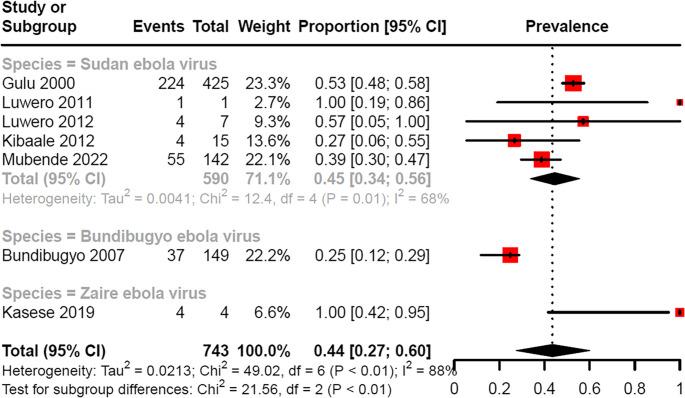
Results: Fifteen reports met inclusion criteria, spanning 741 confirmed cases and 358 deaths. The pooled CFR was 45.4% (95% CI: 26.2%-65.2%; I² = 87.8%) across seven outbreaks. By species, Sudan ebolavirus outbreaks (n = 5) had a CFR of 44.6% (95% CI: 33.7%-55.6%), Bundibugyo ebolavirus (n = 1) 24.8% (95% CI: 18.2%-32.1%), and Zaire ebolavirus (n = 1) 100% (95% CI: 61.2%-100.0%). In meta-regression, each additional day from first case report to specimen collection was associated with a significant increase in CFR (β = 0.142 on the transformed scale; p = 0.025; R² = 62%), translating to an approximate absolute increase of 3.8% points in CFR per day at a baseline risk of 45%. Conversely, longer delays from symptom onset in the index case to national outbreak declaration were linked to a slight decrease in CFR (β = - 0.00765; p = 0.047).
Conclusions: Uganda's EBOD outbreaks exhibit high and variable mortality, with diagnostic delays substantially amplifying case-fatality. Rapid specimen collection and prompt public health responses are critical to reducing EBOD mortality. Strengthening laboratory networks and accelerating declaration protocols should be central to future outbreak preparedness in Uganda and similar contexts.
期刊介绍:
The Journal of Epidemiology and Global Health is an esteemed international publication, offering a platform for peer-reviewed articles that drive advancements in global epidemiology and international health. Our mission is to shape global health policy by showcasing cutting-edge scholarship and innovative strategies.



 求助内容:
求助内容: 应助结果提醒方式:

 京公网安备 11010802042870号


