Seth W. McPherson , Yeh-Chuan Chou , Insoo Shin , Stephen A. Maclean , Dmytro Nykypanchuk , Tai-de Li , Chieh-Ting Lin , Jaemin Kong , Jason A. Röhr , André D. Taylor
{"title":"La(TFSI)3配位掺杂MEH-PPV使钙钛矿太阳能电池具有无空气导电性和稳定的性能","authors":"Seth W. McPherson , Yeh-Chuan Chou , Insoo Shin , Stephen A. Maclean , Dmytro Nykypanchuk , Tai-de Li , Chieh-Ting Lin , Jaemin Kong , Jason A. Röhr , André D. Taylor","doi":"10.1016/j.orgel.2025.107351","DOIUrl":null,"url":null,"abstract":"<div><div>Achieving high electrical conductivity in conjugated polymers without negatively impacting morphology and stability remains a central challenge in the development of organic optoelectronic devices. Here, we demonstrate that doping MEH-PPV with lanthanum bistriflimide [La(TFSI)<sub>3</sub>] results in a conductivity enhancement exceeding six orders of magnitude under fully inert conditions. Unlike monovalent dopants such as LiTFSI, which require environmental activation and lead to morphological defects, La(TFSI)<sub>3</sub> enables oxygen-independent conductivity by forming multidentate coordination complexes with polymer sidechains. Spectroscopic analyses (FTIR, Raman, PL) indicate that La<sup>3+</sup> induces crosslinking and suppresses emissive disorder, promoting interchain charge hopping even without generating polarons. Morphological studies show that La<sup>3+</sup> doping eliminates pinholes and produces structurally cohesive films, in contrast to the inhomogeneous and unstable films produced with LiTFSI. When used as a hole transport layer in perovskite solar cells, La(TFSI)<sub>3</sub> doped MEH-PPV increases the power conversion efficiency from 13.05 % to 18.50 % and enables devices that retain 100 % of their efficiency after 1000 h of inert storage. These results highlight a coordination-driven, air-free doping strategy for enabling durable, high-performance organic electronics.</div></div>","PeriodicalId":399,"journal":{"name":"Organic Electronics","volume":"148 ","pages":"Article 107351"},"PeriodicalIF":2.6000,"publicationDate":"2026-01-01","publicationTypes":"Journal Article","fieldsOfStudy":null,"isOpenAccess":false,"openAccessPdf":"","citationCount":"0","resultStr":"{\"title\":\"Coordination-based doping of MEH-PPV with La(TFSI)3 enables air-free conductivity and stable performance in perovskite solar cells\",\"authors\":\"Seth W. McPherson , Yeh-Chuan Chou , Insoo Shin , Stephen A. Maclean , Dmytro Nykypanchuk , Tai-de Li , Chieh-Ting Lin , Jaemin Kong , Jason A. Röhr , André D. Taylor\",\"doi\":\"10.1016/j.orgel.2025.107351\",\"DOIUrl\":null,\"url\":null,\"abstract\":\"<div><div>Achieving high electrical conductivity in conjugated polymers without negatively impacting morphology and stability remains a central challenge in the development of organic optoelectronic devices. Here, we demonstrate that doping MEH-PPV with lanthanum bistriflimide [La(TFSI)<sub>3</sub>] results in a conductivity enhancement exceeding six orders of magnitude under fully inert conditions. Unlike monovalent dopants such as LiTFSI, which require environmental activation and lead to morphological defects, La(TFSI)<sub>3</sub> enables oxygen-independent conductivity by forming multidentate coordination complexes with polymer sidechains. Spectroscopic analyses (FTIR, Raman, PL) indicate that La<sup>3+</sup> induces crosslinking and suppresses emissive disorder, promoting interchain charge hopping even without generating polarons. Morphological studies show that La<sup>3+</sup> doping eliminates pinholes and produces structurally cohesive films, in contrast to the inhomogeneous and unstable films produced with LiTFSI. When used as a hole transport layer in perovskite solar cells, La(TFSI)<sub>3</sub> doped MEH-PPV increases the power conversion efficiency from 13.05 % to 18.50 % and enables devices that retain 100 % of their efficiency after 1000 h of inert storage. These results highlight a coordination-driven, air-free doping strategy for enabling durable, high-performance organic electronics.</div></div>\",\"PeriodicalId\":399,\"journal\":{\"name\":\"Organic Electronics\",\"volume\":\"148 \",\"pages\":\"Article 107351\"},\"PeriodicalIF\":2.6000,\"publicationDate\":\"2026-01-01\",\"publicationTypes\":\"Journal Article\",\"fieldsOfStudy\":null,\"isOpenAccess\":false,\"openAccessPdf\":\"\",\"citationCount\":\"0\",\"resultStr\":null,\"platform\":\"Semanticscholar\",\"paperid\":null,\"PeriodicalName\":\"Organic Electronics\",\"FirstCategoryId\":\"5\",\"ListUrlMain\":\"https://www.sciencedirect.com/science/article/pii/S1566119925001570\",\"RegionNum\":4,\"RegionCategory\":\"工程技术\",\"ArticlePicture\":[],\"TitleCN\":null,\"AbstractTextCN\":null,\"PMCID\":null,\"EPubDate\":\"2025/10/21 0:00:00\",\"PubModel\":\"Epub\",\"JCR\":\"Q3\",\"JCRName\":\"MATERIALS SCIENCE, MULTIDISCIPLINARY\",\"Score\":null,\"Total\":0}","platform":"Semanticscholar","paperid":null,"PeriodicalName":"Organic Electronics","FirstCategoryId":"5","ListUrlMain":"https://www.sciencedirect.com/science/article/pii/S1566119925001570","RegionNum":4,"RegionCategory":"工程技术","ArticlePicture":[],"TitleCN":null,"AbstractTextCN":null,"PMCID":null,"EPubDate":"2025/10/21 0:00:00","PubModel":"Epub","JCR":"Q3","JCRName":"MATERIALS SCIENCE, MULTIDISCIPLINARY","Score":null,"Total":0}
Coordination-based doping of MEH-PPV with La(TFSI)3 enables air-free conductivity and stable performance in perovskite solar cells
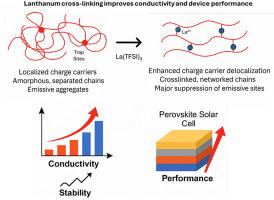
Achieving high electrical conductivity in conjugated polymers without negatively impacting morphology and stability remains a central challenge in the development of organic optoelectronic devices. Here, we demonstrate that doping MEH-PPV with lanthanum bistriflimide [La(TFSI)3] results in a conductivity enhancement exceeding six orders of magnitude under fully inert conditions. Unlike monovalent dopants such as LiTFSI, which require environmental activation and lead to morphological defects, La(TFSI)3 enables oxygen-independent conductivity by forming multidentate coordination complexes with polymer sidechains. Spectroscopic analyses (FTIR, Raman, PL) indicate that La3+ induces crosslinking and suppresses emissive disorder, promoting interchain charge hopping even without generating polarons. Morphological studies show that La3+ doping eliminates pinholes and produces structurally cohesive films, in contrast to the inhomogeneous and unstable films produced with LiTFSI. When used as a hole transport layer in perovskite solar cells, La(TFSI)3 doped MEH-PPV increases the power conversion efficiency from 13.05 % to 18.50 % and enables devices that retain 100 % of their efficiency after 1000 h of inert storage. These results highlight a coordination-driven, air-free doping strategy for enabling durable, high-performance organic electronics.
期刊介绍:
Organic Electronics is a journal whose primary interdisciplinary focus is on materials and phenomena related to organic devices such as light emitting diodes, thin film transistors, photovoltaic cells, sensors, memories, etc.
Papers suitable for publication in this journal cover such topics as photoconductive and electronic properties of organic materials, thin film structures and characterization in the context of organic devices, charge and exciton transport, organic electronic and optoelectronic devices.