{"title":"维生素D与骨骼健康:从生理功能到疾病关联。","authors":"Yu Liu, Wei Wang, Yusheng Yang, Jiezhong Deng, Zehua Zhang","doi":"10.1186/s12986-025-01011-1","DOIUrl":null,"url":null,"abstract":"<p><p>Vitamin D (VD) is a pleiotropic secosteroid hormone with well-established roles in calcium homeostasis, bone metabolism, and emerging functions in immune regulation, inflammation, and chronic disease modulation. In this paper, we provide a comprehensive summary of the current research on the significance of VD for bone health, with emphasis on its mechanism of action and its clinical significance in bone health. This review starts with an overview of VD metabolism, with emphasis on the enzyme transformation of vitamin D3 (VD3) and vitamin D2 (VD2) into the active 1,25-dihydroxyvitamin D (1α,25(OH)<sub>2</sub>D) and their genomic and non-genomic signaling pathways through the Vitamin D receptor (VDR). Then, we discuss how VDR polymorphisms affect disease susceptibility and the dual role of VD in promoting innate immunity as well as inhibiting over-adaptive immunity. Our main focus is placed on VD's involvement in bone destruction diseases, including osteoarthritis (OA), osteoporosis (OP), rheumatoid arthritis (RA), and bone tuberculosis. For OA, there is conflicting evidence on whether VD supplementation reduces cartilage degradation or pain. In OP, vitamin D deficiency aggravates bone loss, but the effectiveness of supplementation is dependent on baseline and calcium supplementation. For RA, the immunomodulatory effects of VD may decrease the activity of the disease, whereas in tuberculosis, VD increases the clearance of macrophage-mediated mycobacterial clearance, although the clinical study data are still inconclusive. This review underscores VD as a critical mediator of bone-immune crosstalk while calling for rigorous translational research to clarify its therapeutic potential across diverse diseases.</p>","PeriodicalId":19196,"journal":{"name":"Nutrition & Metabolism","volume":"22 1","pages":"113"},"PeriodicalIF":4.1000,"publicationDate":"2025-10-02","publicationTypes":"Journal Article","fieldsOfStudy":null,"isOpenAccess":false,"openAccessPdf":"https://www.ncbi.nlm.nih.gov/pmc/articles/PMC12490156/pdf/","citationCount":"0","resultStr":"{\"title\":\"Vitamin D and bone health: from physiological function to disease association.\",\"authors\":\"Yu Liu, Wei Wang, Yusheng Yang, Jiezhong Deng, Zehua Zhang\",\"doi\":\"10.1186/s12986-025-01011-1\",\"DOIUrl\":null,\"url\":null,\"abstract\":\"<p><p>Vitamin D (VD) is a pleiotropic secosteroid hormone with well-established roles in calcium homeostasis, bone metabolism, and emerging functions in immune regulation, inflammation, and chronic disease modulation. In this paper, we provide a comprehensive summary of the current research on the significance of VD for bone health, with emphasis on its mechanism of action and its clinical significance in bone health. This review starts with an overview of VD metabolism, with emphasis on the enzyme transformation of vitamin D3 (VD3) and vitamin D2 (VD2) into the active 1,25-dihydroxyvitamin D (1α,25(OH)<sub>2</sub>D) and their genomic and non-genomic signaling pathways through the Vitamin D receptor (VDR). Then, we discuss how VDR polymorphisms affect disease susceptibility and the dual role of VD in promoting innate immunity as well as inhibiting over-adaptive immunity. Our main focus is placed on VD's involvement in bone destruction diseases, including osteoarthritis (OA), osteoporosis (OP), rheumatoid arthritis (RA), and bone tuberculosis. For OA, there is conflicting evidence on whether VD supplementation reduces cartilage degradation or pain. In OP, vitamin D deficiency aggravates bone loss, but the effectiveness of supplementation is dependent on baseline and calcium supplementation. For RA, the immunomodulatory effects of VD may decrease the activity of the disease, whereas in tuberculosis, VD increases the clearance of macrophage-mediated mycobacterial clearance, although the clinical study data are still inconclusive. This review underscores VD as a critical mediator of bone-immune crosstalk while calling for rigorous translational research to clarify its therapeutic potential across diverse diseases.</p>\",\"PeriodicalId\":19196,\"journal\":{\"name\":\"Nutrition & Metabolism\",\"volume\":\"22 1\",\"pages\":\"113\"},\"PeriodicalIF\":4.1000,\"publicationDate\":\"2025-10-02\",\"publicationTypes\":\"Journal Article\",\"fieldsOfStudy\":null,\"isOpenAccess\":false,\"openAccessPdf\":\"https://www.ncbi.nlm.nih.gov/pmc/articles/PMC12490156/pdf/\",\"citationCount\":\"0\",\"resultStr\":null,\"platform\":\"Semanticscholar\",\"paperid\":null,\"PeriodicalName\":\"Nutrition & Metabolism\",\"FirstCategoryId\":\"3\",\"ListUrlMain\":\"https://doi.org/10.1186/s12986-025-01011-1\",\"RegionNum\":2,\"RegionCategory\":\"医学\",\"ArticlePicture\":[],\"TitleCN\":null,\"AbstractTextCN\":null,\"PMCID\":null,\"EPubDate\":\"\",\"PubModel\":\"\",\"JCR\":\"Q2\",\"JCRName\":\"NUTRITION & DIETETICS\",\"Score\":null,\"Total\":0}","platform":"Semanticscholar","paperid":null,"PeriodicalName":"Nutrition & Metabolism","FirstCategoryId":"3","ListUrlMain":"https://doi.org/10.1186/s12986-025-01011-1","RegionNum":2,"RegionCategory":"医学","ArticlePicture":[],"TitleCN":null,"AbstractTextCN":null,"PMCID":null,"EPubDate":"","PubModel":"","JCR":"Q2","JCRName":"NUTRITION & DIETETICS","Score":null,"Total":0}
Vitamin D and bone health: from physiological function to disease association.
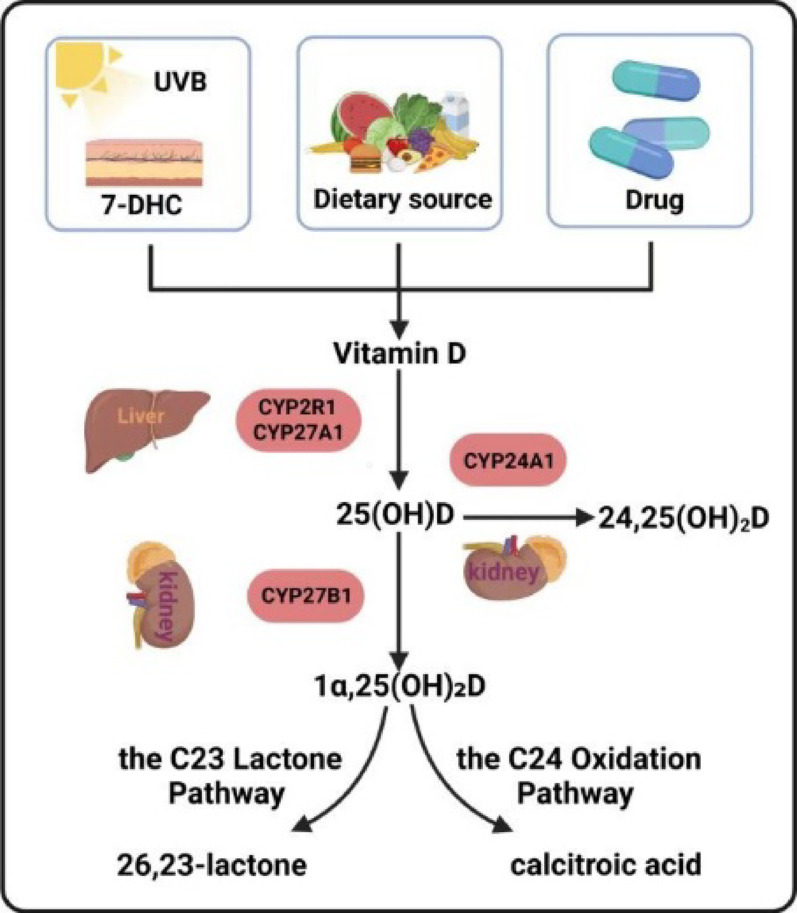
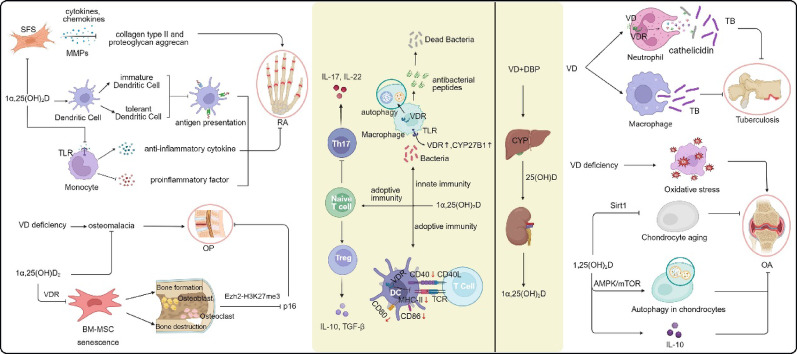
Vitamin D (VD) is a pleiotropic secosteroid hormone with well-established roles in calcium homeostasis, bone metabolism, and emerging functions in immune regulation, inflammation, and chronic disease modulation. In this paper, we provide a comprehensive summary of the current research on the significance of VD for bone health, with emphasis on its mechanism of action and its clinical significance in bone health. This review starts with an overview of VD metabolism, with emphasis on the enzyme transformation of vitamin D3 (VD3) and vitamin D2 (VD2) into the active 1,25-dihydroxyvitamin D (1α,25(OH)2D) and their genomic and non-genomic signaling pathways through the Vitamin D receptor (VDR). Then, we discuss how VDR polymorphisms affect disease susceptibility and the dual role of VD in promoting innate immunity as well as inhibiting over-adaptive immunity. Our main focus is placed on VD's involvement in bone destruction diseases, including osteoarthritis (OA), osteoporosis (OP), rheumatoid arthritis (RA), and bone tuberculosis. For OA, there is conflicting evidence on whether VD supplementation reduces cartilage degradation or pain. In OP, vitamin D deficiency aggravates bone loss, but the effectiveness of supplementation is dependent on baseline and calcium supplementation. For RA, the immunomodulatory effects of VD may decrease the activity of the disease, whereas in tuberculosis, VD increases the clearance of macrophage-mediated mycobacterial clearance, although the clinical study data are still inconclusive. This review underscores VD as a critical mediator of bone-immune crosstalk while calling for rigorous translational research to clarify its therapeutic potential across diverse diseases.
期刊介绍:
Nutrition & Metabolism publishes studies with a clear focus on nutrition and metabolism with applications ranging from nutrition needs, exercise physiology, clinical and population studies, as well as the underlying mechanisms in these aspects.
The areas of interest for Nutrition & Metabolism encompass studies in molecular nutrition in the context of obesity, diabetes, lipedemias, metabolic syndrome and exercise physiology. Manuscripts related to molecular, cellular and human metabolism, nutrient sensing and nutrient–gene interactions are also in interest, as are submissions that have employed new and innovative strategies like metabolomics/lipidomics or other omic-based biomarkers to predict nutritional status and metabolic diseases.
Key areas we wish to encourage submissions from include:
-how diet and specific nutrients interact with genes, proteins or metabolites to influence metabolic phenotypes and disease outcomes;
-the role of epigenetic factors and the microbiome in the pathogenesis of metabolic diseases and their influence on metabolic responses to diet and food components;
-how diet and other environmental factors affect epigenetics and microbiota; the extent to which genetic and nongenetic factors modify personal metabolic responses to diet and food compositions and the mechanisms involved;
-how specific biologic networks and nutrient sensing mechanisms attribute to metabolic variability.

 求助内容:
求助内容: 应助结果提醒方式:

 京公网安备 11010802042870号

