João Augusto Coblinski, Sylwia Pindral, Grzegorz Siebielec
{"title":"2050年气候和土地利用变化下波兰土壤对退化的恢复力","authors":"João Augusto Coblinski, Sylwia Pindral, Grzegorz Siebielec","doi":"10.1016/j.catena.2025.109463","DOIUrl":null,"url":null,"abstract":"<div><div>In Poland, approximately 62,000 ha of soil are degraded due to soil threats (ST). The spatial distribution and intensity of these threats evolve as a result of climate and land use changes. This study evaluates the co-occurrence of soil organic carbon (SOC) loss, erosion, compaction, and soil water retention (SWR), identifying areas susceptible to degradation, resistance, and soil resilience in Poland by 2050 under land use change and an extreme climate change scenario (SSP5-8.5, representing a high-emission pathway). For the first time in Poland, our findings demonstrate the co-occurrence of ST and reduced SWR by 2050, projecting that 47% of Polish soils may face some level of degradation, primarily due to compaction, erosion, SOC loss, and reduced SWR. The most affected areas are in the north, northeast, central, and the Carpathians. The Soil Condition Degradation Index (SCDI) classified 31% of soils as having low susceptibility to degradation, 10% as moderate, 2% as high, and 0.1% as having very high susceptibility to degradation. Conversely, the Resilience and Resistance Index (RRI) shows that 29% of soils will remain resistant or resilient to degradation, with 0.2% showing significant resilience (to three ST), 13% of soils will be resilient to two ST, and 16% remaining stable, showing resistance to change. The presented approach enables the identification of hotspots for targeted management under climate and land use changes, supporting environmental policies, especially the new EU Directive on Soil Monitoring and Resilience (Soil Monitoring Law), and sustainable land management.</div></div>","PeriodicalId":9801,"journal":{"name":"Catena","volume":"260 ","pages":"Article 109463"},"PeriodicalIF":5.7000,"publicationDate":"2025-09-18","publicationTypes":"Journal Article","fieldsOfStudy":null,"isOpenAccess":false,"openAccessPdf":"","citationCount":"0","resultStr":"{\"title\":\"Soil resilience to degradation in Poland by 2050 under climate and land use change\",\"authors\":\"João Augusto Coblinski, Sylwia Pindral, Grzegorz Siebielec\",\"doi\":\"10.1016/j.catena.2025.109463\",\"DOIUrl\":null,\"url\":null,\"abstract\":\"<div><div>In Poland, approximately 62,000 ha of soil are degraded due to soil threats (ST). The spatial distribution and intensity of these threats evolve as a result of climate and land use changes. This study evaluates the co-occurrence of soil organic carbon (SOC) loss, erosion, compaction, and soil water retention (SWR), identifying areas susceptible to degradation, resistance, and soil resilience in Poland by 2050 under land use change and an extreme climate change scenario (SSP5-8.5, representing a high-emission pathway). For the first time in Poland, our findings demonstrate the co-occurrence of ST and reduced SWR by 2050, projecting that 47% of Polish soils may face some level of degradation, primarily due to compaction, erosion, SOC loss, and reduced SWR. The most affected areas are in the north, northeast, central, and the Carpathians. The Soil Condition Degradation Index (SCDI) classified 31% of soils as having low susceptibility to degradation, 10% as moderate, 2% as high, and 0.1% as having very high susceptibility to degradation. Conversely, the Resilience and Resistance Index (RRI) shows that 29% of soils will remain resistant or resilient to degradation, with 0.2% showing significant resilience (to three ST), 13% of soils will be resilient to two ST, and 16% remaining stable, showing resistance to change. The presented approach enables the identification of hotspots for targeted management under climate and land use changes, supporting environmental policies, especially the new EU Directive on Soil Monitoring and Resilience (Soil Monitoring Law), and sustainable land management.</div></div>\",\"PeriodicalId\":9801,\"journal\":{\"name\":\"Catena\",\"volume\":\"260 \",\"pages\":\"Article 109463\"},\"PeriodicalIF\":5.7000,\"publicationDate\":\"2025-09-18\",\"publicationTypes\":\"Journal Article\",\"fieldsOfStudy\":null,\"isOpenAccess\":false,\"openAccessPdf\":\"\",\"citationCount\":\"0\",\"resultStr\":null,\"platform\":\"Semanticscholar\",\"paperid\":null,\"PeriodicalName\":\"Catena\",\"FirstCategoryId\":\"97\",\"ListUrlMain\":\"https://www.sciencedirect.com/science/article/pii/S0341816225007659\",\"RegionNum\":1,\"RegionCategory\":\"农林科学\",\"ArticlePicture\":[],\"TitleCN\":null,\"AbstractTextCN\":null,\"PMCID\":null,\"EPubDate\":\"\",\"PubModel\":\"\",\"JCR\":\"Q1\",\"JCRName\":\"GEOSCIENCES, MULTIDISCIPLINARY\",\"Score\":null,\"Total\":0}","platform":"Semanticscholar","paperid":null,"PeriodicalName":"Catena","FirstCategoryId":"97","ListUrlMain":"https://www.sciencedirect.com/science/article/pii/S0341816225007659","RegionNum":1,"RegionCategory":"农林科学","ArticlePicture":[],"TitleCN":null,"AbstractTextCN":null,"PMCID":null,"EPubDate":"","PubModel":"","JCR":"Q1","JCRName":"GEOSCIENCES, MULTIDISCIPLINARY","Score":null,"Total":0}
Soil resilience to degradation in Poland by 2050 under climate and land use change
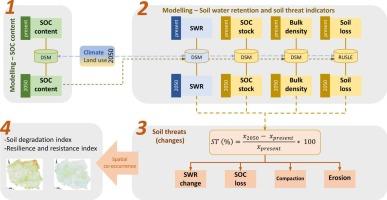
In Poland, approximately 62,000 ha of soil are degraded due to soil threats (ST). The spatial distribution and intensity of these threats evolve as a result of climate and land use changes. This study evaluates the co-occurrence of soil organic carbon (SOC) loss, erosion, compaction, and soil water retention (SWR), identifying areas susceptible to degradation, resistance, and soil resilience in Poland by 2050 under land use change and an extreme climate change scenario (SSP5-8.5, representing a high-emission pathway). For the first time in Poland, our findings demonstrate the co-occurrence of ST and reduced SWR by 2050, projecting that 47% of Polish soils may face some level of degradation, primarily due to compaction, erosion, SOC loss, and reduced SWR. The most affected areas are in the north, northeast, central, and the Carpathians. The Soil Condition Degradation Index (SCDI) classified 31% of soils as having low susceptibility to degradation, 10% as moderate, 2% as high, and 0.1% as having very high susceptibility to degradation. Conversely, the Resilience and Resistance Index (RRI) shows that 29% of soils will remain resistant or resilient to degradation, with 0.2% showing significant resilience (to three ST), 13% of soils will be resilient to two ST, and 16% remaining stable, showing resistance to change. The presented approach enables the identification of hotspots for targeted management under climate and land use changes, supporting environmental policies, especially the new EU Directive on Soil Monitoring and Resilience (Soil Monitoring Law), and sustainable land management.
期刊介绍:
Catena publishes papers describing original field and laboratory investigations and reviews on geoecology and landscape evolution with emphasis on interdisciplinary aspects of soil science, hydrology and geomorphology. It aims to disseminate new knowledge and foster better understanding of the physical environment, of evolutionary sequences that have resulted in past and current landscapes, and of the natural processes that are likely to determine the fate of our terrestrial environment.
Papers within any one of the above topics are welcome provided they are of sufficiently wide interest and relevance.