中国上海BVOCs的综合分析:排放模式、清单及其与臭氧污染的关系

IF 5.7 1区 农林科学 Q1 AGRONOMY
Xiang Xu , Zhihua Xiao , Yuanzhi Ni , Xuan Zhao , Cheng Peng , Limei Cao , Wei Zhang , Hongli Wang
{"title":"中国上海BVOCs的综合分析:排放模式、清单及其与臭氧污染的关系","authors":"Xiang Xu ,&nbsp;Zhihua Xiao ,&nbsp;Yuanzhi Ni ,&nbsp;Xuan Zhao ,&nbsp;Cheng Peng ,&nbsp;Limei Cao ,&nbsp;Wei Zhang ,&nbsp;Hongli Wang","doi":"10.1016/j.agrformet.2025.110832","DOIUrl":null,"url":null,"abstract":"<div><div>Biogenic volatile organic compounds (BVOCs) influence urban air quality through atmospheric chemical reactions, yet current understanding of their emissions and associated pollution in megacities remains insufficient. This study investigated major agricultural and natural vegetation in Shanghai, China, measuring BVOC emission rates from 15 plant species across different growing seasons, analyzing seasonal variations in emission components and rates, and constructing an emission inventory based on the 'G95′ model. The results identified isoprene and monoterpenes as the primary emitted compounds. Emission rates from dominant tree species and characteristic urban landscape plants peaked in summer and decreased in winter. Significant differences were observed in BVOC emissions from crops and economic fruit species across different phenological stages. <em>Populus tomentosa</em> exhibited the highest isoprene emission rate at 72.94 ± 4.74 μg·g<sup>-1</sup>·h<sup>-1</sup>, while <em>Cinnamomum camphora, Magnolia grandiflora, Osmanthus fragrans</em>, and <em>Euonymus japonicus</em> showed relatively lower emissions. In 2022, total BVOC emissions reached 14,608.6 tonnes, with isoprene as the predominant contributor. The total ozone (O<sub>3</sub>) formation potential (OFP) of isoprene and monoterpenes was 66,940.0 tonnes and 12,666.6 tonnes, respectively. Woodland served as the primary source of BVOC emissions, with <em>Populus tomentosa</em> contributing the most to the OFP of isoprene and <em>Metasequoia glyptostroboides</em> to that of monoterpenes. <em>Oryza sativa</em> contributed the most to the OFP of isoprene and monoterpenes from cropland. Monthly variations in BVOC emissions aligned with O<sub>3</sub> pollution trends, following a single-peaked distribution. This study provides a theoretical foundation for selecting urban greening tree species and developing regional emission reduction strategies.</div></div>","PeriodicalId":50839,"journal":{"name":"Agricultural and Forest Meteorology","volume":"375 ","pages":"Article 110832"},"PeriodicalIF":5.7000,"publicationDate":"2025-09-11","publicationTypes":"Journal Article","fieldsOfStudy":null,"isOpenAccess":false,"openAccessPdf":"","citationCount":"0","resultStr":"{\"title\":\"Comprehensive analysis of BVOCs in Shanghai, China: Emission patterns, inventory, and association with ozone pollution\",\"authors\":\"Xiang Xu ,&nbsp;Zhihua Xiao ,&nbsp;Yuanzhi Ni ,&nbsp;Xuan Zhao ,&nbsp;Cheng Peng ,&nbsp;Limei Cao ,&nbsp;Wei Zhang ,&nbsp;Hongli Wang\",\"doi\":\"10.1016/j.agrformet.2025.110832\",\"DOIUrl\":null,\"url\":null,\"abstract\":\"<div><div>Biogenic volatile organic compounds (BVOCs) influence urban air quality through atmospheric chemical reactions, yet current understanding of their emissions and associated pollution in megacities remains insufficient. This study investigated major agricultural and natural vegetation in Shanghai, China, measuring BVOC emission rates from 15 plant species across different growing seasons, analyzing seasonal variations in emission components and rates, and constructing an emission inventory based on the 'G95′ model. The results identified isoprene and monoterpenes as the primary emitted compounds. Emission rates from dominant tree species and characteristic urban landscape plants peaked in summer and decreased in winter. Significant differences were observed in BVOC emissions from crops and economic fruit species across different phenological stages. <em>Populus tomentosa</em> exhibited the highest isoprene emission rate at 72.94 ± 4.74 μg·g<sup>-1</sup>·h<sup>-1</sup>, while <em>Cinnamomum camphora, Magnolia grandiflora, Osmanthus fragrans</em>, and <em>Euonymus japonicus</em> showed relatively lower emissions. In 2022, total BVOC emissions reached 14,608.6 tonnes, with isoprene as the predominant contributor. The total ozone (O<sub>3</sub>) formation potential (OFP) of isoprene and monoterpenes was 66,940.0 tonnes and 12,666.6 tonnes, respectively. Woodland served as the primary source of BVOC emissions, with <em>Populus tomentosa</em> contributing the most to the OFP of isoprene and <em>Metasequoia glyptostroboides</em> to that of monoterpenes. <em>Oryza sativa</em> contributed the most to the OFP of isoprene and monoterpenes from cropland. Monthly variations in BVOC emissions aligned with O<sub>3</sub> pollution trends, following a single-peaked distribution. This study provides a theoretical foundation for selecting urban greening tree species and developing regional emission reduction strategies.</div></div>\",\"PeriodicalId\":50839,\"journal\":{\"name\":\"Agricultural and Forest Meteorology\",\"volume\":\"375 \",\"pages\":\"Article 110832\"},\"PeriodicalIF\":5.7000,\"publicationDate\":\"2025-09-11\",\"publicationTypes\":\"Journal Article\",\"fieldsOfStudy\":null,\"isOpenAccess\":false,\"openAccessPdf\":\"\",\"citationCount\":\"0\",\"resultStr\":null,\"platform\":\"Semanticscholar\",\"paperid\":null,\"PeriodicalName\":\"Agricultural and Forest Meteorology\",\"FirstCategoryId\":\"97\",\"ListUrlMain\":\"https://www.sciencedirect.com/science/article/pii/S0168192325004514\",\"RegionNum\":1,\"RegionCategory\":\"农林科学\",\"ArticlePicture\":[],\"TitleCN\":null,\"AbstractTextCN\":null,\"PMCID\":null,\"EPubDate\":\"\",\"PubModel\":\"\",\"JCR\":\"Q1\",\"JCRName\":\"AGRONOMY\",\"Score\":null,\"Total\":0}","platform":"Semanticscholar","paperid":null,"PeriodicalName":"Agricultural and Forest Meteorology","FirstCategoryId":"97","ListUrlMain":"https://www.sciencedirect.com/science/article/pii/S0168192325004514","RegionNum":1,"RegionCategory":"农林科学","ArticlePicture":[],"TitleCN":null,"AbstractTextCN":null,"PMCID":null,"EPubDate":"","PubModel":"","JCR":"Q1","JCRName":"AGRONOMY","Score":null,"Total":0}
引用次数: 0

摘要

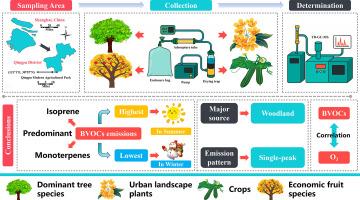
生物源性挥发性有机化合物(BVOCs)通过大气化学反应影响城市空气质量,但目前对其排放和大城市相关污染的了解仍然不足。本研究以上海市主要农业植被和自然植被为研究对象,测量了15种植物不同生长季节的BVOC排放率,分析了排放组分和排放率的季节变化,并基于“G95”模型构建了排放清查表。结果发现异戊二烯和单萜烯是主要的排放物。优势树种和城市景观特色植物的排放速率在夏季达到峰值,冬季下降。不同物候期作物和经济水果的BVOC排放量存在显著差异。毛白杨的异戊二烯排放量最高,为72.94±4.74 μg·g-1·h-1,樟树、广玉兰、桂花和刺桐的排放量相对较低。2022年,BVOC总排放量达到14608.6吨,异戊二烯是主要排放源。异戊二烯和单萜烯的总臭氧形成电位(OFP)分别为66,940.0吨和12,666.6吨。林地是BVOC的主要排放源,毛白杨对异戊二烯的OFP贡献最大,水杉对单萜的OFP贡献最大。水稻对农田中异戊二烯和单萜烯的OFP贡献最大。BVOC排放量的月度变化与O3污染趋势一致,遵循单峰分布。本研究为城市绿化树种的选择和区域减排策略的制定提供了理论依据。
本文章由计算机程序翻译,如有差异,请以英文原文为准。

Comprehensive analysis of BVOCs in Shanghai, China: Emission patterns, inventory, and association with ozone pollution

Comprehensive analysis of BVOCs in Shanghai, China: Emission patterns, inventory, and association with ozone pollution

Comprehensive analysis of BVOCs in Shanghai, China: Emission patterns, inventory, and association with ozone pollution
Biogenic volatile organic compounds (BVOCs) influence urban air quality through atmospheric chemical reactions, yet current understanding of their emissions and associated pollution in megacities remains insufficient. This study investigated major agricultural and natural vegetation in Shanghai, China, measuring BVOC emission rates from 15 plant species across different growing seasons, analyzing seasonal variations in emission components and rates, and constructing an emission inventory based on the 'G95′ model. The results identified isoprene and monoterpenes as the primary emitted compounds. Emission rates from dominant tree species and characteristic urban landscape plants peaked in summer and decreased in winter. Significant differences were observed in BVOC emissions from crops and economic fruit species across different phenological stages. Populus tomentosa exhibited the highest isoprene emission rate at 72.94 ± 4.74 μg·g-1·h-1, while Cinnamomum camphora, Magnolia grandiflora, Osmanthus fragrans, and Euonymus japonicus showed relatively lower emissions. In 2022, total BVOC emissions reached 14,608.6 tonnes, with isoprene as the predominant contributor. The total ozone (O3) formation potential (OFP) of isoprene and monoterpenes was 66,940.0 tonnes and 12,666.6 tonnes, respectively. Woodland served as the primary source of BVOC emissions, with Populus tomentosa contributing the most to the OFP of isoprene and Metasequoia glyptostroboides to that of monoterpenes. Oryza sativa contributed the most to the OFP of isoprene and monoterpenes from cropland. Monthly variations in BVOC emissions aligned with O3 pollution trends, following a single-peaked distribution. This study provides a theoretical foundation for selecting urban greening tree species and developing regional emission reduction strategies.
求助全文
通过发布文献求助,成功后即可免费获取论文全文。 去求助
来源期刊
CiteScore
10.30
自引率
9.70%
发文量
415
审稿时长
69 days
期刊介绍: Agricultural and Forest Meteorology is an international journal for the publication of original articles and reviews on the inter-relationship between meteorology, agriculture, forestry, and natural ecosystems. Emphasis is on basic and applied scientific research relevant to practical problems in the field of plant and soil sciences, ecology and biogeochemistry as affected by weather as well as climate variability and change. Theoretical models should be tested against experimental data. Articles must appeal to an international audience. Special issues devoted to single topics are also published. Typical topics include canopy micrometeorology (e.g. canopy radiation transfer, turbulence near the ground, evapotranspiration, energy balance, fluxes of trace gases), micrometeorological instrumentation (e.g., sensors for trace gases, flux measurement instruments, radiation measurement techniques), aerobiology (e.g. the dispersion of pollen, spores, insects and pesticides), biometeorology (e.g. the effect of weather and climate on plant distribution, crop yield, water-use efficiency, and plant phenology), forest-fire/weather interactions, and feedbacks from vegetation to weather and the climate system.

×
引用
GB/T 7714-2015
复制
MLA
复制
APA
复制
导出至
BibTeX EndNote RefMan NoteFirst NoteExpress
×
提示
您的信息不完整,为了账户安全,请先补充。
现在去补充
×
提示
您因"违规操作"
具体请查看互助需知
我知道了
×
提示
确定
请完成安全验证×
copy
已复制链接
快去分享给好友吧!
我知道了
右上角分享
点击右上角分享
0
联系我们:info@booksci.cn Book学术提供免费学术资源搜索服务,方便国内外学者检索中英文文献。致力于提供最便捷和优质的服务体验。 Copyright © 2023 布克学术 All rights reserved.
京ICP备2023020795号-1
ghs 京公网安备 11010802042870号
Book学术文献互助
Book学术文献互助群
群 号:604180095
Book学术官方微信