Esther C. Hessong , Tianjiao Lei , Brandon Fields , Raphael Pierre Thiraux , Brad L. Boyce , Timothy J. Rupert
{"title":"非晶态配位辅助烧结使大块纳米晶Cu-Zr具有高强度和抗压塑性","authors":"Esther C. Hessong , Tianjiao Lei , Brandon Fields , Raphael Pierre Thiraux , Brad L. Boyce , Timothy J. Rupert","doi":"10.1016/j.mtla.2025.102510","DOIUrl":null,"url":null,"abstract":"<div><div>Nanocrystalline alloys can have exceptional strengths, yet due to limited microstructural stability it is difficult to fabricate bulk pieces through traditional processing routes that retain nanosized grains. In this study, centimeter-sized Cu-Zr alloy pellets were fabricated via a simple and improved powder metallurgy processing route. Different consolidation temperatures and times were employed to investigate the effect of amorphous grain boundary complexions on densification and the resulting mechanical properties. Bulk compression tests were carried out, with the samples that were hot pressed at 900 °C for 10 h exhibiting an excellent combination of average yield strength of 722 ± 45 MPa and average failure strain of 25.3 ± 2.4 %. Therefore, we find that a powder processing route which enables amorphous complexion-assisted sintering leads to samples that (1) reach full density without requiring quenching treatments or other complex processing, (2) demonstrate appreciable plasticity, and (3) have strength that competes with commercially available high-strength Cu alloys.</div></div>","PeriodicalId":47623,"journal":{"name":"Materialia","volume":"43 ","pages":"Article 102510"},"PeriodicalIF":2.9000,"publicationDate":"2025-07-31","publicationTypes":"Journal Article","fieldsOfStudy":null,"isOpenAccess":false,"openAccessPdf":"","citationCount":"0","resultStr":"{\"title\":\"Amorphous complexion-aided sintering enables scalable processing of bulk nanocrystalline Cu-Zr with high strength and compressive plasticity\",\"authors\":\"Esther C. Hessong , Tianjiao Lei , Brandon Fields , Raphael Pierre Thiraux , Brad L. Boyce , Timothy J. Rupert\",\"doi\":\"10.1016/j.mtla.2025.102510\",\"DOIUrl\":null,\"url\":null,\"abstract\":\"<div><div>Nanocrystalline alloys can have exceptional strengths, yet due to limited microstructural stability it is difficult to fabricate bulk pieces through traditional processing routes that retain nanosized grains. In this study, centimeter-sized Cu-Zr alloy pellets were fabricated via a simple and improved powder metallurgy processing route. Different consolidation temperatures and times were employed to investigate the effect of amorphous grain boundary complexions on densification and the resulting mechanical properties. Bulk compression tests were carried out, with the samples that were hot pressed at 900 °C for 10 h exhibiting an excellent combination of average yield strength of 722 ± 45 MPa and average failure strain of 25.3 ± 2.4 %. Therefore, we find that a powder processing route which enables amorphous complexion-assisted sintering leads to samples that (1) reach full density without requiring quenching treatments or other complex processing, (2) demonstrate appreciable plasticity, and (3) have strength that competes with commercially available high-strength Cu alloys.</div></div>\",\"PeriodicalId\":47623,\"journal\":{\"name\":\"Materialia\",\"volume\":\"43 \",\"pages\":\"Article 102510\"},\"PeriodicalIF\":2.9000,\"publicationDate\":\"2025-07-31\",\"publicationTypes\":\"Journal Article\",\"fieldsOfStudy\":null,\"isOpenAccess\":false,\"openAccessPdf\":\"\",\"citationCount\":\"0\",\"resultStr\":null,\"platform\":\"Semanticscholar\",\"paperid\":null,\"PeriodicalName\":\"Materialia\",\"FirstCategoryId\":\"1085\",\"ListUrlMain\":\"https://www.sciencedirect.com/science/article/pii/S2589152925001784\",\"RegionNum\":0,\"RegionCategory\":null,\"ArticlePicture\":[],\"TitleCN\":null,\"AbstractTextCN\":null,\"PMCID\":null,\"EPubDate\":\"\",\"PubModel\":\"\",\"JCR\":\"Q2\",\"JCRName\":\"MATERIALS SCIENCE, MULTIDISCIPLINARY\",\"Score\":null,\"Total\":0}","platform":"Semanticscholar","paperid":null,"PeriodicalName":"Materialia","FirstCategoryId":"1085","ListUrlMain":"https://www.sciencedirect.com/science/article/pii/S2589152925001784","RegionNum":0,"RegionCategory":null,"ArticlePicture":[],"TitleCN":null,"AbstractTextCN":null,"PMCID":null,"EPubDate":"","PubModel":"","JCR":"Q2","JCRName":"MATERIALS SCIENCE, MULTIDISCIPLINARY","Score":null,"Total":0}
Amorphous complexion-aided sintering enables scalable processing of bulk nanocrystalline Cu-Zr with high strength and compressive plasticity
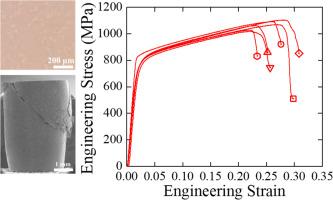
Nanocrystalline alloys can have exceptional strengths, yet due to limited microstructural stability it is difficult to fabricate bulk pieces through traditional processing routes that retain nanosized grains. In this study, centimeter-sized Cu-Zr alloy pellets were fabricated via a simple and improved powder metallurgy processing route. Different consolidation temperatures and times were employed to investigate the effect of amorphous grain boundary complexions on densification and the resulting mechanical properties. Bulk compression tests were carried out, with the samples that were hot pressed at 900 °C for 10 h exhibiting an excellent combination of average yield strength of 722 ± 45 MPa and average failure strain of 25.3 ± 2.4 %. Therefore, we find that a powder processing route which enables amorphous complexion-assisted sintering leads to samples that (1) reach full density without requiring quenching treatments or other complex processing, (2) demonstrate appreciable plasticity, and (3) have strength that competes with commercially available high-strength Cu alloys.
期刊介绍:
Materialia is a multidisciplinary journal of materials science and engineering that publishes original peer-reviewed research articles. Articles in Materialia advance the understanding of the relationship between processing, structure, property, and function of materials.
Materialia publishes full-length research articles, review articles, and letters (short communications). In addition to receiving direct submissions, Materialia also accepts transfers from Acta Materialia, Inc. partner journals. Materialia offers authors the choice to publish on an open access model (with author fee), or on a subscription model (with no author fee).