{"title":"视觉搜索中统计规律的转移。","authors":"Gabriel Siegel, Richard A. Abrams","doi":"10.3758/s13414-025-03117-3","DOIUrl":null,"url":null,"abstract":"<div><p>People are able to take advantage of statistical regularities in scenes, using those regularities to bias their attention to the likely locations of items of interest. People also seem able to learn object-centered statistical regularities—for example, that the top of an object is the most likely target location. We show here that such regularities transfer to new spatial locations even in the absence of any explicit object and hence may not be truly object centered. Additionally, when transfer is measured on a new object with a new shape—the transfer is substantially reduced. The findings suggest that statistical information about likely target locations can be encoded in a configuration-based reference frame that is sensitive to the context established by the objects in the scene. The results lead to a new interpretation of earlier findings and have important implications for understanding the coordinate systems in which attentional priorities are represented.</p></div>","PeriodicalId":55433,"journal":{"name":"Attention Perception & Psychophysics","volume":"87 6","pages":"1852 - 1863"},"PeriodicalIF":1.7000,"publicationDate":"2025-07-09","publicationTypes":"Journal Article","fieldsOfStudy":null,"isOpenAccess":false,"openAccessPdf":"","citationCount":"0","resultStr":"{\"title\":\"Transfer of statistical regularity in visual search\",\"authors\":\"Gabriel Siegel, Richard A. Abrams\",\"doi\":\"10.3758/s13414-025-03117-3\",\"DOIUrl\":null,\"url\":null,\"abstract\":\"<div><p>People are able to take advantage of statistical regularities in scenes, using those regularities to bias their attention to the likely locations of items of interest. People also seem able to learn object-centered statistical regularities—for example, that the top of an object is the most likely target location. We show here that such regularities transfer to new spatial locations even in the absence of any explicit object and hence may not be truly object centered. Additionally, when transfer is measured on a new object with a new shape—the transfer is substantially reduced. The findings suggest that statistical information about likely target locations can be encoded in a configuration-based reference frame that is sensitive to the context established by the objects in the scene. The results lead to a new interpretation of earlier findings and have important implications for understanding the coordinate systems in which attentional priorities are represented.</p></div>\",\"PeriodicalId\":55433,\"journal\":{\"name\":\"Attention Perception & Psychophysics\",\"volume\":\"87 6\",\"pages\":\"1852 - 1863\"},\"PeriodicalIF\":1.7000,\"publicationDate\":\"2025-07-09\",\"publicationTypes\":\"Journal Article\",\"fieldsOfStudy\":null,\"isOpenAccess\":false,\"openAccessPdf\":\"\",\"citationCount\":\"0\",\"resultStr\":null,\"platform\":\"Semanticscholar\",\"paperid\":null,\"PeriodicalName\":\"Attention Perception & Psychophysics\",\"FirstCategoryId\":\"102\",\"ListUrlMain\":\"https://link.springer.com/article/10.3758/s13414-025-03117-3\",\"RegionNum\":4,\"RegionCategory\":\"心理学\",\"ArticlePicture\":[],\"TitleCN\":null,\"AbstractTextCN\":null,\"PMCID\":null,\"EPubDate\":\"\",\"PubModel\":\"\",\"JCR\":\"Q3\",\"JCRName\":\"PSYCHOLOGY\",\"Score\":null,\"Total\":0}","platform":"Semanticscholar","paperid":null,"PeriodicalName":"Attention Perception & Psychophysics","FirstCategoryId":"102","ListUrlMain":"https://link.springer.com/article/10.3758/s13414-025-03117-3","RegionNum":4,"RegionCategory":"心理学","ArticlePicture":[],"TitleCN":null,"AbstractTextCN":null,"PMCID":null,"EPubDate":"","PubModel":"","JCR":"Q3","JCRName":"PSYCHOLOGY","Score":null,"Total":0}
Transfer of statistical regularity in visual search
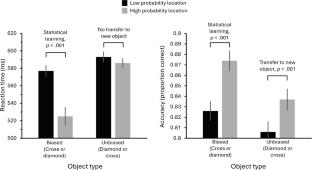
People are able to take advantage of statistical regularities in scenes, using those regularities to bias their attention to the likely locations of items of interest. People also seem able to learn object-centered statistical regularities—for example, that the top of an object is the most likely target location. We show here that such regularities transfer to new spatial locations even in the absence of any explicit object and hence may not be truly object centered. Additionally, when transfer is measured on a new object with a new shape—the transfer is substantially reduced. The findings suggest that statistical information about likely target locations can be encoded in a configuration-based reference frame that is sensitive to the context established by the objects in the scene. The results lead to a new interpretation of earlier findings and have important implications for understanding the coordinate systems in which attentional priorities are represented.
期刊介绍:
The journal Attention, Perception, & Psychophysics is an official journal of the Psychonomic Society. It spans all areas of research in sensory processes, perception, attention, and psychophysics. Most articles published are reports of experimental work; the journal also presents theoretical, integrative, and evaluative reviews. Commentary on issues of importance to researchers appears in a special section of the journal. Founded in 1966 as Perception & Psychophysics, the journal assumed its present name in 2009.

 求助内容:
求助内容: 应助结果提醒方式:

 京公网安备 11010802042870号

