{"title":"整体感知需要注意。","authors":"Ruth Kimchi, Shahar Sabary","doi":"10.3758/s13414-025-03111-9","DOIUrl":null,"url":null,"abstract":"<div><p>The question of whether ensemble perception can take place without attention is unresolved. We examined this issue in four experiments, using an inattention paradigm that provides an on-line, indirect measure of processing of unattended stimuli. Participants performed an attention-demanding change-detection task on a small matrix presented on a background of task-irrelevant ensemble consisting of circles of different size (Experiment 1) or oriented lines (Experiments 2–4). Independently of any change in the matrix, the ensemble mean changed or stayed the same between successive displays on each trial. We hypothesized that if ensemble mean is extracted under inattention, changes in the ensemble mean would produce congruency effects on the speed or accuracy of performance in the matrix change judgments, such that performance is faster or more accurate on congruent than incongruent trials. The results showed that changes in the ensemble mean size or mean orientation produced no congruency effects on performance of the target change-detection task. Also, participants could not report, when probed with surprise questions, whether or not the ensemble mean changed. When participants attended to the ensemble, their accuracy of explicit reports about a change were significantly above chance. These results are seen to suggest that ensemble perception requires attention. The differences between the present study and previous ones, concerning the conditions and definition of unattended and their implication for understanding the relation between ensemble perception and attention, are discussed.</p></div>","PeriodicalId":55433,"journal":{"name":"Attention Perception & Psychophysics","volume":"87 6","pages":"1888 - 1903"},"PeriodicalIF":1.7000,"publicationDate":"2025-06-18","publicationTypes":"Journal Article","fieldsOfStudy":null,"isOpenAccess":false,"openAccessPdf":"https://www.ncbi.nlm.nih.gov/pmc/articles/PMC12331843/pdf/","citationCount":"0","resultStr":"{\"title\":\"Ensemble perception requires attention\",\"authors\":\"Ruth Kimchi, Shahar Sabary\",\"doi\":\"10.3758/s13414-025-03111-9\",\"DOIUrl\":null,\"url\":null,\"abstract\":\"<div><p>The question of whether ensemble perception can take place without attention is unresolved. We examined this issue in four experiments, using an inattention paradigm that provides an on-line, indirect measure of processing of unattended stimuli. Participants performed an attention-demanding change-detection task on a small matrix presented on a background of task-irrelevant ensemble consisting of circles of different size (Experiment 1) or oriented lines (Experiments 2–4). Independently of any change in the matrix, the ensemble mean changed or stayed the same between successive displays on each trial. We hypothesized that if ensemble mean is extracted under inattention, changes in the ensemble mean would produce congruency effects on the speed or accuracy of performance in the matrix change judgments, such that performance is faster or more accurate on congruent than incongruent trials. The results showed that changes in the ensemble mean size or mean orientation produced no congruency effects on performance of the target change-detection task. Also, participants could not report, when probed with surprise questions, whether or not the ensemble mean changed. When participants attended to the ensemble, their accuracy of explicit reports about a change were significantly above chance. These results are seen to suggest that ensemble perception requires attention. The differences between the present study and previous ones, concerning the conditions and definition of unattended and their implication for understanding the relation between ensemble perception and attention, are discussed.</p></div>\",\"PeriodicalId\":55433,\"journal\":{\"name\":\"Attention Perception & Psychophysics\",\"volume\":\"87 6\",\"pages\":\"1888 - 1903\"},\"PeriodicalIF\":1.7000,\"publicationDate\":\"2025-06-18\",\"publicationTypes\":\"Journal Article\",\"fieldsOfStudy\":null,\"isOpenAccess\":false,\"openAccessPdf\":\"https://www.ncbi.nlm.nih.gov/pmc/articles/PMC12331843/pdf/\",\"citationCount\":\"0\",\"resultStr\":null,\"platform\":\"Semanticscholar\",\"paperid\":null,\"PeriodicalName\":\"Attention Perception & Psychophysics\",\"FirstCategoryId\":\"102\",\"ListUrlMain\":\"https://link.springer.com/article/10.3758/s13414-025-03111-9\",\"RegionNum\":4,\"RegionCategory\":\"心理学\",\"ArticlePicture\":[],\"TitleCN\":null,\"AbstractTextCN\":null,\"PMCID\":null,\"EPubDate\":\"\",\"PubModel\":\"\",\"JCR\":\"Q3\",\"JCRName\":\"PSYCHOLOGY\",\"Score\":null,\"Total\":0}","platform":"Semanticscholar","paperid":null,"PeriodicalName":"Attention Perception & Psychophysics","FirstCategoryId":"102","ListUrlMain":"https://link.springer.com/article/10.3758/s13414-025-03111-9","RegionNum":4,"RegionCategory":"心理学","ArticlePicture":[],"TitleCN":null,"AbstractTextCN":null,"PMCID":null,"EPubDate":"","PubModel":"","JCR":"Q3","JCRName":"PSYCHOLOGY","Score":null,"Total":0}
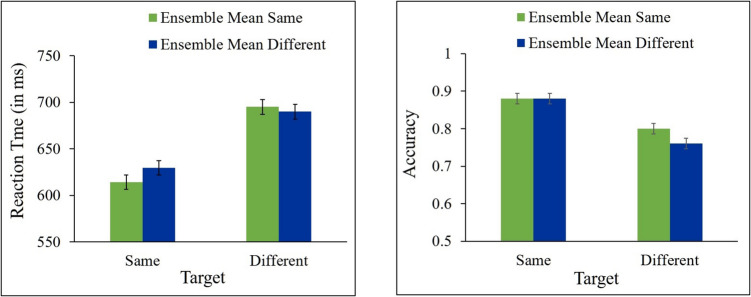
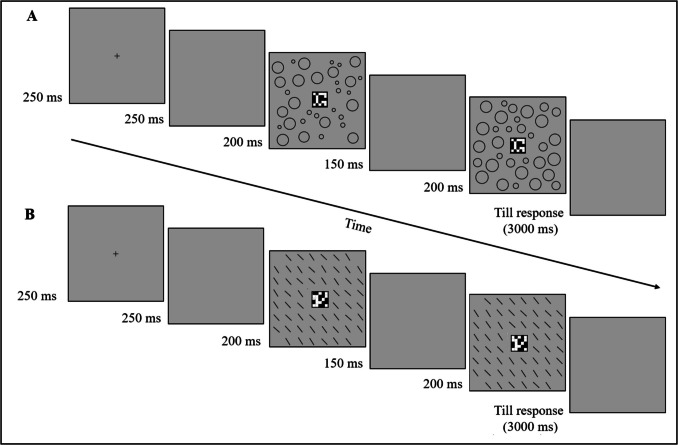
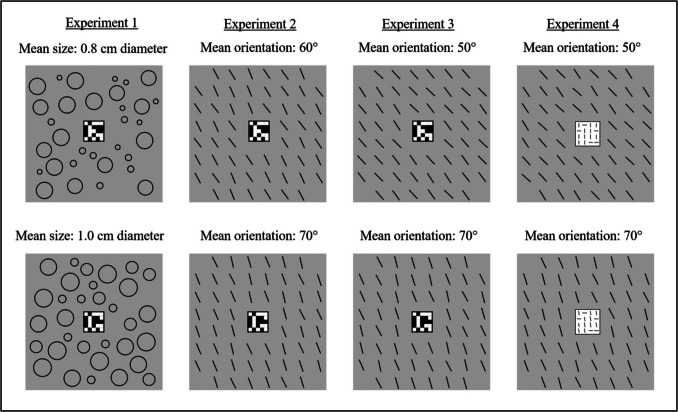
The question of whether ensemble perception can take place without attention is unresolved. We examined this issue in four experiments, using an inattention paradigm that provides an on-line, indirect measure of processing of unattended stimuli. Participants performed an attention-demanding change-detection task on a small matrix presented on a background of task-irrelevant ensemble consisting of circles of different size (Experiment 1) or oriented lines (Experiments 2–4). Independently of any change in the matrix, the ensemble mean changed or stayed the same between successive displays on each trial. We hypothesized that if ensemble mean is extracted under inattention, changes in the ensemble mean would produce congruency effects on the speed or accuracy of performance in the matrix change judgments, such that performance is faster or more accurate on congruent than incongruent trials. The results showed that changes in the ensemble mean size or mean orientation produced no congruency effects on performance of the target change-detection task. Also, participants could not report, when probed with surprise questions, whether or not the ensemble mean changed. When participants attended to the ensemble, their accuracy of explicit reports about a change were significantly above chance. These results are seen to suggest that ensemble perception requires attention. The differences between the present study and previous ones, concerning the conditions and definition of unattended and their implication for understanding the relation between ensemble perception and attention, are discussed.
期刊介绍:
The journal Attention, Perception, & Psychophysics is an official journal of the Psychonomic Society. It spans all areas of research in sensory processes, perception, attention, and psychophysics. Most articles published are reports of experimental work; the journal also presents theoretical, integrative, and evaluative reviews. Commentary on issues of importance to researchers appears in a special section of the journal. Founded in 1966 as Perception & Psychophysics, the journal assumed its present name in 2009.

 求助内容:
求助内容: 应助结果提醒方式:

 京公网安备 11010802042870号

