Shiyuan Feng , Junjie Song , Xinyuan Guo , Yang-Yang Zhang , Jiale Liu , Liang Wei , Jun Li , Chang Liu , Xiaoqin Nie
{"title":"采用Janus膜蒸馏法处理核电站模拟去污废水","authors":"Shiyuan Feng , Junjie Song , Xinyuan Guo , Yang-Yang Zhang , Jiale Liu , Liang Wei , Jun Li , Chang Liu , Xiaoqin Nie","doi":"10.1016/j.desal.2025.118881","DOIUrl":null,"url":null,"abstract":"<div><div>In the daily operation of nuclear power plants, large amounts of low-level radioactive decontamination wastewater are generated for the cleaning and washing purposes. Compared to traditional methods such as evaporation and chemical precipitation, which are energy-intensive and prone to generating large-volume secondary pollutants, membrane distillation (MD) demonstrates advantages through waste heat utilization and reduction in concentrate volume. In this study, a Janus membrane was fabricated by dual-layer coating on polytetrafluoroethylene (PTFE) hollow fiber membranes incorporating a poly-dopamine/polyethyleneimine intermediate layer and a polyvinyl alcohol/tannic acid hydrogel top layer. The Janus membrane demonstrated exceptional anti-wetting stability, delaying membrane wetting onset by at least 30-fold compared to commercial PTFE membranes, while achieving >99.97 % rejection of nuclides (Sr<sup><em>2+</em></sup>, Cs<sup><em>+</em></sup>, Co<sup><em>2+</em></sup>). Long-term VMD experiments confirmed stable performance (8 L·m<sup><em>−2</em></sup>·h<sup><em>−1</em></sup> flux) over 60 h with periodic cleaning, showcasing its potential for sustainable low-level radioactive wastewater treatment. The underlying mechanism of the anti-wetting properties of the Janus membrane was then elucidated by comprehensive analysis of membrane physicochemical properties as well as the simulation study using molecular dynamics and density functional theory calculation. This work advances membrane design for nuclear wastewater management by synergistically integrating anti-wetting properties and nuclide recovery capabilities.</div></div>","PeriodicalId":299,"journal":{"name":"Desalination","volume":"609 ","pages":"Article 118881"},"PeriodicalIF":9.8000,"publicationDate":"2025-08-15","publicationTypes":"Journal Article","fieldsOfStudy":null,"isOpenAccess":false,"openAccessPdf":"","citationCount":"0","resultStr":"{\"title\":\"Treatment of simulated decontamination wastewater in nuclear power plants by membrane distillation using Janus membrane\",\"authors\":\"Shiyuan Feng , Junjie Song , Xinyuan Guo , Yang-Yang Zhang , Jiale Liu , Liang Wei , Jun Li , Chang Liu , Xiaoqin Nie\",\"doi\":\"10.1016/j.desal.2025.118881\",\"DOIUrl\":null,\"url\":null,\"abstract\":\"<div><div>In the daily operation of nuclear power plants, large amounts of low-level radioactive decontamination wastewater are generated for the cleaning and washing purposes. Compared to traditional methods such as evaporation and chemical precipitation, which are energy-intensive and prone to generating large-volume secondary pollutants, membrane distillation (MD) demonstrates advantages through waste heat utilization and reduction in concentrate volume. In this study, a Janus membrane was fabricated by dual-layer coating on polytetrafluoroethylene (PTFE) hollow fiber membranes incorporating a poly-dopamine/polyethyleneimine intermediate layer and a polyvinyl alcohol/tannic acid hydrogel top layer. The Janus membrane demonstrated exceptional anti-wetting stability, delaying membrane wetting onset by at least 30-fold compared to commercial PTFE membranes, while achieving >99.97 % rejection of nuclides (Sr<sup><em>2+</em></sup>, Cs<sup><em>+</em></sup>, Co<sup><em>2+</em></sup>). Long-term VMD experiments confirmed stable performance (8 L·m<sup><em>−2</em></sup>·h<sup><em>−1</em></sup> flux) over 60 h with periodic cleaning, showcasing its potential for sustainable low-level radioactive wastewater treatment. The underlying mechanism of the anti-wetting properties of the Janus membrane was then elucidated by comprehensive analysis of membrane physicochemical properties as well as the simulation study using molecular dynamics and density functional theory calculation. This work advances membrane design for nuclear wastewater management by synergistically integrating anti-wetting properties and nuclide recovery capabilities.</div></div>\",\"PeriodicalId\":299,\"journal\":{\"name\":\"Desalination\",\"volume\":\"609 \",\"pages\":\"Article 118881\"},\"PeriodicalIF\":9.8000,\"publicationDate\":\"2025-08-15\",\"publicationTypes\":\"Journal Article\",\"fieldsOfStudy\":null,\"isOpenAccess\":false,\"openAccessPdf\":\"\",\"citationCount\":\"0\",\"resultStr\":null,\"platform\":\"Semanticscholar\",\"paperid\":null,\"PeriodicalName\":\"Desalination\",\"FirstCategoryId\":\"5\",\"ListUrlMain\":\"https://www.sciencedirect.com/science/article/pii/S001191642500356X\",\"RegionNum\":1,\"RegionCategory\":\"工程技术\",\"ArticlePicture\":[],\"TitleCN\":null,\"AbstractTextCN\":null,\"PMCID\":null,\"EPubDate\":\"2025/4/5 0:00:00\",\"PubModel\":\"Epub\",\"JCR\":\"Q1\",\"JCRName\":\"ENGINEERING, CHEMICAL\",\"Score\":null,\"Total\":0}","platform":"Semanticscholar","paperid":null,"PeriodicalName":"Desalination","FirstCategoryId":"5","ListUrlMain":"https://www.sciencedirect.com/science/article/pii/S001191642500356X","RegionNum":1,"RegionCategory":"工程技术","ArticlePicture":[],"TitleCN":null,"AbstractTextCN":null,"PMCID":null,"EPubDate":"2025/4/5 0:00:00","PubModel":"Epub","JCR":"Q1","JCRName":"ENGINEERING, CHEMICAL","Score":null,"Total":0}
Treatment of simulated decontamination wastewater in nuclear power plants by membrane distillation using Janus membrane
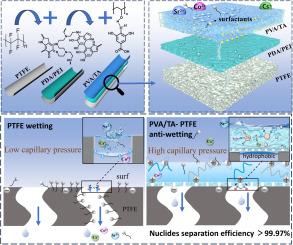
In the daily operation of nuclear power plants, large amounts of low-level radioactive decontamination wastewater are generated for the cleaning and washing purposes. Compared to traditional methods such as evaporation and chemical precipitation, which are energy-intensive and prone to generating large-volume secondary pollutants, membrane distillation (MD) demonstrates advantages through waste heat utilization and reduction in concentrate volume. In this study, a Janus membrane was fabricated by dual-layer coating on polytetrafluoroethylene (PTFE) hollow fiber membranes incorporating a poly-dopamine/polyethyleneimine intermediate layer and a polyvinyl alcohol/tannic acid hydrogel top layer. The Janus membrane demonstrated exceptional anti-wetting stability, delaying membrane wetting onset by at least 30-fold compared to commercial PTFE membranes, while achieving >99.97 % rejection of nuclides (Sr2+, Cs+, Co2+). Long-term VMD experiments confirmed stable performance (8 L·m−2·h−1 flux) over 60 h with periodic cleaning, showcasing its potential for sustainable low-level radioactive wastewater treatment. The underlying mechanism of the anti-wetting properties of the Janus membrane was then elucidated by comprehensive analysis of membrane physicochemical properties as well as the simulation study using molecular dynamics and density functional theory calculation. This work advances membrane design for nuclear wastewater management by synergistically integrating anti-wetting properties and nuclide recovery capabilities.
期刊介绍:
Desalination is a scholarly journal that focuses on the field of desalination materials, processes, and associated technologies. It encompasses a wide range of disciplines and aims to publish exceptional papers in this area.
The journal invites submissions that explicitly revolve around water desalting and its applications to various sources such as seawater, groundwater, and wastewater. It particularly encourages research on diverse desalination methods including thermal, membrane, sorption, and hybrid processes.
By providing a platform for innovative studies, Desalination aims to advance the understanding and development of desalination technologies, promoting sustainable solutions for water scarcity challenges.