{"title":"还原剂对CO优先氧化中氧空位与Au位构效关系的影响","authors":"Ganghua Xiang, Xing Lin and Zhigang Liu","doi":"10.1039/D5NR00548E","DOIUrl":null,"url":null,"abstract":"<p >Ceria (CeO<small><sub>2</sub></small>)-based gold (Au) catalysts exhibit remarkable catalytic performance for preferential oxidation of CO in an H<small><sub>2</sub></small>-rich stream (CO-PROX), and their activity can be further enhanced by defect engineering and regulation of Au sites. Herein, oxygen vacancies (O<small><sub>v</sub></small>) were constructed on CeO<small><sub>2</sub></small> using different reducing agents, including H<small><sub>2</sub></small>, NaBH<small><sub>4</sub></small> and ascorbic acid, to modulate the electronic structure and coordination environment of Au sites. The properties of O<small><sub>v</sub></small> and Au species were investigated by a series of characterization methods, such as electron paramagnetic resonance (EPR), electrochemical impedance spectroscopy (EIS), and X-ray photoelectron spectroscopy (XPS). The results of catalytic tests for CO-PROX showed that the sample reduced by H<small><sub>2</sub></small> at 400 °C (Au/CeO<small><sub>2</sub></small>-H<small><sub>2</sub></small>-400) achieved the best performance, which completely converted CO across a wide temperature window, ranging from 70 °C to 150 °C, while maintaining satisfactory selectivity and stability. The superior performance was attributed to the fact that, unlike ascorbic acid and NaBH<small><sub>4</sub></small>, H<small><sub>2</sub></small> is a small molecule with negligible steric hindrance, leading to a more concentrated distribution of O<small><sub>v</sub></small>. These vacancies promoted the formation of partially oxidized Au<small><sup>+</sup></small> with a moderate Au–O coordination number, which enhanced CO adsorption and facilitated the activation of lattice oxygen, thereby contributing to the exceptional catalytic activity.</p>","PeriodicalId":92,"journal":{"name":"Nanoscale","volume":" 16","pages":" 10303-10313"},"PeriodicalIF":5.1000,"publicationDate":"2025-03-20","publicationTypes":"Journal Article","fieldsOfStudy":null,"isOpenAccess":false,"openAccessPdf":"","citationCount":"0","resultStr":"{\"title\":\"The influence of reducing agents on structure–activity relationships between oxygen vacancies and Au sites for CO preferential oxidation†\",\"authors\":\"Ganghua Xiang, Xing Lin and Zhigang Liu\",\"doi\":\"10.1039/D5NR00548E\",\"DOIUrl\":null,\"url\":null,\"abstract\":\"<p >Ceria (CeO<small><sub>2</sub></small>)-based gold (Au) catalysts exhibit remarkable catalytic performance for preferential oxidation of CO in an H<small><sub>2</sub></small>-rich stream (CO-PROX), and their activity can be further enhanced by defect engineering and regulation of Au sites. Herein, oxygen vacancies (O<small><sub>v</sub></small>) were constructed on CeO<small><sub>2</sub></small> using different reducing agents, including H<small><sub>2</sub></small>, NaBH<small><sub>4</sub></small> and ascorbic acid, to modulate the electronic structure and coordination environment of Au sites. The properties of O<small><sub>v</sub></small> and Au species were investigated by a series of characterization methods, such as electron paramagnetic resonance (EPR), electrochemical impedance spectroscopy (EIS), and X-ray photoelectron spectroscopy (XPS). The results of catalytic tests for CO-PROX showed that the sample reduced by H<small><sub>2</sub></small> at 400 °C (Au/CeO<small><sub>2</sub></small>-H<small><sub>2</sub></small>-400) achieved the best performance, which completely converted CO across a wide temperature window, ranging from 70 °C to 150 °C, while maintaining satisfactory selectivity and stability. The superior performance was attributed to the fact that, unlike ascorbic acid and NaBH<small><sub>4</sub></small>, H<small><sub>2</sub></small> is a small molecule with negligible steric hindrance, leading to a more concentrated distribution of O<small><sub>v</sub></small>. These vacancies promoted the formation of partially oxidized Au<small><sup>+</sup></small> with a moderate Au–O coordination number, which enhanced CO adsorption and facilitated the activation of lattice oxygen, thereby contributing to the exceptional catalytic activity.</p>\",\"PeriodicalId\":92,\"journal\":{\"name\":\"Nanoscale\",\"volume\":\" 16\",\"pages\":\" 10303-10313\"},\"PeriodicalIF\":5.1000,\"publicationDate\":\"2025-03-20\",\"publicationTypes\":\"Journal Article\",\"fieldsOfStudy\":null,\"isOpenAccess\":false,\"openAccessPdf\":\"\",\"citationCount\":\"0\",\"resultStr\":null,\"platform\":\"Semanticscholar\",\"paperid\":null,\"PeriodicalName\":\"Nanoscale\",\"FirstCategoryId\":\"88\",\"ListUrlMain\":\"https://pubs.rsc.org/en/content/articlelanding/2025/nr/d5nr00548e\",\"RegionNum\":3,\"RegionCategory\":\"材料科学\",\"ArticlePicture\":[],\"TitleCN\":null,\"AbstractTextCN\":null,\"PMCID\":null,\"EPubDate\":\"\",\"PubModel\":\"\",\"JCR\":\"Q1\",\"JCRName\":\"CHEMISTRY, MULTIDISCIPLINARY\",\"Score\":null,\"Total\":0}","platform":"Semanticscholar","paperid":null,"PeriodicalName":"Nanoscale","FirstCategoryId":"88","ListUrlMain":"https://pubs.rsc.org/en/content/articlelanding/2025/nr/d5nr00548e","RegionNum":3,"RegionCategory":"材料科学","ArticlePicture":[],"TitleCN":null,"AbstractTextCN":null,"PMCID":null,"EPubDate":"","PubModel":"","JCR":"Q1","JCRName":"CHEMISTRY, MULTIDISCIPLINARY","Score":null,"Total":0}
The influence of reducing agents on structure–activity relationships between oxygen vacancies and Au sites for CO preferential oxidation†
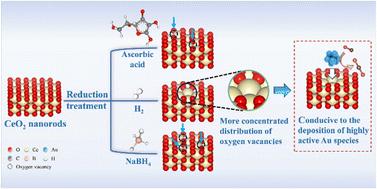
Ceria (CeO2)-based gold (Au) catalysts exhibit remarkable catalytic performance for preferential oxidation of CO in an H2-rich stream (CO-PROX), and their activity can be further enhanced by defect engineering and regulation of Au sites. Herein, oxygen vacancies (Ov) were constructed on CeO2 using different reducing agents, including H2, NaBH4 and ascorbic acid, to modulate the electronic structure and coordination environment of Au sites. The properties of Ov and Au species were investigated by a series of characterization methods, such as electron paramagnetic resonance (EPR), electrochemical impedance spectroscopy (EIS), and X-ray photoelectron spectroscopy (XPS). The results of catalytic tests for CO-PROX showed that the sample reduced by H2 at 400 °C (Au/CeO2-H2-400) achieved the best performance, which completely converted CO across a wide temperature window, ranging from 70 °C to 150 °C, while maintaining satisfactory selectivity and stability. The superior performance was attributed to the fact that, unlike ascorbic acid and NaBH4, H2 is a small molecule with negligible steric hindrance, leading to a more concentrated distribution of Ov. These vacancies promoted the formation of partially oxidized Au+ with a moderate Au–O coordination number, which enhanced CO adsorption and facilitated the activation of lattice oxygen, thereby contributing to the exceptional catalytic activity.
期刊介绍:
Nanoscale is a high-impact international journal, publishing high-quality research across nanoscience and nanotechnology. Nanoscale publishes a full mix of research articles on experimental and theoretical work, including reviews, communications, and full papers.Highly interdisciplinary, this journal appeals to scientists, researchers and professionals interested in nanoscience and nanotechnology, quantum materials and quantum technology, including the areas of physics, chemistry, biology, medicine, materials, energy/environment, information technology, detection science, healthcare and drug discovery, and electronics.

 求助内容:
求助内容: 应助结果提醒方式:

 京公网安备 11010802042870号


