一种新型二维biio3分子印迹光催化剂的超高抗精神病药物选择性积累和高效光催化降解。

IF 7.7 2区 环境科学与生态学 Q1 ENVIRONMENTAL SCIENCES
Environmental Research Pub Date : 2025-06-01 Epub Date: 2025-03-07 DOI:10.1016/j.envres.2025.121296
Lin Liu, Runan Chen, Chenshi Luo, Pengfei Liang, Mengyuan Zhang, Yongli Liu, Guifen Zhu
{"title":"一种新型二维biio3分子印迹光催化剂的超高抗精神病药物选择性积累和高效光催化降解。","authors":"Lin Liu,&nbsp;Runan Chen,&nbsp;Chenshi Luo,&nbsp;Pengfei Liang,&nbsp;Mengyuan Zhang,&nbsp;Yongli Liu,&nbsp;Guifen Zhu","doi":"10.1016/j.envres.2025.121296","DOIUrl":null,"url":null,"abstract":"<div><div>Adsorption-assisted photocatalytic degradation of pollutants is an effective method to improve degradation efficiency. However, most adsorptive photocatalysts are not selective and cannot efficiently remove low-concentration targets in complex systems, which limit their practical application. Therefore, a novel molecularly imprinted photocatalyst (MI-BiOIO<sub>3</sub>) with high selectivity and adsorption capacity was prepared using two-dimensional BiOIO<sub>3</sub> nanosheet as the matrix. Based on the abundant imprinting sites in the surface imprinted polymer of BiOIO<sub>3</sub>, the prepared MI-BiOIO<sub>3</sub> exhibited ultrahigh risperidone (RIS) selective accumulation performance, with a theoretical maximum adsorption capacity calculated by the Langmuir equation reaching 272.24 mg g<sup>−1</sup> within 5 min and an imprinting factor as high as 15.3. The adsorption property was not affected by common pH changes and the coexistence of humic acid and inorganic ions. Due to the synergistic effect of adsorption and photocatalysis, RIS after being concentrated by MI-BiOIO<sub>3</sub> could be completely degraded within 30 min, and more than two-thirds of the degradation intermediates were nontoxic. After five cycles, the selective adsorption and degradation performance of MI-BiOIO<sub>3</sub> toward RIS did not reduce considerably. As an adsorptive photocatalyst, the prepared MI-BiOIO<sub>3</sub> could selectively remove 50.3%–61.5% of 1 mg L<sup>−1</sup> of RIS in river, lake, and municipal wastewater samples. DFT simulation analysis verified that the ultrahigh selective accumulation performance was due to the van der Waals force, hydrogen bonds, electrostatic interaction, and π–π stacking interactions between MI-BiOIO<sub>3</sub> and RIS. This study provides a new concentrate-and-destroy strategy by photocatalysts for low-concentration drug contaminants in complex media.</div></div>","PeriodicalId":312,"journal":{"name":"Environmental Research","volume":"274 ","pages":"Article 121296"},"PeriodicalIF":7.7000,"publicationDate":"2025-06-01","publicationTypes":"Journal Article","fieldsOfStudy":null,"isOpenAccess":false,"openAccessPdf":"","citationCount":"0","resultStr":"{\"title\":\"Ultrahigh antipsychotics selective accumulation and efficient photocatalytic degradation using a novel 2D BiOIO3-based molecularly imprinted photocatalyst\",\"authors\":\"Lin Liu,&nbsp;Runan Chen,&nbsp;Chenshi Luo,&nbsp;Pengfei Liang,&nbsp;Mengyuan Zhang,&nbsp;Yongli Liu,&nbsp;Guifen Zhu\",\"doi\":\"10.1016/j.envres.2025.121296\",\"DOIUrl\":null,\"url\":null,\"abstract\":\"<div><div>Adsorption-assisted photocatalytic degradation of pollutants is an effective method to improve degradation efficiency. However, most adsorptive photocatalysts are not selective and cannot efficiently remove low-concentration targets in complex systems, which limit their practical application. Therefore, a novel molecularly imprinted photocatalyst (MI-BiOIO<sub>3</sub>) with high selectivity and adsorption capacity was prepared using two-dimensional BiOIO<sub>3</sub> nanosheet as the matrix. Based on the abundant imprinting sites in the surface imprinted polymer of BiOIO<sub>3</sub>, the prepared MI-BiOIO<sub>3</sub> exhibited ultrahigh risperidone (RIS) selective accumulation performance, with a theoretical maximum adsorption capacity calculated by the Langmuir equation reaching 272.24 mg g<sup>−1</sup> within 5 min and an imprinting factor as high as 15.3. The adsorption property was not affected by common pH changes and the coexistence of humic acid and inorganic ions. Due to the synergistic effect of adsorption and photocatalysis, RIS after being concentrated by MI-BiOIO<sub>3</sub> could be completely degraded within 30 min, and more than two-thirds of the degradation intermediates were nontoxic. After five cycles, the selective adsorption and degradation performance of MI-BiOIO<sub>3</sub> toward RIS did not reduce considerably. As an adsorptive photocatalyst, the prepared MI-BiOIO<sub>3</sub> could selectively remove 50.3%–61.5% of 1 mg L<sup>−1</sup> of RIS in river, lake, and municipal wastewater samples. DFT simulation analysis verified that the ultrahigh selective accumulation performance was due to the van der Waals force, hydrogen bonds, electrostatic interaction, and π–π stacking interactions between MI-BiOIO<sub>3</sub> and RIS. This study provides a new concentrate-and-destroy strategy by photocatalysts for low-concentration drug contaminants in complex media.</div></div>\",\"PeriodicalId\":312,\"journal\":{\"name\":\"Environmental Research\",\"volume\":\"274 \",\"pages\":\"Article 121296\"},\"PeriodicalIF\":7.7000,\"publicationDate\":\"2025-06-01\",\"publicationTypes\":\"Journal Article\",\"fieldsOfStudy\":null,\"isOpenAccess\":false,\"openAccessPdf\":\"\",\"citationCount\":\"0\",\"resultStr\":null,\"platform\":\"Semanticscholar\",\"paperid\":null,\"PeriodicalName\":\"Environmental Research\",\"FirstCategoryId\":\"93\",\"ListUrlMain\":\"https://www.sciencedirect.com/science/article/pii/S001393512500547X\",\"RegionNum\":2,\"RegionCategory\":\"环境科学与生态学\",\"ArticlePicture\":[],\"TitleCN\":null,\"AbstractTextCN\":null,\"PMCID\":null,\"EPubDate\":\"2025/3/7 0:00:00\",\"PubModel\":\"Epub\",\"JCR\":\"Q1\",\"JCRName\":\"ENVIRONMENTAL SCIENCES\",\"Score\":null,\"Total\":0}","platform":"Semanticscholar","paperid":null,"PeriodicalName":"Environmental Research","FirstCategoryId":"93","ListUrlMain":"https://www.sciencedirect.com/science/article/pii/S001393512500547X","RegionNum":2,"RegionCategory":"环境科学与生态学","ArticlePicture":[],"TitleCN":null,"AbstractTextCN":null,"PMCID":null,"EPubDate":"2025/3/7 0:00:00","PubModel":"Epub","JCR":"Q1","JCRName":"ENVIRONMENTAL SCIENCES","Score":null,"Total":0}
引用次数: 0

摘要

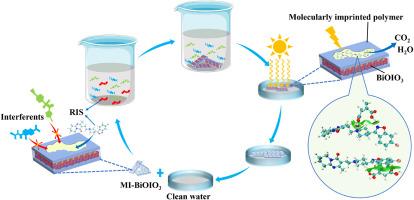
吸附辅助光催化降解污染物是提高降解效率的有效方法。然而,大多数吸附光催化剂不具有选择性,不能有效去除复杂体系中的低浓度目标,限制了它们的实际应用。因此,以二维biio3纳米片为基体,制备了一种具有高选择性和高吸附能力的新型分子印迹光催化剂(MI-BiOIO3)。基于BiOIO3表面印迹聚合物中丰富的印迹位点,制备的MI-BiOIO3具有超高的利培酮(RIS)选择性积累性能,根据Langmuir方程计算的理论最大吸附量在5 min内达到272.24 mg g-1,印迹因子高达15.3。吸附性能不受一般pH变化和腐植酸与无机离子共存的影响。由于吸附和光催化的协同作用,RIS经MI-BiOIO3浓缩后可在30 min内完全降解,且超过三分之二的降解中间体无毒。经过5个循环后,MI-BiOIO3对RIS的选择性吸附和降解性能没有明显下降。作为一种吸附光催化剂,制备的MI-BiOIO3可选择性去除河流、湖泊和城市污水样品中1 mg L-1的RIS的50.3% ~ 61.5%。DFT模拟分析证实了MI-BiOIO3与RIS之间的范德华力、氢键、静电相互作用和π-π堆积相互作用是其超高选择性积累性能的主要原因。该研究为复杂介质中低浓度药物污染物的光催化富集和破坏提供了一种新的策略。
本文章由计算机程序翻译,如有差异,请以英文原文为准。

Ultrahigh antipsychotics selective accumulation and efficient photocatalytic degradation using a novel 2D BiOIO3-based molecularly imprinted photocatalyst

Ultrahigh antipsychotics selective accumulation and efficient photocatalytic degradation using a novel 2D BiOIO3-based molecularly imprinted photocatalyst
Adsorption-assisted photocatalytic degradation of pollutants is an effective method to improve degradation efficiency. However, most adsorptive photocatalysts are not selective and cannot efficiently remove low-concentration targets in complex systems, which limit their practical application. Therefore, a novel molecularly imprinted photocatalyst (MI-BiOIO3) with high selectivity and adsorption capacity was prepared using two-dimensional BiOIO3 nanosheet as the matrix. Based on the abundant imprinting sites in the surface imprinted polymer of BiOIO3, the prepared MI-BiOIO3 exhibited ultrahigh risperidone (RIS) selective accumulation performance, with a theoretical maximum adsorption capacity calculated by the Langmuir equation reaching 272.24 mg g−1 within 5 min and an imprinting factor as high as 15.3. The adsorption property was not affected by common pH changes and the coexistence of humic acid and inorganic ions. Due to the synergistic effect of adsorption and photocatalysis, RIS after being concentrated by MI-BiOIO3 could be completely degraded within 30 min, and more than two-thirds of the degradation intermediates were nontoxic. After five cycles, the selective adsorption and degradation performance of MI-BiOIO3 toward RIS did not reduce considerably. As an adsorptive photocatalyst, the prepared MI-BiOIO3 could selectively remove 50.3%–61.5% of 1 mg L−1 of RIS in river, lake, and municipal wastewater samples. DFT simulation analysis verified that the ultrahigh selective accumulation performance was due to the van der Waals force, hydrogen bonds, electrostatic interaction, and π–π stacking interactions between MI-BiOIO3 and RIS. This study provides a new concentrate-and-destroy strategy by photocatalysts for low-concentration drug contaminants in complex media.
求助全文
通过发布文献求助,成功后即可免费获取论文全文。 去求助
来源期刊
Environmental Research
Environmental Research 环境科学-公共卫生、环境卫生与职业卫生
CiteScore
12.60
自引率
8.40%
发文量
2480
审稿时长
4.7 months
期刊介绍: The Environmental Research journal presents a broad range of interdisciplinary research, focused on addressing worldwide environmental concerns and featuring innovative findings. Our publication strives to explore relevant anthropogenic issues across various environmental sectors, showcasing practical applications in real-life settings.

×
引用
GB/T 7714-2015
复制
MLA
复制
APA
复制
导出至
BibTeX EndNote RefMan NoteFirst NoteExpress
×
提示
您的信息不完整,为了账户安全,请先补充。
现在去补充
×
提示
您因"违规操作"
具体请查看互助需知
我知道了
×
提示
确定
请完成安全验证×
copy
已复制链接
快去分享给好友吧!
我知道了
右上角分享
点击右上角分享
0
联系我们:info@booksci.cn Book学术提供免费学术资源搜索服务,方便国内外学者检索中英文文献。致力于提供最便捷和优质的服务体验。 Copyright © 2023 布克学术 All rights reserved.
京ICP备2023020795号-1
ghs 京公网安备 11010802042870号
Book学术文献互助
Book学术文献互助群
群 号:604180095
Book学术官方微信
小红书