{"title":"海上可再生能源的全球跨资源评估","authors":"Spalding James , White Christopher , Ross Lauren","doi":"10.1016/j.rser.2025.115563","DOIUrl":null,"url":null,"abstract":"<div><div>Current global climate mitigation efforts are considered insufficient to meet international carbon emission targets. Modeled scenarios showing how these targets can be reached are underpinned by further renewable energy development. Offshore renewable energy has been shown to have energy potentials that are more than double the global electricity demand. Previous assessments investigating Offshore renewable energy potentials typically focused on a single resource type and use a wide range of units. However, these assessments have not been compared on a global scale and therefore it is largely unknown which resource types have the largest energy potentials at any given location. This study undertakes a global cross-resource assessment of marine renewable energy potentials, collecting previous marine renewable energy resource assessments in a single database with standardized energy potentials. The assessments collected are compared to the theoretical energy potential of other resource types at each location. Tidal and ocean currents and offshore solar are found to have consistently higher energy potentials than the other resource types. An expanded feasible global energy potential for tidal currents and offshore solar is found. Results show if only 2 % of this potential is harnessed from future turbine development, CO<sup>2</sup> emissions could be significantly reduced helping meet international emission targets and United Nations Sustainable Development Goals.</div></div>","PeriodicalId":418,"journal":{"name":"Renewable and Sustainable Energy Reviews","volume":"215 ","pages":"Article 115563"},"PeriodicalIF":16.3000,"publicationDate":"2025-06-01","publicationTypes":"Journal Article","fieldsOfStudy":null,"isOpenAccess":false,"openAccessPdf":"","citationCount":"0","resultStr":"{\"title\":\"A global cross-resource assessment of offshore renewable energy\",\"authors\":\"Spalding James , White Christopher , Ross Lauren\",\"doi\":\"10.1016/j.rser.2025.115563\",\"DOIUrl\":null,\"url\":null,\"abstract\":\"<div><div>Current global climate mitigation efforts are considered insufficient to meet international carbon emission targets. Modeled scenarios showing how these targets can be reached are underpinned by further renewable energy development. Offshore renewable energy has been shown to have energy potentials that are more than double the global electricity demand. Previous assessments investigating Offshore renewable energy potentials typically focused on a single resource type and use a wide range of units. However, these assessments have not been compared on a global scale and therefore it is largely unknown which resource types have the largest energy potentials at any given location. This study undertakes a global cross-resource assessment of marine renewable energy potentials, collecting previous marine renewable energy resource assessments in a single database with standardized energy potentials. The assessments collected are compared to the theoretical energy potential of other resource types at each location. Tidal and ocean currents and offshore solar are found to have consistently higher energy potentials than the other resource types. An expanded feasible global energy potential for tidal currents and offshore solar is found. Results show if only 2 % of this potential is harnessed from future turbine development, CO<sup>2</sup> emissions could be significantly reduced helping meet international emission targets and United Nations Sustainable Development Goals.</div></div>\",\"PeriodicalId\":418,\"journal\":{\"name\":\"Renewable and Sustainable Energy Reviews\",\"volume\":\"215 \",\"pages\":\"Article 115563\"},\"PeriodicalIF\":16.3000,\"publicationDate\":\"2025-06-01\",\"publicationTypes\":\"Journal Article\",\"fieldsOfStudy\":null,\"isOpenAccess\":false,\"openAccessPdf\":\"\",\"citationCount\":\"0\",\"resultStr\":null,\"platform\":\"Semanticscholar\",\"paperid\":null,\"PeriodicalName\":\"Renewable and Sustainable Energy Reviews\",\"FirstCategoryId\":\"1\",\"ListUrlMain\":\"https://www.sciencedirect.com/science/article/pii/S1364032125002369\",\"RegionNum\":1,\"RegionCategory\":\"工程技术\",\"ArticlePicture\":[],\"TitleCN\":null,\"AbstractTextCN\":null,\"PMCID\":null,\"EPubDate\":\"2025/3/6 0:00:00\",\"PubModel\":\"Epub\",\"JCR\":\"Q1\",\"JCRName\":\"ENERGY & FUELS\",\"Score\":null,\"Total\":0}","platform":"Semanticscholar","paperid":null,"PeriodicalName":"Renewable and Sustainable Energy Reviews","FirstCategoryId":"1","ListUrlMain":"https://www.sciencedirect.com/science/article/pii/S1364032125002369","RegionNum":1,"RegionCategory":"工程技术","ArticlePicture":[],"TitleCN":null,"AbstractTextCN":null,"PMCID":null,"EPubDate":"2025/3/6 0:00:00","PubModel":"Epub","JCR":"Q1","JCRName":"ENERGY & FUELS","Score":null,"Total":0}
A global cross-resource assessment of offshore renewable energy
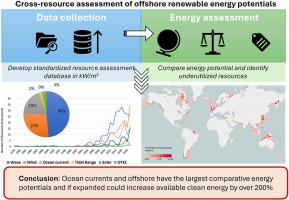
Current global climate mitigation efforts are considered insufficient to meet international carbon emission targets. Modeled scenarios showing how these targets can be reached are underpinned by further renewable energy development. Offshore renewable energy has been shown to have energy potentials that are more than double the global electricity demand. Previous assessments investigating Offshore renewable energy potentials typically focused on a single resource type and use a wide range of units. However, these assessments have not been compared on a global scale and therefore it is largely unknown which resource types have the largest energy potentials at any given location. This study undertakes a global cross-resource assessment of marine renewable energy potentials, collecting previous marine renewable energy resource assessments in a single database with standardized energy potentials. The assessments collected are compared to the theoretical energy potential of other resource types at each location. Tidal and ocean currents and offshore solar are found to have consistently higher energy potentials than the other resource types. An expanded feasible global energy potential for tidal currents and offshore solar is found. Results show if only 2 % of this potential is harnessed from future turbine development, CO2 emissions could be significantly reduced helping meet international emission targets and United Nations Sustainable Development Goals.
期刊介绍:
The mission of Renewable and Sustainable Energy Reviews is to disseminate the most compelling and pertinent critical insights in renewable and sustainable energy, fostering collaboration among the research community, private sector, and policy and decision makers. The journal aims to exchange challenges, solutions, innovative concepts, and technologies, contributing to sustainable development, the transition to a low-carbon future, and the attainment of emissions targets outlined by the United Nations Framework Convention on Climate Change.
Renewable and Sustainable Energy Reviews publishes a diverse range of content, including review papers, original research, case studies, and analyses of new technologies, all featuring a substantial review component such as critique, comparison, or analysis. Introducing a distinctive paper type, Expert Insights, the journal presents commissioned mini-reviews authored by field leaders, addressing topics of significant interest. Case studies undergo consideration only if they showcase the work's applicability to other regions or contribute valuable insights to the broader field of renewable and sustainable energy. Notably, a bibliographic or literature review lacking critical analysis is deemed unsuitable for publication.