基于可穿戴脉搏和血流速度传感器同步信号的动脉狭窄检测

IF 9.1 1区 化学 Q1 CHEMISTRY, ANALYTICAL
Pengrui Zhu, Xiaowei Zhao, Xuanhe Chen, Ran Liu, Han Ouyang, Yiran Hu, Bojing Shi, Yubo Fan
{"title":"基于可穿戴脉搏和血流速度传感器同步信号的动脉狭窄检测","authors":"Pengrui Zhu, Xiaowei Zhao, Xuanhe Chen, Ran Liu, Han Ouyang, Yiran Hu, Bojing Shi, Yubo Fan","doi":"10.1021/acssensors.4c03537","DOIUrl":null,"url":null,"abstract":"Atherosclerosis is the main cause of ischemic stroke. It occurs as a condition that leads to thickening of the arterial blood vessel walls and narrowing of the blood vessels, which can seriously affect the normal flow of blood. Currently, the detection of arterial stenosis relies on large-scale hospital equipment like computed tomography (CT) and magnetic resonance imaging (MRI), which require specialized technicians to operate and are not convenient for daily use. In addition, stenosis affects multiple parameters of hemodynamics in the blood flow field, and relying on a single physical quantity is not sufficient to understand the blood flow field localized in the stenotic vessel. Here, we demonstrated combined sensors of pulse wave and blood flow velocity (CSPB) based on photoelectric plethysmography and an ultrasonic Doppler device. We found that when the stenosis rate increased by 30%, the amplitude difference of the pulse wave curve between the two sides of the stenosis increased by over 11%, the amplitude of the blood flow curve decreased by 8%, and the blood flow resistance increased by 11%. We also prepared silicone-based models of blood stenosis vessels to build in vitro blood flow systems and achieve more accurate simulation of vascular stenosis diseases. Based on this, we studied the pulse wave and blood flow velocity curves of CSPB under different stenosis parameters. Meanwhile, we used the finite element analysis method of fluid–structure interactions to study the pulse wave and blood flow velocity changes under different arterial stenosis conditions. This study is expected to provide theoretical and technical references for achieving noninvasive detection of cardiovascular and cerebrovascular diseases based on multisensor fusion.","PeriodicalId":24,"journal":{"name":"ACS Sensors","volume":"42 1","pages":""},"PeriodicalIF":9.1000,"publicationDate":"2025-02-25","publicationTypes":"Journal Article","fieldsOfStudy":null,"isOpenAccess":false,"openAccessPdf":"","citationCount":"0","resultStr":"{\"title\":\"Detection of Arterial Stenosis Based on Synchronized Signals from Wearable Pulse and Blood Flow Velocity Sensors\",\"authors\":\"Pengrui Zhu, Xiaowei Zhao, Xuanhe Chen, Ran Liu, Han Ouyang, Yiran Hu, Bojing Shi, Yubo Fan\",\"doi\":\"10.1021/acssensors.4c03537\",\"DOIUrl\":null,\"url\":null,\"abstract\":\"Atherosclerosis is the main cause of ischemic stroke. It occurs as a condition that leads to thickening of the arterial blood vessel walls and narrowing of the blood vessels, which can seriously affect the normal flow of blood. Currently, the detection of arterial stenosis relies on large-scale hospital equipment like computed tomography (CT) and magnetic resonance imaging (MRI), which require specialized technicians to operate and are not convenient for daily use. In addition, stenosis affects multiple parameters of hemodynamics in the blood flow field, and relying on a single physical quantity is not sufficient to understand the blood flow field localized in the stenotic vessel. Here, we demonstrated combined sensors of pulse wave and blood flow velocity (CSPB) based on photoelectric plethysmography and an ultrasonic Doppler device. We found that when the stenosis rate increased by 30%, the amplitude difference of the pulse wave curve between the two sides of the stenosis increased by over 11%, the amplitude of the blood flow curve decreased by 8%, and the blood flow resistance increased by 11%. We also prepared silicone-based models of blood stenosis vessels to build in vitro blood flow systems and achieve more accurate simulation of vascular stenosis diseases. Based on this, we studied the pulse wave and blood flow velocity curves of CSPB under different stenosis parameters. Meanwhile, we used the finite element analysis method of fluid–structure interactions to study the pulse wave and blood flow velocity changes under different arterial stenosis conditions. This study is expected to provide theoretical and technical references for achieving noninvasive detection of cardiovascular and cerebrovascular diseases based on multisensor fusion.\",\"PeriodicalId\":24,\"journal\":{\"name\":\"ACS Sensors\",\"volume\":\"42 1\",\"pages\":\"\"},\"PeriodicalIF\":9.1000,\"publicationDate\":\"2025-02-25\",\"publicationTypes\":\"Journal Article\",\"fieldsOfStudy\":null,\"isOpenAccess\":false,\"openAccessPdf\":\"\",\"citationCount\":\"0\",\"resultStr\":null,\"platform\":\"Semanticscholar\",\"paperid\":null,\"PeriodicalName\":\"ACS Sensors\",\"FirstCategoryId\":\"92\",\"ListUrlMain\":\"https://doi.org/10.1021/acssensors.4c03537\",\"RegionNum\":1,\"RegionCategory\":\"化学\",\"ArticlePicture\":[],\"TitleCN\":null,\"AbstractTextCN\":null,\"PMCID\":null,\"EPubDate\":\"\",\"PubModel\":\"\",\"JCR\":\"Q1\",\"JCRName\":\"CHEMISTRY, ANALYTICAL\",\"Score\":null,\"Total\":0}","platform":"Semanticscholar","paperid":null,"PeriodicalName":"ACS Sensors","FirstCategoryId":"92","ListUrlMain":"https://doi.org/10.1021/acssensors.4c03537","RegionNum":1,"RegionCategory":"化学","ArticlePicture":[],"TitleCN":null,"AbstractTextCN":null,"PMCID":null,"EPubDate":"","PubModel":"","JCR":"Q1","JCRName":"CHEMISTRY, ANALYTICAL","Score":null,"Total":0}
引用次数: 0

摘要

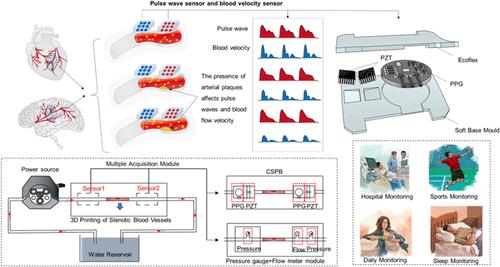
动脉粥样硬化是缺血性中风的主要原因。它是一种导致动脉血管壁增厚和血管狭窄的疾病,会严重影响血液的正常流动。目前,动脉狭窄的检测依赖于计算机断层扫描(CT)和磁共振成像(MRI)等大型医院设备,这些设备需要专业技术人员操作,日常使用不方便。此外,狭窄影响血流场中的多个血流动力学参数,仅依靠单一的物理量不足以了解狭窄血管局部的血流场。在这里,我们展示了基于光电体积脉搏波和超声多普勒装置的脉搏波和血流速度传感器(CSPB)。我们发现,当狭窄率增加30%时,狭窄两侧脉波曲线幅值差增加11%以上,血流曲线幅值下降8%,血流阻力增加11%。我们还制备了基于硅酮的血管狭窄模型,构建体外血流系统,实现对血管狭窄疾病更精确的模拟。在此基础上,我们研究了不同狭窄参数下CSPB的脉搏波和血流速度曲线。同时,采用流固相互作用的有限元分析方法,研究了不同动脉狭窄条件下脉搏波和血流速度的变化。本研究有望为实现基于多传感器融合的心脑血管疾病无创检测提供理论和技术参考。
本文章由计算机程序翻译,如有差异,请以英文原文为准。

Detection of Arterial Stenosis Based on Synchronized Signals from Wearable Pulse and Blood Flow Velocity Sensors

Detection of Arterial Stenosis Based on Synchronized Signals from Wearable Pulse and Blood Flow Velocity Sensors
Atherosclerosis is the main cause of ischemic stroke. It occurs as a condition that leads to thickening of the arterial blood vessel walls and narrowing of the blood vessels, which can seriously affect the normal flow of blood. Currently, the detection of arterial stenosis relies on large-scale hospital equipment like computed tomography (CT) and magnetic resonance imaging (MRI), which require specialized technicians to operate and are not convenient for daily use. In addition, stenosis affects multiple parameters of hemodynamics in the blood flow field, and relying on a single physical quantity is not sufficient to understand the blood flow field localized in the stenotic vessel. Here, we demonstrated combined sensors of pulse wave and blood flow velocity (CSPB) based on photoelectric plethysmography and an ultrasonic Doppler device. We found that when the stenosis rate increased by 30%, the amplitude difference of the pulse wave curve between the two sides of the stenosis increased by over 11%, the amplitude of the blood flow curve decreased by 8%, and the blood flow resistance increased by 11%. We also prepared silicone-based models of blood stenosis vessels to build in vitro blood flow systems and achieve more accurate simulation of vascular stenosis diseases. Based on this, we studied the pulse wave and blood flow velocity curves of CSPB under different stenosis parameters. Meanwhile, we used the finite element analysis method of fluid–structure interactions to study the pulse wave and blood flow velocity changes under different arterial stenosis conditions. This study is expected to provide theoretical and technical references for achieving noninvasive detection of cardiovascular and cerebrovascular diseases based on multisensor fusion.
求助全文
通过发布文献求助,成功后即可免费获取论文全文。 去求助
来源期刊
ACS Sensors
ACS Sensors Chemical Engineering-Bioengineering
CiteScore
14.50
自引率
3.40%
发文量
372
期刊介绍: ACS Sensors is a peer-reviewed research journal that focuses on the dissemination of new and original knowledge in the field of sensor science, particularly those that selectively sense chemical or biological species or processes. The journal covers a broad range of topics, including but not limited to biosensors, chemical sensors, gas sensors, intracellular sensors, single molecule sensors, cell chips, and microfluidic devices. It aims to publish articles that address conceptual advances in sensing technology applicable to various types of analytes or application papers that report on the use of existing sensing concepts in new ways or for new analytes.

×
引用
GB/T 7714-2015
复制
MLA
复制
APA
复制
导出至
BibTeX EndNote RefMan NoteFirst NoteExpress
×
提示
您的信息不完整,为了账户安全,请先补充。
现在去补充
×
提示
您因"违规操作"
具体请查看互助需知
我知道了
×
提示
确定
请完成安全验证×
copy
已复制链接
快去分享给好友吧!
我知道了
右上角分享
点击右上角分享
0
联系我们:info@booksci.cn Book学术提供免费学术资源搜索服务,方便国内外学者检索中英文文献。致力于提供最便捷和优质的服务体验。 Copyright © 2023 布克学术 All rights reserved.
京ICP备2023020795号-1
ghs 京公网安备 11010802042870号
Book学术文献互助
Book学术文献互助群
群 号:604180095
Book学术官方微信
小红书