{"title":"应力自适应工程提高了微Sn低温储钠循环稳定性","authors":"Sainan Luo, Jinyu Yang, Mingxu Wang, Jiafeng Ruan, Jiaming Hu, Qin Li, Ziyue Li, Fang Fang, Fei Wang, Shiyou Zheng","doi":"10.1002/aenm.202406078","DOIUrl":null,"url":null,"abstract":"<p>Microsized Sn (μ-Sn) is a promising anode material for sodium-ion batteries that has a high theoretical capacity of 847 mAh g<sup>−1</sup> and demonstrates a phase transition from β-Sn to α-Sn below 13 °C, enabling faster ion transport at low-temperatures. However, it faces challenges such as considerable volume expansion during cycling, unstable solid electrolyte interphase (SEI) formation, and an absence of effective regulation methods. Herein, a “killing three birds with one stone” strategy leveraging stress self-adaptive engineering is proposed to achieve low-temperature cycling stability in μ-Sn. At the expense of a partially reversible capacity, lowering the temperature increases the polarization voltage of μ-Sn during sodiation, resulting in a lower sodiation degree and the formation of dispersed amorphous products, thereby reducing the volume change. This relatively small volume expansion, compared to that at room temperature, is mitigated by the high-mechanical-strength SEI formed by the preferred low-temperature-resistant electrolyte, suppressing chemomechanical degradation and enhancing low-temperature cycling stability. The μ-Sn exhibits a high specific capacity of 680.9 mAh g<sup>−1</sup> after 150 cycles at −30 °C, which is 6.6 times higher than that at 25 °C. This work demonstrates a simple and effective approach for obtaining safe and high-performance sodium-ion batteries across broad temperature ranges.</p>","PeriodicalId":111,"journal":{"name":"Advanced Energy Materials","volume":"15 24","pages":""},"PeriodicalIF":26.0000,"publicationDate":"2025-02-25","publicationTypes":"Journal Article","fieldsOfStudy":null,"isOpenAccess":false,"openAccessPdf":"","citationCount":"0","resultStr":"{\"title\":\"Stress Self-Adaptive Engineering Advances the Low-Temperature Na Storage Cycling Stability of Microsized Sn\",\"authors\":\"Sainan Luo, Jinyu Yang, Mingxu Wang, Jiafeng Ruan, Jiaming Hu, Qin Li, Ziyue Li, Fang Fang, Fei Wang, Shiyou Zheng\",\"doi\":\"10.1002/aenm.202406078\",\"DOIUrl\":null,\"url\":null,\"abstract\":\"<p>Microsized Sn (μ-Sn) is a promising anode material for sodium-ion batteries that has a high theoretical capacity of 847 mAh g<sup>−1</sup> and demonstrates a phase transition from β-Sn to α-Sn below 13 °C, enabling faster ion transport at low-temperatures. However, it faces challenges such as considerable volume expansion during cycling, unstable solid electrolyte interphase (SEI) formation, and an absence of effective regulation methods. Herein, a “killing three birds with one stone” strategy leveraging stress self-adaptive engineering is proposed to achieve low-temperature cycling stability in μ-Sn. At the expense of a partially reversible capacity, lowering the temperature increases the polarization voltage of μ-Sn during sodiation, resulting in a lower sodiation degree and the formation of dispersed amorphous products, thereby reducing the volume change. This relatively small volume expansion, compared to that at room temperature, is mitigated by the high-mechanical-strength SEI formed by the preferred low-temperature-resistant electrolyte, suppressing chemomechanical degradation and enhancing low-temperature cycling stability. The μ-Sn exhibits a high specific capacity of 680.9 mAh g<sup>−1</sup> after 150 cycles at −30 °C, which is 6.6 times higher than that at 25 °C. This work demonstrates a simple and effective approach for obtaining safe and high-performance sodium-ion batteries across broad temperature ranges.</p>\",\"PeriodicalId\":111,\"journal\":{\"name\":\"Advanced Energy Materials\",\"volume\":\"15 24\",\"pages\":\"\"},\"PeriodicalIF\":26.0000,\"publicationDate\":\"2025-02-25\",\"publicationTypes\":\"Journal Article\",\"fieldsOfStudy\":null,\"isOpenAccess\":false,\"openAccessPdf\":\"\",\"citationCount\":\"0\",\"resultStr\":null,\"platform\":\"Semanticscholar\",\"paperid\":null,\"PeriodicalName\":\"Advanced Energy Materials\",\"FirstCategoryId\":\"88\",\"ListUrlMain\":\"https://advanced.onlinelibrary.wiley.com/doi/10.1002/aenm.202406078\",\"RegionNum\":1,\"RegionCategory\":\"材料科学\",\"ArticlePicture\":[],\"TitleCN\":null,\"AbstractTextCN\":null,\"PMCID\":null,\"EPubDate\":\"\",\"PubModel\":\"\",\"JCR\":\"Q1\",\"JCRName\":\"CHEMISTRY, PHYSICAL\",\"Score\":null,\"Total\":0}","platform":"Semanticscholar","paperid":null,"PeriodicalName":"Advanced Energy Materials","FirstCategoryId":"88","ListUrlMain":"https://advanced.onlinelibrary.wiley.com/doi/10.1002/aenm.202406078","RegionNum":1,"RegionCategory":"材料科学","ArticlePicture":[],"TitleCN":null,"AbstractTextCN":null,"PMCID":null,"EPubDate":"","PubModel":"","JCR":"Q1","JCRName":"CHEMISTRY, PHYSICAL","Score":null,"Total":0}
引用次数: 0
摘要
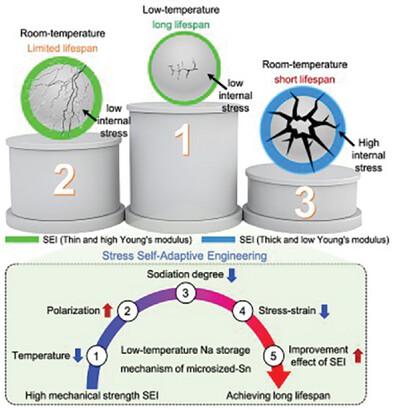
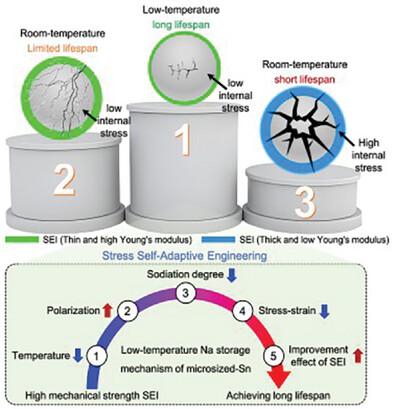
微Sn (μ-Sn)是一种很有前途的钠离子电池负极材料,具有847 mAh g - 1的高理论容量,并且在13°C以下从β-Sn到α-Sn的相变,可以在低温下实现更快的离子传输。然而,它面临着循环过程中体积膨胀、固体电解质间相(SEI)形成不稳定以及缺乏有效调节方法等挑战。为此,提出了一种利用应力自适应工程实现μ-Sn低温循环稳定性的“一石三鸟”策略。以牺牲部分可逆容量为代价,降低温度使μ-Sn在钠化过程中的极化电压升高,导致钠化程度降低,形成分散的非晶产物,从而减小体积变化。与室温下相比,这种相对较小的体积膨胀可以通过首选耐低温电解质形成的高机械强度SEI来缓解,从而抑制化学机械降解并增强低温循环稳定性。μ-Sn在−30℃下循环150次后的比容量达到680.9 mAh g−1,是25℃下比容量的6.6倍。这项工作展示了一种简单有效的方法,可以在广泛的温度范围内获得安全和高性能的钠离子电池。
Stress Self-Adaptive Engineering Advances the Low-Temperature Na Storage Cycling Stability of Microsized Sn
Microsized Sn (μ-Sn) is a promising anode material for sodium-ion batteries that has a high theoretical capacity of 847 mAh g−1 and demonstrates a phase transition from β-Sn to α-Sn below 13 °C, enabling faster ion transport at low-temperatures. However, it faces challenges such as considerable volume expansion during cycling, unstable solid electrolyte interphase (SEI) formation, and an absence of effective regulation methods. Herein, a “killing three birds with one stone” strategy leveraging stress self-adaptive engineering is proposed to achieve low-temperature cycling stability in μ-Sn. At the expense of a partially reversible capacity, lowering the temperature increases the polarization voltage of μ-Sn during sodiation, resulting in a lower sodiation degree and the formation of dispersed amorphous products, thereby reducing the volume change. This relatively small volume expansion, compared to that at room temperature, is mitigated by the high-mechanical-strength SEI formed by the preferred low-temperature-resistant electrolyte, suppressing chemomechanical degradation and enhancing low-temperature cycling stability. The μ-Sn exhibits a high specific capacity of 680.9 mAh g−1 after 150 cycles at −30 °C, which is 6.6 times higher than that at 25 °C. This work demonstrates a simple and effective approach for obtaining safe and high-performance sodium-ion batteries across broad temperature ranges.
期刊介绍:
Established in 2011, Advanced Energy Materials is an international, interdisciplinary, English-language journal that focuses on materials used in energy harvesting, conversion, and storage. It is regarded as a top-quality journal alongside Advanced Materials, Advanced Functional Materials, and Small.
With a 2022 Impact Factor of 27.8, Advanced Energy Materials is considered a prime source for the best energy-related research. The journal covers a wide range of topics in energy-related research, including organic and inorganic photovoltaics, batteries and supercapacitors, fuel cells, hydrogen generation and storage, thermoelectrics, water splitting and photocatalysis, solar fuels and thermosolar power, magnetocalorics, and piezoelectronics.
The readership of Advanced Energy Materials includes materials scientists, chemists, physicists, and engineers in both academia and industry. The journal is indexed in various databases and collections, such as Advanced Technologies & Aerospace Database, FIZ Karlsruhe, INSPEC (IET), Science Citation Index Expanded, Technology Collection, and Web of Science, among others.




 求助内容:
求助内容: 应助结果提醒方式:

 京公网安备 11010802042870号


