{"title":"植物乳杆菌改善了低蛋白饲粮对蛋鸡生长性能、抗氧化能力、免疫状态和肠道微生物群的负面影响。","authors":"Lele Hou, Huiling Qiu, Jihong Dong, Huawei Liu, Shansong Gao, Fu Chen","doi":"10.3389/fmicb.2025.1507752","DOIUrl":null,"url":null,"abstract":"<p><p>This experiment was conducted to investigate the effects of adding <i>Lactiplantibacillus plantarum</i> to a low-protein diet on the growth performance, ability immune status, and intestinal microbiota of 0-21-day-old layer chickens. A total of 180 one-day-old healthy Hy-line brown laying chicks were randomly divided into three groups with three replicates each of 20 chicks. The control group was fed a basal diet containing 19% protein, the low-protein (LP) group was fed a diet containing 17% protein, and the probiotic (LPL) group was fed with the 17% protein diet supplemented with <i>L. plantarum</i> (1.0 × 10<sup>9</sup> CFU/kg). The growth performance, antioxidant capacity, immune status, and gut microbiota of laying chickens were detected. We found that <i>L. plantarum</i> supplementation increased the activities of superoxide dismutase (SOD) and glutathione peroxidase (GSH-Px), total antioxidant capacity (T-AOC), and levels of immunoglobulin (Ig) A, IgG, and interleukin-10 (IL-10) in serum of 17% protein +1.0 × 10<sup>9</sup> CFU/kg <i>L. plantarum</i> (LPL) compared to the 19% protein group (control). Furthermore, <i>L. plantarum</i> supplementation increased the liver index, GSH-Px and T-AOC activity in serum, and changed the microflora structure, diversity, and polyketose unit bioanabolic metabolism of 17% protein +1.0 × 10<sup>9</sup> CFU/kg L. plantarum (LPL) compared to the 17% protein group (LP). In conclusion, <i>L. plantarum</i> supplementation could compensate for the adverse effects of low-protein diets in chicks, and the combination of a low-protein diet and <i>L. plantarum</i> is a feasible way to reduce protein in the diet.</p>","PeriodicalId":12466,"journal":{"name":"Frontiers in Microbiology","volume":"16 ","pages":"1507752"},"PeriodicalIF":4.0000,"publicationDate":"2025-02-05","publicationTypes":"Journal Article","fieldsOfStudy":null,"isOpenAccess":false,"openAccessPdf":"https://www.ncbi.nlm.nih.gov/pmc/articles/PMC11835938/pdf/","citationCount":"0","resultStr":"{\"title\":\"<i>Lactiplantibacillus plantarum</i> ameliorated the negative effects of a low-protein diet on growth performance, antioxidant capacity, immune status, and gut microbiota of laying chicks.\",\"authors\":\"Lele Hou, Huiling Qiu, Jihong Dong, Huawei Liu, Shansong Gao, Fu Chen\",\"doi\":\"10.3389/fmicb.2025.1507752\",\"DOIUrl\":null,\"url\":null,\"abstract\":\"<p><p>This experiment was conducted to investigate the effects of adding <i>Lactiplantibacillus plantarum</i> to a low-protein diet on the growth performance, ability immune status, and intestinal microbiota of 0-21-day-old layer chickens. A total of 180 one-day-old healthy Hy-line brown laying chicks were randomly divided into three groups with three replicates each of 20 chicks. The control group was fed a basal diet containing 19% protein, the low-protein (LP) group was fed a diet containing 17% protein, and the probiotic (LPL) group was fed with the 17% protein diet supplemented with <i>L. plantarum</i> (1.0 × 10<sup>9</sup> CFU/kg). The growth performance, antioxidant capacity, immune status, and gut microbiota of laying chickens were detected. We found that <i>L. plantarum</i> supplementation increased the activities of superoxide dismutase (SOD) and glutathione peroxidase (GSH-Px), total antioxidant capacity (T-AOC), and levels of immunoglobulin (Ig) A, IgG, and interleukin-10 (IL-10) in serum of 17% protein +1.0 × 10<sup>9</sup> CFU/kg <i>L. plantarum</i> (LPL) compared to the 19% protein group (control). Furthermore, <i>L. plantarum</i> supplementation increased the liver index, GSH-Px and T-AOC activity in serum, and changed the microflora structure, diversity, and polyketose unit bioanabolic metabolism of 17% protein +1.0 × 10<sup>9</sup> CFU/kg L. plantarum (LPL) compared to the 17% protein group (LP). In conclusion, <i>L. plantarum</i> supplementation could compensate for the adverse effects of low-protein diets in chicks, and the combination of a low-protein diet and <i>L. plantarum</i> is a feasible way to reduce protein in the diet.</p>\",\"PeriodicalId\":12466,\"journal\":{\"name\":\"Frontiers in Microbiology\",\"volume\":\"16 \",\"pages\":\"1507752\"},\"PeriodicalIF\":4.0000,\"publicationDate\":\"2025-02-05\",\"publicationTypes\":\"Journal Article\",\"fieldsOfStudy\":null,\"isOpenAccess\":false,\"openAccessPdf\":\"https://www.ncbi.nlm.nih.gov/pmc/articles/PMC11835938/pdf/\",\"citationCount\":\"0\",\"resultStr\":null,\"platform\":\"Semanticscholar\",\"paperid\":null,\"PeriodicalName\":\"Frontiers in Microbiology\",\"FirstCategoryId\":\"99\",\"ListUrlMain\":\"https://doi.org/10.3389/fmicb.2025.1507752\",\"RegionNum\":2,\"RegionCategory\":\"生物学\",\"ArticlePicture\":[],\"TitleCN\":null,\"AbstractTextCN\":null,\"PMCID\":null,\"EPubDate\":\"2025/1/1 0:00:00\",\"PubModel\":\"eCollection\",\"JCR\":\"Q2\",\"JCRName\":\"MICROBIOLOGY\",\"Score\":null,\"Total\":0}","platform":"Semanticscholar","paperid":null,"PeriodicalName":"Frontiers in Microbiology","FirstCategoryId":"99","ListUrlMain":"https://doi.org/10.3389/fmicb.2025.1507752","RegionNum":2,"RegionCategory":"生物学","ArticlePicture":[],"TitleCN":null,"AbstractTextCN":null,"PMCID":null,"EPubDate":"2025/1/1 0:00:00","PubModel":"eCollection","JCR":"Q2","JCRName":"MICROBIOLOGY","Score":null,"Total":0}
引用次数: 0
摘要
本试验旨在研究低蛋白饲粮中添加植物乳杆菌对0 ~ 21日龄蛋鸡生长性能、能力免疫状态和肠道菌群的影响。选取180只1日龄健康海兰褐蛋鸡,随机分为3组,每组3个重复,每重复20只鸡。对照组饲喂蛋白质含量为19%的基础饲粮,低蛋白(LP)组饲喂蛋白质含量为17%的饲粮,益生菌(LPL)组饲喂在17%蛋白质饲粮中添加1.0 × 10⁹ CFU/kg植物乳杆菌的饲粮。检测蛋鸡的生长性能、抗氧化能力、免疫状态和肠道微生物群。研究发现,与对照组相比,添加17%蛋白+1.0 × 109 CFU/kg L. plantarum (LPL)组血清超氧化物歧化酶(SOD)和谷胱甘肽过氧化物酶(GSH-Px)活性、总抗氧化能力(T-AOC)以及免疫球蛋白(Ig) A、IgG和白细胞介素-10 (IL-10)水平均显著提高。此外,与添加17%蛋白质组(LP)相比,添加17%蛋白质+1.0 × 10⁹ CFU/kg植物乳草组(LPL)提高了肝脏指数、血清GSH-Px和T-AOC活性,并改变了微生物区系结构、多样性和聚酮糖单位生物合成代谢。综上所述,添加植物乳杆菌可以弥补雏鸡低蛋白饲粮的不利影响,低蛋白饲粮与植物乳杆菌相结合是降低饲粮蛋白质含量的可行途径。
Lactiplantibacillus plantarum ameliorated the negative effects of a low-protein diet on growth performance, antioxidant capacity, immune status, and gut microbiota of laying chicks.
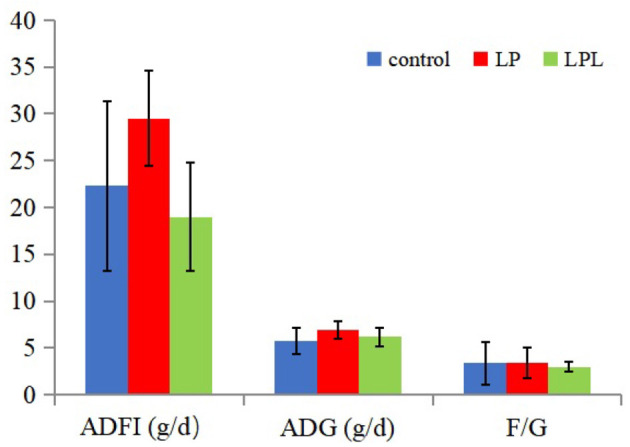
This experiment was conducted to investigate the effects of adding Lactiplantibacillus plantarum to a low-protein diet on the growth performance, ability immune status, and intestinal microbiota of 0-21-day-old layer chickens. A total of 180 one-day-old healthy Hy-line brown laying chicks were randomly divided into three groups with three replicates each of 20 chicks. The control group was fed a basal diet containing 19% protein, the low-protein (LP) group was fed a diet containing 17% protein, and the probiotic (LPL) group was fed with the 17% protein diet supplemented with L. plantarum (1.0 × 10⁹ CFU/kg). The growth performance, antioxidant capacity, immune status, and gut microbiota of laying chickens were detected. We found that L. plantarum supplementation increased the activities of superoxide dismutase (SOD) and glutathione peroxidase (GSH-Px), total antioxidant capacity (T-AOC), and levels of immunoglobulin (Ig) A, IgG, and interleukin-10 (IL-10) in serum of 17% protein +1.0 × 10⁹ CFU/kg L. plantarum (LPL) compared to the 19% protein group (control). Furthermore, L. plantarum supplementation increased the liver index, GSH-Px and T-AOC activity in serum, and changed the microflora structure, diversity, and polyketose unit bioanabolic metabolism of 17% protein +1.0 × 10⁹ CFU/kg L. plantarum (LPL) compared to the 17% protein group (LP). In conclusion, L. plantarum supplementation could compensate for the adverse effects of low-protein diets in chicks, and the combination of a low-protein diet and L. plantarum is a feasible way to reduce protein in the diet.
期刊介绍:
Frontiers in Microbiology is a leading journal in its field, publishing rigorously peer-reviewed research across the entire spectrum of microbiology. Field Chief Editor Martin G. Klotz at Washington State University is supported by an outstanding Editorial Board of international researchers. This multidisciplinary open-access journal is at the forefront of disseminating and communicating scientific knowledge and impactful discoveries to researchers, academics, clinicians and the public worldwide.



 求助内容:
求助内容: 应助结果提醒方式:

 京公网安备 11010802042870号


