Amalina T. Buda, Dr. Reinhard M. Pritzl, Dr. Monika M. Pointner, Jennifer Steinadler, Prof. Dr. Wolfgang Schnick
{"title":"Ba2BP7N14 -一种具有混合三维网络结构的氮硼磷酸季铵盐碱土。","authors":"Amalina T. Buda, Dr. Reinhard M. Pritzl, Dr. Monika M. Pointner, Jennifer Steinadler, Prof. Dr. Wolfgang Schnick","doi":"10.1002/chem.202404755","DOIUrl":null,"url":null,"abstract":"<p>Highly condensed alkaline earth nitridophosphates have attracted increasing scientific interest, due to their high thermal and chemical stability, as well as their promising luminescence behavior upon doping with Eu<sup>2+</sup> for pc-LED applications. In particular, the barely explored mixed tetrahedra-based nitridophosphates offer a wide range of structural and compositional diversity, enabling new insights into structure-property relationships. Herein, we report on the first quaternary alkaline earth nitridoborophosphate Ba<sub>2</sub>BP<sub>7</sub>N<sub>14</sub>, synthesized at 8 GPa and 1600 °C in a multianvil press, starting from Ba(N<sub>3</sub>)<sub>2</sub>, h-BN and P<sub>3</sub>N<sub>5</sub>. Ba<sub>2</sub>BP<sub>7</sub>N<sub>14</sub> crystallizes in the barylite-1O polytype and features a highly condensed mixed (B,P)–N anionic 3D network (<i>κ</i>≈0.57) built up of PN<sub>4</sub> and mixed occupied (P<sub>0.75</sub>B<sub>0.25</sub>)N<sub>4</sub> tetrahedra. The structure was characterized by a multi-step process involving single-crystal and powder X-ray diffraction (SCXRD, PXRD), elemental analysis, electron microscopy (STEM, EELS), and solid-state <sup>31</sup>P and <sup>11</sup>B MAS NMR spectroscopy. The plausibility of the structural model was corroborated by low-cost crystallographic calculations. The optical band gap and the thermal behavior of an undoped sample of Ba<sub>2</sub>BP<sub>7</sub>N<sub>14</sub>, were determined from diffuse reflectance spectroscopy and temperature-dependent powder X-ray diffraction, respectively. Irradiation of a Eu<sup>2+</sup>-doped sample with near-UV light results in a blue emission peaking at <i>λ</i><sub>em</sub>=422 nm.</p>","PeriodicalId":144,"journal":{"name":"Chemistry - A European Journal","volume":"31 20","pages":""},"PeriodicalIF":3.7000,"publicationDate":"2025-02-13","publicationTypes":"Journal Article","fieldsOfStudy":null,"isOpenAccess":false,"openAccessPdf":"https://onlinelibrary.wiley.com/doi/epdf/10.1002/chem.202404755","citationCount":"0","resultStr":"{\"title\":\"Ba2BP7N14 – A Quaternary Alkaline Earth Nitridoborophosphate with a Mixed 3D Network Structure\",\"authors\":\"Amalina T. Buda, Dr. Reinhard M. Pritzl, Dr. Monika M. Pointner, Jennifer Steinadler, Prof. Dr. Wolfgang Schnick\",\"doi\":\"10.1002/chem.202404755\",\"DOIUrl\":null,\"url\":null,\"abstract\":\"<p>Highly condensed alkaline earth nitridophosphates have attracted increasing scientific interest, due to their high thermal and chemical stability, as well as their promising luminescence behavior upon doping with Eu<sup>2+</sup> for pc-LED applications. In particular, the barely explored mixed tetrahedra-based nitridophosphates offer a wide range of structural and compositional diversity, enabling new insights into structure-property relationships. Herein, we report on the first quaternary alkaline earth nitridoborophosphate Ba<sub>2</sub>BP<sub>7</sub>N<sub>14</sub>, synthesized at 8 GPa and 1600 °C in a multianvil press, starting from Ba(N<sub>3</sub>)<sub>2</sub>, h-BN and P<sub>3</sub>N<sub>5</sub>. Ba<sub>2</sub>BP<sub>7</sub>N<sub>14</sub> crystallizes in the barylite-1O polytype and features a highly condensed mixed (B,P)–N anionic 3D network (<i>κ</i>≈0.57) built up of PN<sub>4</sub> and mixed occupied (P<sub>0.75</sub>B<sub>0.25</sub>)N<sub>4</sub> tetrahedra. The structure was characterized by a multi-step process involving single-crystal and powder X-ray diffraction (SCXRD, PXRD), elemental analysis, electron microscopy (STEM, EELS), and solid-state <sup>31</sup>P and <sup>11</sup>B MAS NMR spectroscopy. The plausibility of the structural model was corroborated by low-cost crystallographic calculations. The optical band gap and the thermal behavior of an undoped sample of Ba<sub>2</sub>BP<sub>7</sub>N<sub>14</sub>, were determined from diffuse reflectance spectroscopy and temperature-dependent powder X-ray diffraction, respectively. Irradiation of a Eu<sup>2+</sup>-doped sample with near-UV light results in a blue emission peaking at <i>λ</i><sub>em</sub>=422 nm.</p>\",\"PeriodicalId\":144,\"journal\":{\"name\":\"Chemistry - A European Journal\",\"volume\":\"31 20\",\"pages\":\"\"},\"PeriodicalIF\":3.7000,\"publicationDate\":\"2025-02-13\",\"publicationTypes\":\"Journal Article\",\"fieldsOfStudy\":null,\"isOpenAccess\":false,\"openAccessPdf\":\"https://onlinelibrary.wiley.com/doi/epdf/10.1002/chem.202404755\",\"citationCount\":\"0\",\"resultStr\":null,\"platform\":\"Semanticscholar\",\"paperid\":null,\"PeriodicalName\":\"Chemistry - A European Journal\",\"FirstCategoryId\":\"92\",\"ListUrlMain\":\"https://chemistry-europe.onlinelibrary.wiley.com/doi/10.1002/chem.202404755\",\"RegionNum\":2,\"RegionCategory\":\"化学\",\"ArticlePicture\":[],\"TitleCN\":null,\"AbstractTextCN\":null,\"PMCID\":null,\"EPubDate\":\"\",\"PubModel\":\"\",\"JCR\":\"Q2\",\"JCRName\":\"CHEMISTRY, MULTIDISCIPLINARY\",\"Score\":null,\"Total\":0}","platform":"Semanticscholar","paperid":null,"PeriodicalName":"Chemistry - A European Journal","FirstCategoryId":"92","ListUrlMain":"https://chemistry-europe.onlinelibrary.wiley.com/doi/10.1002/chem.202404755","RegionNum":2,"RegionCategory":"化学","ArticlePicture":[],"TitleCN":null,"AbstractTextCN":null,"PMCID":null,"EPubDate":"","PubModel":"","JCR":"Q2","JCRName":"CHEMISTRY, MULTIDISCIPLINARY","Score":null,"Total":0}
引用次数: 0
摘要
高度浓缩的碱土氮磷由于其高的热稳定性和化学稳定性以及在掺杂Eu2+后用于pc-LED的发光行为而引起了越来越多的科学兴趣。特别是,很少被探索的混合四面体基氮磷酸盐提供了广泛的结构和成分多样性,使人们能够对结构-性质关系有新的认识。本文报道了以Ba(N3)2、h-BN和P3N5为原料,在800 GPa和1600℃条件下,在多砧压机下合成的第一个季铵盐碱土Ba2BP7N14。Ba2BP7N14结晶为重晶石- 10多型,具有由PN4和混合占据(P0.75B0.25)N4四面体组成的高度凝聚的混合(B,P)-N阴离子三维网络(κ≈0.57)。通过单晶和粉末x射线衍射(SCXRD, PXRD),元素分析,电子显微镜(STEM, EELS)以及固态31P和11B MAS NMR谱等多步骤过程对结构进行了表征。低成本晶体学计算证实了结构模型的合理性。利用漫反射光谱和温度相关粉末x射线衍射分别测定了未掺杂Ba2BP7N14样品的光学带隙和热行为。用近紫外光照射Eu2+掺杂样品,在λem = 422 nm处出现蓝色发射峰。
Ba2BP7N14 – A Quaternary Alkaline Earth Nitridoborophosphate with a Mixed 3D Network Structure
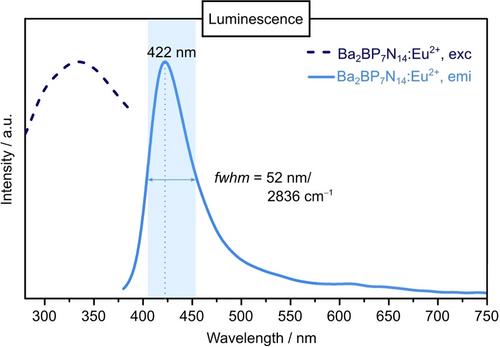
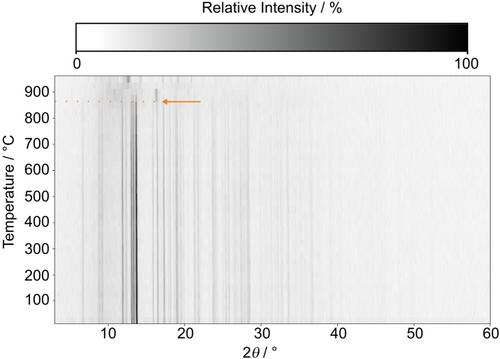
Highly condensed alkaline earth nitridophosphates have attracted increasing scientific interest, due to their high thermal and chemical stability, as well as their promising luminescence behavior upon doping with Eu2+ for pc-LED applications. In particular, the barely explored mixed tetrahedra-based nitridophosphates offer a wide range of structural and compositional diversity, enabling new insights into structure-property relationships. Herein, we report on the first quaternary alkaline earth nitridoborophosphate Ba2BP7N14, synthesized at 8 GPa and 1600 °C in a multianvil press, starting from Ba(N3)2, h-BN and P3N5. Ba2BP7N14 crystallizes in the barylite-1O polytype and features a highly condensed mixed (B,P)–N anionic 3D network (κ≈0.57) built up of PN4 and mixed occupied (P0.75B0.25)N4 tetrahedra. The structure was characterized by a multi-step process involving single-crystal and powder X-ray diffraction (SCXRD, PXRD), elemental analysis, electron microscopy (STEM, EELS), and solid-state 31P and 11B MAS NMR spectroscopy. The plausibility of the structural model was corroborated by low-cost crystallographic calculations. The optical band gap and the thermal behavior of an undoped sample of Ba2BP7N14, were determined from diffuse reflectance spectroscopy and temperature-dependent powder X-ray diffraction, respectively. Irradiation of a Eu2+-doped sample with near-UV light results in a blue emission peaking at λem=422 nm.
期刊介绍:
Chemistry—A European Journal is a truly international journal with top quality contributions (2018 ISI Impact Factor: 5.16). It publishes a wide range of outstanding Reviews, Minireviews, Concepts, Full Papers, and Communications from all areas of chemistry and related fields.
Based in Europe Chemistry—A European Journal provides an excellent platform for increasing the visibility of European chemistry as well as for featuring the best research from authors from around the world.
All manuscripts are peer-reviewed, and electronic processing ensures accurate reproduction of text and data, plus short publication times.
The Concepts section provides nonspecialist readers with a useful conceptual guide to unfamiliar areas and experts with new angles on familiar problems.
Chemistry—A European Journal is published on behalf of ChemPubSoc Europe, a group of 16 national chemical societies from within Europe, and supported by the Asian Chemical Editorial Societies. The ChemPubSoc Europe family comprises: Angewandte Chemie, Chemistry—A European Journal, European Journal of Organic Chemistry, European Journal of Inorganic Chemistry, ChemPhysChem, ChemBioChem, ChemMedChem, ChemCatChem, ChemSusChem, ChemPlusChem, ChemElectroChem, and ChemistryOpen.



 求助内容:
求助内容: 应助结果提醒方式:

 京公网安备 11010802042870号


