{"title":"构建n/n -型钙钛矿同质结以实现高效稳定的可印刷介观钙钛矿太阳能电池","authors":"Changqing Chen, Wenfeng Liu, Yiwen Chen, Yang Zhang, Rongrong Guo, Weihuang Yang, Yan Liu, Qin Zeng, Xing Li, Jian Xiong, Yu Huang, Jian Zhang","doi":"10.1002/smll.202409943","DOIUrl":null,"url":null,"abstract":"<p>In recent years, carbon-based printable mesoscopic perovskite solar cells (p-MPSCs) without hole transport layers have garnered considerable interest because of their outstanding benefits in terms of stability and cost. However, the use of carbon electrodes instead of hole transport materials and noble metal electrodes leads to energy level mismatch, which limits the power conversion efficiency (PCE) of p-MPSCs. In this work, a molecular doping strategy is proposed employing cyclopentylmethanamine to passivate surface and subsurface crystal defects in perovskite layers while inducing an energy shift toward the p-type in the perovskite region within carbon electrodes. This approach facilitates the formation of a perovskite homojunction at carbon micro-interfaces between carbon electrodes and perovskites. Results demonstrate that the formation of this homojunction optimizes the internal energy level alignment of devices, thereby increasing driving force for hole transfer to carbon electrodes. Ultimately, the devices optimized through this strategy increase the PCE from 17.50% to 19.50% while retaining over 92% of the initial PCE after over 150 days in air ambiance. This study provides a straightforward and effective approach for designing high-efficiency and stable p-MPSCs.</p>","PeriodicalId":228,"journal":{"name":"Small","volume":"21 9","pages":""},"PeriodicalIF":12.1000,"publicationDate":"2025-01-28","publicationTypes":"Journal Article","fieldsOfStudy":null,"isOpenAccess":false,"openAccessPdf":"","citationCount":"0","resultStr":"{\"title\":\"Constructing n/n− Type Perovskite Homojunctions to Achieve High-Efficiency and Stable Printable Mesoscopic Perovskite Solar Cells\",\"authors\":\"Changqing Chen, Wenfeng Liu, Yiwen Chen, Yang Zhang, Rongrong Guo, Weihuang Yang, Yan Liu, Qin Zeng, Xing Li, Jian Xiong, Yu Huang, Jian Zhang\",\"doi\":\"10.1002/smll.202409943\",\"DOIUrl\":null,\"url\":null,\"abstract\":\"<p>In recent years, carbon-based printable mesoscopic perovskite solar cells (p-MPSCs) without hole transport layers have garnered considerable interest because of their outstanding benefits in terms of stability and cost. However, the use of carbon electrodes instead of hole transport materials and noble metal electrodes leads to energy level mismatch, which limits the power conversion efficiency (PCE) of p-MPSCs. In this work, a molecular doping strategy is proposed employing cyclopentylmethanamine to passivate surface and subsurface crystal defects in perovskite layers while inducing an energy shift toward the p-type in the perovskite region within carbon electrodes. This approach facilitates the formation of a perovskite homojunction at carbon micro-interfaces between carbon electrodes and perovskites. Results demonstrate that the formation of this homojunction optimizes the internal energy level alignment of devices, thereby increasing driving force for hole transfer to carbon electrodes. Ultimately, the devices optimized through this strategy increase the PCE from 17.50% to 19.50% while retaining over 92% of the initial PCE after over 150 days in air ambiance. This study provides a straightforward and effective approach for designing high-efficiency and stable p-MPSCs.</p>\",\"PeriodicalId\":228,\"journal\":{\"name\":\"Small\",\"volume\":\"21 9\",\"pages\":\"\"},\"PeriodicalIF\":12.1000,\"publicationDate\":\"2025-01-28\",\"publicationTypes\":\"Journal Article\",\"fieldsOfStudy\":null,\"isOpenAccess\":false,\"openAccessPdf\":\"\",\"citationCount\":\"0\",\"resultStr\":null,\"platform\":\"Semanticscholar\",\"paperid\":null,\"PeriodicalName\":\"Small\",\"FirstCategoryId\":\"88\",\"ListUrlMain\":\"https://onlinelibrary.wiley.com/doi/10.1002/smll.202409943\",\"RegionNum\":2,\"RegionCategory\":\"材料科学\",\"ArticlePicture\":[],\"TitleCN\":null,\"AbstractTextCN\":null,\"PMCID\":null,\"EPubDate\":\"\",\"PubModel\":\"\",\"JCR\":\"Q1\",\"JCRName\":\"CHEMISTRY, MULTIDISCIPLINARY\",\"Score\":null,\"Total\":0}","platform":"Semanticscholar","paperid":null,"PeriodicalName":"Small","FirstCategoryId":"88","ListUrlMain":"https://onlinelibrary.wiley.com/doi/10.1002/smll.202409943","RegionNum":2,"RegionCategory":"材料科学","ArticlePicture":[],"TitleCN":null,"AbstractTextCN":null,"PMCID":null,"EPubDate":"","PubModel":"","JCR":"Q1","JCRName":"CHEMISTRY, MULTIDISCIPLINARY","Score":null,"Total":0}
Constructing n/n− Type Perovskite Homojunctions to Achieve High-Efficiency and Stable Printable Mesoscopic Perovskite Solar Cells
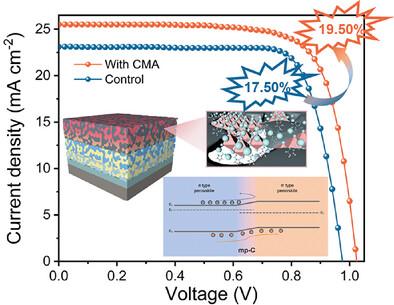
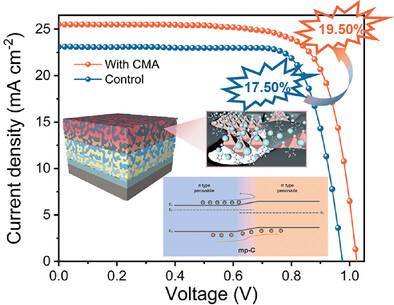
In recent years, carbon-based printable mesoscopic perovskite solar cells (p-MPSCs) without hole transport layers have garnered considerable interest because of their outstanding benefits in terms of stability and cost. However, the use of carbon electrodes instead of hole transport materials and noble metal electrodes leads to energy level mismatch, which limits the power conversion efficiency (PCE) of p-MPSCs. In this work, a molecular doping strategy is proposed employing cyclopentylmethanamine to passivate surface and subsurface crystal defects in perovskite layers while inducing an energy shift toward the p-type in the perovskite region within carbon electrodes. This approach facilitates the formation of a perovskite homojunction at carbon micro-interfaces between carbon electrodes and perovskites. Results demonstrate that the formation of this homojunction optimizes the internal energy level alignment of devices, thereby increasing driving force for hole transfer to carbon electrodes. Ultimately, the devices optimized through this strategy increase the PCE from 17.50% to 19.50% while retaining over 92% of the initial PCE after over 150 days in air ambiance. This study provides a straightforward and effective approach for designing high-efficiency and stable p-MPSCs.
期刊介绍:
Small serves as an exceptional platform for both experimental and theoretical studies in fundamental and applied interdisciplinary research at the nano- and microscale. The journal offers a compelling mix of peer-reviewed Research Articles, Reviews, Perspectives, and Comments.
With a remarkable 2022 Journal Impact Factor of 13.3 (Journal Citation Reports from Clarivate Analytics, 2023), Small remains among the top multidisciplinary journals, covering a wide range of topics at the interface of materials science, chemistry, physics, engineering, medicine, and biology.
Small's readership includes biochemists, biologists, biomedical scientists, chemists, engineers, information technologists, materials scientists, physicists, and theoreticians alike.

 求助内容:
求助内容: 应助结果提醒方式:

 京公网安备 11010802042870号


