弹性体泡沫模板三维杂化水凝胶异质集成可拉伸电子

IF 13.2 1区 工程技术 Q1 ENGINEERING, CHEMICAL
Changqing Qin, Qian Wang, Ting Fang, Lin Wang, Cheng Yang, Yong Lin, Chong Bai, Wenqiang He, Likang Ding, Jinheng Zhang, Dongchan Li, Desheng Kong
{"title":"弹性体泡沫模板三维杂化水凝胶异质集成可拉伸电子","authors":"Changqing Qin, Qian Wang, Ting Fang, Lin Wang, Cheng Yang, Yong Lin, Chong Bai, Wenqiang He, Likang Ding, Jinheng Zhang, Dongchan Li, Desheng Kong","doi":"10.1016/j.cej.2025.159937","DOIUrl":null,"url":null,"abstract":"Hydrogels are soft, tissue-like solids with promising potential in biomedical engineering and stretchable electronics. These applications require hydrogels to be shaped into intricate structures and combined with other polymers. This study introduces hybrid hydrogels that use elastomer foams as templates for controlled synthesis. Essentially, TPU foams can be easily structured into diverse 2D or 3D shapes using laser ablation. After hydrophilic modification, these foams absorb hydrogel precursors and crosslink into delicate features of up to 1 mm resolution. The resulting hydrogel/elastomer hybrid exhibits excellent stretchability, capable of withstanding tensile strains exceeding 300 %. Additionally, the hybrid hydrogels can easily bind to conductive CNT nanocomposites, creating bilayer electrodes for wearable applications. Tissue adhesive polydopamine–polyacrylamide hydrogels are used to achieve conformal attachment to the skin, achieving lower contact impedance than commercial Ag/AgCl gel electrodes. These electrodes are integrated with stretchable circuits to create multifunctional patches for electrical stimulation and biopotential recording. An integrated epidermal sensing armband captures multichannel biopotential signals from the forearm, recognizing hand gestures through machine learning to act as a human–machine interface. The foam-templated synthesis introduced in this study offers convenient access to structured hydrogels and hydrogel/polymer hybrids for various cutting-edge applications.","PeriodicalId":270,"journal":{"name":"Chemical Engineering Journal","volume":"63 1","pages":""},"PeriodicalIF":13.2000,"publicationDate":"2025-01-27","publicationTypes":"Journal Article","fieldsOfStudy":null,"isOpenAccess":false,"openAccessPdf":"","citationCount":"0","resultStr":"{\"title\":\"Elastomer foam templated three dimensional hybrid hydrogels for heterogeneously integrated stretchable electronics\",\"authors\":\"Changqing Qin, Qian Wang, Ting Fang, Lin Wang, Cheng Yang, Yong Lin, Chong Bai, Wenqiang He, Likang Ding, Jinheng Zhang, Dongchan Li, Desheng Kong\",\"doi\":\"10.1016/j.cej.2025.159937\",\"DOIUrl\":null,\"url\":null,\"abstract\":\"Hydrogels are soft, tissue-like solids with promising potential in biomedical engineering and stretchable electronics. These applications require hydrogels to be shaped into intricate structures and combined with other polymers. This study introduces hybrid hydrogels that use elastomer foams as templates for controlled synthesis. Essentially, TPU foams can be easily structured into diverse 2D or 3D shapes using laser ablation. After hydrophilic modification, these foams absorb hydrogel precursors and crosslink into delicate features of up to 1 mm resolution. The resulting hydrogel/elastomer hybrid exhibits excellent stretchability, capable of withstanding tensile strains exceeding 300 %. Additionally, the hybrid hydrogels can easily bind to conductive CNT nanocomposites, creating bilayer electrodes for wearable applications. Tissue adhesive polydopamine–polyacrylamide hydrogels are used to achieve conformal attachment to the skin, achieving lower contact impedance than commercial Ag/AgCl gel electrodes. These electrodes are integrated with stretchable circuits to create multifunctional patches for electrical stimulation and biopotential recording. An integrated epidermal sensing armband captures multichannel biopotential signals from the forearm, recognizing hand gestures through machine learning to act as a human–machine interface. The foam-templated synthesis introduced in this study offers convenient access to structured hydrogels and hydrogel/polymer hybrids for various cutting-edge applications.\",\"PeriodicalId\":270,\"journal\":{\"name\":\"Chemical Engineering Journal\",\"volume\":\"63 1\",\"pages\":\"\"},\"PeriodicalIF\":13.2000,\"publicationDate\":\"2025-01-27\",\"publicationTypes\":\"Journal Article\",\"fieldsOfStudy\":null,\"isOpenAccess\":false,\"openAccessPdf\":\"\",\"citationCount\":\"0\",\"resultStr\":null,\"platform\":\"Semanticscholar\",\"paperid\":null,\"PeriodicalName\":\"Chemical Engineering Journal\",\"FirstCategoryId\":\"5\",\"ListUrlMain\":\"https://doi.org/10.1016/j.cej.2025.159937\",\"RegionNum\":1,\"RegionCategory\":\"工程技术\",\"ArticlePicture\":[],\"TitleCN\":null,\"AbstractTextCN\":null,\"PMCID\":null,\"EPubDate\":\"\",\"PubModel\":\"\",\"JCR\":\"Q1\",\"JCRName\":\"ENGINEERING, CHEMICAL\",\"Score\":null,\"Total\":0}","platform":"Semanticscholar","paperid":null,"PeriodicalName":"Chemical Engineering Journal","FirstCategoryId":"5","ListUrlMain":"https://doi.org/10.1016/j.cej.2025.159937","RegionNum":1,"RegionCategory":"工程技术","ArticlePicture":[],"TitleCN":null,"AbstractTextCN":null,"PMCID":null,"EPubDate":"","PubModel":"","JCR":"Q1","JCRName":"ENGINEERING, CHEMICAL","Score":null,"Total":0}
引用次数: 0

摘要

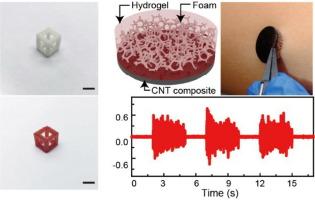
水凝胶是一种柔软的组织状固体,在生物医学工程和可拉伸电子学方面具有很大的潜力。这些应用需要水凝胶形成复杂的结构,并与其他聚合物结合。本研究介绍了以弹性体泡沫为模板进行可控合成的混合水凝胶。从本质上讲,TPU泡沫可以很容易地用激光烧蚀成不同的2D或3D形状。亲水改性后,这些泡沫吸收水凝胶前体和交联成精细的特征,高达1 毫米的分辨率。由此产生的水凝胶/弹性体混合物具有优异的拉伸性,能够承受超过300 %的拉伸应变。此外,混合水凝胶可以很容易地与导电碳纳米管纳米复合材料结合,为可穿戴应用创造双层电极。组织粘合剂聚多巴胺-聚丙烯酰胺水凝胶用于实现与皮肤的保形附着,实现比商用Ag/AgCl凝胶电极更低的接触阻抗。这些电极与可伸缩电路集成,以创建用于电刺激和生物电位记录的多功能贴片。集成的表皮传感臂带捕获来自前臂的多通道生物电位信号,通过机器学习识别手势,作为人机界面。本研究中介绍的泡沫模板合成为结构水凝胶和水凝胶/聚合物混合物的各种尖端应用提供了方便的途径。
本文章由计算机程序翻译,如有差异,请以英文原文为准。

Elastomer foam templated three dimensional hybrid hydrogels for heterogeneously integrated stretchable electronics

Elastomer foam templated three dimensional hybrid hydrogels for heterogeneously integrated stretchable electronics
Hydrogels are soft, tissue-like solids with promising potential in biomedical engineering and stretchable electronics. These applications require hydrogels to be shaped into intricate structures and combined with other polymers. This study introduces hybrid hydrogels that use elastomer foams as templates for controlled synthesis. Essentially, TPU foams can be easily structured into diverse 2D or 3D shapes using laser ablation. After hydrophilic modification, these foams absorb hydrogel precursors and crosslink into delicate features of up to 1 mm resolution. The resulting hydrogel/elastomer hybrid exhibits excellent stretchability, capable of withstanding tensile strains exceeding 300 %. Additionally, the hybrid hydrogels can easily bind to conductive CNT nanocomposites, creating bilayer electrodes for wearable applications. Tissue adhesive polydopamine–polyacrylamide hydrogels are used to achieve conformal attachment to the skin, achieving lower contact impedance than commercial Ag/AgCl gel electrodes. These electrodes are integrated with stretchable circuits to create multifunctional patches for electrical stimulation and biopotential recording. An integrated epidermal sensing armband captures multichannel biopotential signals from the forearm, recognizing hand gestures through machine learning to act as a human–machine interface. The foam-templated synthesis introduced in this study offers convenient access to structured hydrogels and hydrogel/polymer hybrids for various cutting-edge applications.
求助全文
通过发布文献求助,成功后即可免费获取论文全文。 去求助
来源期刊

Chemical Engineering Journal
Chemical Engineering Journal 工程技术-工程:化工
CiteScore
21.70
自引率
9.30%
发文量
6781
审稿时长
2.4 months
期刊介绍: The Chemical Engineering Journal is an international research journal that invites contributions of original and novel fundamental research. It aims to provide an international platform for presenting original fundamental research, interpretative reviews, and discussions on new developments in chemical engineering. The journal welcomes papers that describe novel theory and its practical application, as well as those that demonstrate the transfer of techniques from other disciplines. It also welcomes reports on carefully conducted experimental work that is soundly interpreted. The main focus of the journal is on original and rigorous research results that have broad significance. The Catalysis section within the Chemical Engineering Journal focuses specifically on Experimental and Theoretical studies in the fields of heterogeneous catalysis, molecular catalysis, and biocatalysis. These studies have industrial impact on various sectors such as chemicals, energy, materials, foods, healthcare, and environmental protection.

×
引用
GB/T 7714-2015
复制
MLA
复制
APA
复制
导出至
BibTeX EndNote RefMan NoteFirst NoteExpress
×
提示
您的信息不完整,为了账户安全,请先补充。
现在去补充
×
提示
您因"违规操作"
具体请查看互助需知
我知道了
×
提示
确定
请完成安全验证×
copy
已复制链接
快去分享给好友吧!
我知道了
右上角分享
点击右上角分享
0
联系我们:info@booksci.cn Book学术提供免费学术资源搜索服务,方便国内外学者检索中英文文献。致力于提供最便捷和优质的服务体验。 Copyright © 2023 布克学术 All rights reserved.
京ICP备2023020795号-1
ghs 京公网安备 11010802042870号
Book学术文献互助
Book学术文献互助群
群 号:604180095
Book学术官方微信
小红书