Lizhen Xu, Xin Wang, Ling Huang, Lixuan Dai, Dan Tan, Weiying Lin
{"title":"2 ', 7 ' -二氯荧光素解锁高效超氧阴离子NIR-II荧光成像和肿瘤光热治疗的分子工程","authors":"Lizhen Xu, Xin Wang, Ling Huang, Lixuan Dai, Dan Tan, Weiying Lin","doi":"10.1002/smll.202407918","DOIUrl":null,"url":null,"abstract":"<p>Although classical fluorescent dyes feature advantages of high quantum yield, tunable “OFF-ON” fluorescence, and modifiable chemical structures, etc., their bio-applications in deep tissue remains challenging due to their excessively short emission wavelength (that may lead to superficial tissue penetration depth). Therefore, there is a pressing need for pushing the wavelength of classical dyes from visible region to NIR-II window. As a representative classical dye, the 2′,7′-Dichlorofluorescein (<b>DCF</b>), a derivative of Fluorescein, is selected and rationally engineered to develop a novel NIR-II platform, <b>CR-OH</b>, which exhibits a substantial red-shift in the wavelength from the visible region to the NIR-II region. This achievement is attributed to molecular modification strategies that include extending π-conjugation, enhancing molecular rigidity, and incorporating strong electron-withdrawing groups. Furthermore, based on this developed NIR-II platform, a NIR-II fluorescence probe and a photothermal nanoagent are successfully constructed to unlock its bio-application in the NIR-II fluorescence imaging of endogenous O<sub>2</sub><sup>·–</sup> fluctuations in a CIRI model for the first time, as well as effective photothermal therapy for 4T1 tumors with a high photothermal conversion efficiency (44.0%). Significantly, this work overcomes the wavelength limitation of classical dyes, effectively unlocking their applications for the diagnosis and treatment of early disease in the NIR-II window.</p>","PeriodicalId":228,"journal":{"name":"Small","volume":"21 7","pages":""},"PeriodicalIF":12.1000,"publicationDate":"2025-01-12","publicationTypes":"Journal Article","fieldsOfStudy":null,"isOpenAccess":false,"openAccessPdf":"","citationCount":"0","resultStr":"{\"title\":\"Molecular Engineering of 2′, 7′-Dichlorofluorescein to Unlock Efficient Superoxide Anion NIR-II Fluorescent Imaging and Tumor Photothermal Therapy\",\"authors\":\"Lizhen Xu, Xin Wang, Ling Huang, Lixuan Dai, Dan Tan, Weiying Lin\",\"doi\":\"10.1002/smll.202407918\",\"DOIUrl\":null,\"url\":null,\"abstract\":\"<p>Although classical fluorescent dyes feature advantages of high quantum yield, tunable “OFF-ON” fluorescence, and modifiable chemical structures, etc., their bio-applications in deep tissue remains challenging due to their excessively short emission wavelength (that may lead to superficial tissue penetration depth). Therefore, there is a pressing need for pushing the wavelength of classical dyes from visible region to NIR-II window. As a representative classical dye, the 2′,7′-Dichlorofluorescein (<b>DCF</b>), a derivative of Fluorescein, is selected and rationally engineered to develop a novel NIR-II platform, <b>CR-OH</b>, which exhibits a substantial red-shift in the wavelength from the visible region to the NIR-II region. This achievement is attributed to molecular modification strategies that include extending π-conjugation, enhancing molecular rigidity, and incorporating strong electron-withdrawing groups. Furthermore, based on this developed NIR-II platform, a NIR-II fluorescence probe and a photothermal nanoagent are successfully constructed to unlock its bio-application in the NIR-II fluorescence imaging of endogenous O<sub>2</sub><sup>·–</sup> fluctuations in a CIRI model for the first time, as well as effective photothermal therapy for 4T1 tumors with a high photothermal conversion efficiency (44.0%). Significantly, this work overcomes the wavelength limitation of classical dyes, effectively unlocking their applications for the diagnosis and treatment of early disease in the NIR-II window.</p>\",\"PeriodicalId\":228,\"journal\":{\"name\":\"Small\",\"volume\":\"21 7\",\"pages\":\"\"},\"PeriodicalIF\":12.1000,\"publicationDate\":\"2025-01-12\",\"publicationTypes\":\"Journal Article\",\"fieldsOfStudy\":null,\"isOpenAccess\":false,\"openAccessPdf\":\"\",\"citationCount\":\"0\",\"resultStr\":null,\"platform\":\"Semanticscholar\",\"paperid\":null,\"PeriodicalName\":\"Small\",\"FirstCategoryId\":\"88\",\"ListUrlMain\":\"https://onlinelibrary.wiley.com/doi/10.1002/smll.202407918\",\"RegionNum\":2,\"RegionCategory\":\"材料科学\",\"ArticlePicture\":[],\"TitleCN\":null,\"AbstractTextCN\":null,\"PMCID\":null,\"EPubDate\":\"\",\"PubModel\":\"\",\"JCR\":\"Q1\",\"JCRName\":\"CHEMISTRY, MULTIDISCIPLINARY\",\"Score\":null,\"Total\":0}","platform":"Semanticscholar","paperid":null,"PeriodicalName":"Small","FirstCategoryId":"88","ListUrlMain":"https://onlinelibrary.wiley.com/doi/10.1002/smll.202407918","RegionNum":2,"RegionCategory":"材料科学","ArticlePicture":[],"TitleCN":null,"AbstractTextCN":null,"PMCID":null,"EPubDate":"","PubModel":"","JCR":"Q1","JCRName":"CHEMISTRY, MULTIDISCIPLINARY","Score":null,"Total":0}
Molecular Engineering of 2′, 7′-Dichlorofluorescein to Unlock Efficient Superoxide Anion NIR-II Fluorescent Imaging and Tumor Photothermal Therapy
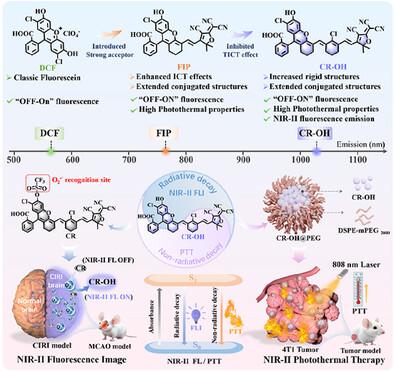
Although classical fluorescent dyes feature advantages of high quantum yield, tunable “OFF-ON” fluorescence, and modifiable chemical structures, etc., their bio-applications in deep tissue remains challenging due to their excessively short emission wavelength (that may lead to superficial tissue penetration depth). Therefore, there is a pressing need for pushing the wavelength of classical dyes from visible region to NIR-II window. As a representative classical dye, the 2′,7′-Dichlorofluorescein (DCF), a derivative of Fluorescein, is selected and rationally engineered to develop a novel NIR-II platform, CR-OH, which exhibits a substantial red-shift in the wavelength from the visible region to the NIR-II region. This achievement is attributed to molecular modification strategies that include extending π-conjugation, enhancing molecular rigidity, and incorporating strong electron-withdrawing groups. Furthermore, based on this developed NIR-II platform, a NIR-II fluorescence probe and a photothermal nanoagent are successfully constructed to unlock its bio-application in the NIR-II fluorescence imaging of endogenous O2·– fluctuations in a CIRI model for the first time, as well as effective photothermal therapy for 4T1 tumors with a high photothermal conversion efficiency (44.0%). Significantly, this work overcomes the wavelength limitation of classical dyes, effectively unlocking their applications for the diagnosis and treatment of early disease in the NIR-II window.
期刊介绍:
Small serves as an exceptional platform for both experimental and theoretical studies in fundamental and applied interdisciplinary research at the nano- and microscale. The journal offers a compelling mix of peer-reviewed Research Articles, Reviews, Perspectives, and Comments.
With a remarkable 2022 Journal Impact Factor of 13.3 (Journal Citation Reports from Clarivate Analytics, 2023), Small remains among the top multidisciplinary journals, covering a wide range of topics at the interface of materials science, chemistry, physics, engineering, medicine, and biology.
Small's readership includes biochemists, biologists, biomedical scientists, chemists, engineers, information technologists, materials scientists, physicists, and theoreticians alike.


 求助内容:
求助内容: 应助结果提醒方式:

 京公网安备 11010802042870号


