
钠离子电池硬碳阳极孔结构/界面官能团的分子工程研究
IF 20.2
1区 材料科学
Q1 CHEMISTRY, PHYSICAL
引用次数: 0
摘要
硬碳具有丰富的孔隙结构和合适的界面,是钠离子电池极具发展前景的阳极材料。然而,如何准确调控硬碳微孔结构和定制合适的界面仍然是一个挑战。在前驱体中引入不同的杂原子,通过其热解组分调节硬碳的孔隙结构,并采用原位掺杂的方法优化界面。结果表明,与氧杂化物交联的硬碳(HC-O)具有丰富的微孔(0.5 ~ 0.9 nm)和羰基基团(C=O)。微孔可以加速平台容量,而C=O可以诱导富无机固体电解质界面(SEI)的形成,提高初始库仑效率(ICE)。得益于HC-O独特的结构,Na//HC-O半电池具有352.9 mAh g-1的高可逆容量和88.0%的ICE。此外,组装的HC-O//Na3V2(PO4)2F3@C全电池表现出优异的倍率性能和良好的循环稳定性,循环300次后容量保持率为86.1%。系统研究了不同杂原子交联前驱体对硬碳改性的意义,为高性能钠离子电池硬碳阳极的设计提供了新的思路和见解。本文章由计算机程序翻译,如有差异,请以英文原文为准。
Molecular engineering of pore structure/interfacial functional groups toward hard carbon anode in sodium-ion batteries
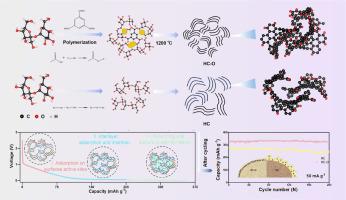
Hard carbon with abundant pore structure and suitable interface has become a promising anode for sodium-ion batteries. However, it is still a challenge to accurately regulate the hard carbon micropore structure and customize the appropriate interface. Herein, different heteroatoms are introduced into the precursor to regulate the pore structure of hard carbon through its pyrolytic components, and in-situ doping is also used to optimize the interface. The results show that the hard carbon cross-linked with oxy-hybrid (HC![]() O) possesses affluent micropores (0.5∼0.9 nm) and groups of carbonyls (C = O). The micropores can accelerate the plateau capacity, while the C = O can induce the formation of inorganic rich solid electrolyte interface (SEI) to promote initial coulombic efficiency (ICE). Benefiting from the unique structure of HC
O) possesses affluent micropores (0.5∼0.9 nm) and groups of carbonyls (C = O). The micropores can accelerate the plateau capacity, while the C = O can induce the formation of inorganic rich solid electrolyte interface (SEI) to promote initial coulombic efficiency (ICE). Benefiting from the unique structure of HC![]() O, the Na//HC
O, the Na//HC![]() O half-cell exhibits high reversible capacity of 352.9 mAh g-1 and ICE of 88.0 %. In addition, the assembled HC
O half-cell exhibits high reversible capacity of 352.9 mAh g-1 and ICE of 88.0 %. In addition, the assembled HC![]() O//Na3V2(PO4)2F3@C full-cell reveals splendid rate performance and excellent cycling stability with capacity retention rate of 86.1 % after 300 cycles. The significance of different heteroatom cross-linked precursors on hard carbon modification is studied systematically, which provides new ideas and insights for designing hard carbon anodes of high-performance sodium-ion batteries.
O//Na3V2(PO4)2F3@C full-cell reveals splendid rate performance and excellent cycling stability with capacity retention rate of 86.1 % after 300 cycles. The significance of different heteroatom cross-linked precursors on hard carbon modification is studied systematically, which provides new ideas and insights for designing hard carbon anodes of high-performance sodium-ion batteries.
求助全文
通过发布文献求助,成功后即可免费获取论文全文。
去求助
来源期刊
Energy Storage Materials
Materials Science-General Materials Science
CiteScore
33.00
自引率
5.90%
发文量
652
审稿时长
27 days
期刊介绍:
Energy Storage Materials is a global interdisciplinary journal dedicated to sharing scientific and technological advancements in materials and devices for advanced energy storage and related energy conversion, such as in metal-O2 batteries. The journal features comprehensive research articles, including full papers and short communications, as well as authoritative feature articles and reviews by leading experts in the field.
Energy Storage Materials covers a wide range of topics, including the synthesis, fabrication, structure, properties, performance, and technological applications of energy storage materials. Additionally, the journal explores strategies, policies, and developments in the field of energy storage materials and devices for sustainable energy.
Published papers are selected based on their scientific and technological significance, their ability to provide valuable new knowledge, and their relevance to the international research community.
 求助内容:
求助内容: 应助结果提醒方式:

 京公网安备 11010802042870号


