{"title":"MXene的多功能优化提高晶体硅-MXene背异质结太阳能电池的综合性能","authors":"Xiaoyang Liu, Hongbo Tong, Yali Li, Wenxuan Li, Guodong Wan, Qiming Liu, Yujun Fu, Deyan He, Zhenguo Li, Junshuai Li","doi":"10.1002/smll.202410160","DOIUrl":null,"url":null,"abstract":"<p>Enhancing the cost-performance ratio is a fundamental objective for the advancement of the photovoltaic sector. In this context, the development of innovative solar cells that offer a straightforward device configuration but high performance is arguably the most crucial element. Herein, an undoped back-heterojunction crystalline silicon (c-Si) solar cell is endeavored to be crafted by simply drop-casting a Ti<sub>3</sub>C<sub>2</sub>T<i><sub>x</sub></i> MXene ethanol colloidal solution onto the backside of an <i>n</i>-type c-Si (<i>n</i>-Si) wafer. Leveraging the good electrical property and stability, as well as the adjustable work function of MXene treated by europium trifluoromethanesulfonate (Eu(OTF)<sub>3</sub>), the elementary Ag/ZnO/<i>n</i>-Si/MXene/Ag solar cell delivers an impressive power conversion efficiency (PCE) of 12.5%. Moreover, the deposition of a SiO<sub>2</sub> passivation layer through a simple self-developed electrochemical method increases the PCE further to 13.5% by ameliorating the interfacial contact between MXene and <i>n</i>-Si. Moreover, this unencapsulated solar cell exhibits improved stability, compared to the control device without Eu(OTF)<sub>3</sub> treatment and SiO<sub>2</sub> passivation.</p>","PeriodicalId":228,"journal":{"name":"Small","volume":"21 5","pages":""},"PeriodicalIF":12.1000,"publicationDate":"2024-12-19","publicationTypes":"Journal Article","fieldsOfStudy":null,"isOpenAccess":false,"openAccessPdf":"","citationCount":"0","resultStr":"{\"title\":\"Multifunctional Optimization of MXene for Enhanced Comprehensive Performance of Crystal Silicon-MXene Back-Heterojunction Solar Cells\",\"authors\":\"Xiaoyang Liu, Hongbo Tong, Yali Li, Wenxuan Li, Guodong Wan, Qiming Liu, Yujun Fu, Deyan He, Zhenguo Li, Junshuai Li\",\"doi\":\"10.1002/smll.202410160\",\"DOIUrl\":null,\"url\":null,\"abstract\":\"<p>Enhancing the cost-performance ratio is a fundamental objective for the advancement of the photovoltaic sector. In this context, the development of innovative solar cells that offer a straightforward device configuration but high performance is arguably the most crucial element. Herein, an undoped back-heterojunction crystalline silicon (c-Si) solar cell is endeavored to be crafted by simply drop-casting a Ti<sub>3</sub>C<sub>2</sub>T<i><sub>x</sub></i> MXene ethanol colloidal solution onto the backside of an <i>n</i>-type c-Si (<i>n</i>-Si) wafer. Leveraging the good electrical property and stability, as well as the adjustable work function of MXene treated by europium trifluoromethanesulfonate (Eu(OTF)<sub>3</sub>), the elementary Ag/ZnO/<i>n</i>-Si/MXene/Ag solar cell delivers an impressive power conversion efficiency (PCE) of 12.5%. Moreover, the deposition of a SiO<sub>2</sub> passivation layer through a simple self-developed electrochemical method increases the PCE further to 13.5% by ameliorating the interfacial contact between MXene and <i>n</i>-Si. Moreover, this unencapsulated solar cell exhibits improved stability, compared to the control device without Eu(OTF)<sub>3</sub> treatment and SiO<sub>2</sub> passivation.</p>\",\"PeriodicalId\":228,\"journal\":{\"name\":\"Small\",\"volume\":\"21 5\",\"pages\":\"\"},\"PeriodicalIF\":12.1000,\"publicationDate\":\"2024-12-19\",\"publicationTypes\":\"Journal Article\",\"fieldsOfStudy\":null,\"isOpenAccess\":false,\"openAccessPdf\":\"\",\"citationCount\":\"0\",\"resultStr\":null,\"platform\":\"Semanticscholar\",\"paperid\":null,\"PeriodicalName\":\"Small\",\"FirstCategoryId\":\"88\",\"ListUrlMain\":\"https://onlinelibrary.wiley.com/doi/10.1002/smll.202410160\",\"RegionNum\":2,\"RegionCategory\":\"材料科学\",\"ArticlePicture\":[],\"TitleCN\":null,\"AbstractTextCN\":null,\"PMCID\":null,\"EPubDate\":\"\",\"PubModel\":\"\",\"JCR\":\"Q1\",\"JCRName\":\"CHEMISTRY, MULTIDISCIPLINARY\",\"Score\":null,\"Total\":0}","platform":"Semanticscholar","paperid":null,"PeriodicalName":"Small","FirstCategoryId":"88","ListUrlMain":"https://onlinelibrary.wiley.com/doi/10.1002/smll.202410160","RegionNum":2,"RegionCategory":"材料科学","ArticlePicture":[],"TitleCN":null,"AbstractTextCN":null,"PMCID":null,"EPubDate":"","PubModel":"","JCR":"Q1","JCRName":"CHEMISTRY, MULTIDISCIPLINARY","Score":null,"Total":0}
Multifunctional Optimization of MXene for Enhanced Comprehensive Performance of Crystal Silicon-MXene Back-Heterojunction Solar Cells
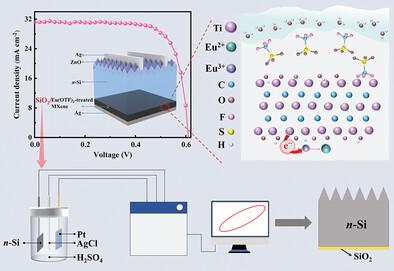
Enhancing the cost-performance ratio is a fundamental objective for the advancement of the photovoltaic sector. In this context, the development of innovative solar cells that offer a straightforward device configuration but high performance is arguably the most crucial element. Herein, an undoped back-heterojunction crystalline silicon (c-Si) solar cell is endeavored to be crafted by simply drop-casting a Ti3C2Tx MXene ethanol colloidal solution onto the backside of an n-type c-Si (n-Si) wafer. Leveraging the good electrical property and stability, as well as the adjustable work function of MXene treated by europium trifluoromethanesulfonate (Eu(OTF)3), the elementary Ag/ZnO/n-Si/MXene/Ag solar cell delivers an impressive power conversion efficiency (PCE) of 12.5%. Moreover, the deposition of a SiO2 passivation layer through a simple self-developed electrochemical method increases the PCE further to 13.5% by ameliorating the interfacial contact between MXene and n-Si. Moreover, this unencapsulated solar cell exhibits improved stability, compared to the control device without Eu(OTF)3 treatment and SiO2 passivation.
期刊介绍:
Small serves as an exceptional platform for both experimental and theoretical studies in fundamental and applied interdisciplinary research at the nano- and microscale. The journal offers a compelling mix of peer-reviewed Research Articles, Reviews, Perspectives, and Comments.
With a remarkable 2022 Journal Impact Factor of 13.3 (Journal Citation Reports from Clarivate Analytics, 2023), Small remains among the top multidisciplinary journals, covering a wide range of topics at the interface of materials science, chemistry, physics, engineering, medicine, and biology.
Small's readership includes biochemists, biologists, biomedical scientists, chemists, engineers, information technologists, materials scientists, physicists, and theoreticians alike.


 求助内容:
求助内容: 应助结果提醒方式:

 京公网安备 11010802042870号


