Wei Zhang, Hongshu Jing, Qiang Niu, Zhihua Wu, Ying Sun, Yourong Duan and Xianwen Wang
{"title":"基于中空、多孔和 pH 值敏感氧化锌微球的促进伤口愈合的可喷涂热敏性水凝胶。","authors":"Wei Zhang, Hongshu Jing, Qiang Niu, Zhihua Wu, Ying Sun, Yourong Duan and Xianwen Wang","doi":"10.1039/D4TB00961D","DOIUrl":null,"url":null,"abstract":"<p >A solvothermal method and the subsequent heat treatment process were developed to fabricate hollow ZnO particles with hierarchical pores on a large scale. The as-obtained hollow, porous ZnO microspheres with tunable sizes, high specific surface areas, pH sensitivity, antibacterial properties, and high adsorption capacities showed significant advantages for drug delivery. Sprayable hydrogels containing hollow, porous ZnO microspheres and curcumin nanoparticles (CNPs) were prepared to accelerate wound healing. The water-dispersed CNPs promoted both the migration of fibroblasts and angiogenesis and an aqueous solution of Pluronic F127 (a temperature-sensitive phase-change hydrogel material) was shown to be an effective choice for medical dressings. The experimental data suggest that hollow, porous ZnO microspheres can be loaded with additional CNPs to achieve continuous long-term therapeutic effects.</p>","PeriodicalId":83,"journal":{"name":"Journal of Materials Chemistry B","volume":" 31","pages":" 7519-7531"},"PeriodicalIF":6.1000,"publicationDate":"2024-06-20","publicationTypes":"Journal Article","fieldsOfStudy":null,"isOpenAccess":false,"openAccessPdf":"","citationCount":"0","resultStr":"{\"title\":\"Sprayable, thermosensitive hydrogels for promoting wound healing based on hollow, porous and pH-sensitive ZnO microspheres†\",\"authors\":\"Wei Zhang, Hongshu Jing, Qiang Niu, Zhihua Wu, Ying Sun, Yourong Duan and Xianwen Wang\",\"doi\":\"10.1039/D4TB00961D\",\"DOIUrl\":null,\"url\":null,\"abstract\":\"<p >A solvothermal method and the subsequent heat treatment process were developed to fabricate hollow ZnO particles with hierarchical pores on a large scale. The as-obtained hollow, porous ZnO microspheres with tunable sizes, high specific surface areas, pH sensitivity, antibacterial properties, and high adsorption capacities showed significant advantages for drug delivery. Sprayable hydrogels containing hollow, porous ZnO microspheres and curcumin nanoparticles (CNPs) were prepared to accelerate wound healing. The water-dispersed CNPs promoted both the migration of fibroblasts and angiogenesis and an aqueous solution of Pluronic F127 (a temperature-sensitive phase-change hydrogel material) was shown to be an effective choice for medical dressings. The experimental data suggest that hollow, porous ZnO microspheres can be loaded with additional CNPs to achieve continuous long-term therapeutic effects.</p>\",\"PeriodicalId\":83,\"journal\":{\"name\":\"Journal of Materials Chemistry B\",\"volume\":\" 31\",\"pages\":\" 7519-7531\"},\"PeriodicalIF\":6.1000,\"publicationDate\":\"2024-06-20\",\"publicationTypes\":\"Journal Article\",\"fieldsOfStudy\":null,\"isOpenAccess\":false,\"openAccessPdf\":\"\",\"citationCount\":\"0\",\"resultStr\":null,\"platform\":\"Semanticscholar\",\"paperid\":null,\"PeriodicalName\":\"Journal of Materials Chemistry B\",\"FirstCategoryId\":\"1\",\"ListUrlMain\":\"https://pubs.rsc.org/en/content/articlelanding/2024/tb/d4tb00961d\",\"RegionNum\":3,\"RegionCategory\":\"医学\",\"ArticlePicture\":[],\"TitleCN\":null,\"AbstractTextCN\":null,\"PMCID\":null,\"EPubDate\":\"\",\"PubModel\":\"\",\"JCR\":\"Q1\",\"JCRName\":\"MATERIALS SCIENCE, BIOMATERIALS\",\"Score\":null,\"Total\":0}","platform":"Semanticscholar","paperid":null,"PeriodicalName":"Journal of Materials Chemistry B","FirstCategoryId":"1","ListUrlMain":"https://pubs.rsc.org/en/content/articlelanding/2024/tb/d4tb00961d","RegionNum":3,"RegionCategory":"医学","ArticlePicture":[],"TitleCN":null,"AbstractTextCN":null,"PMCID":null,"EPubDate":"","PubModel":"","JCR":"Q1","JCRName":"MATERIALS SCIENCE, BIOMATERIALS","Score":null,"Total":0}
Sprayable, thermosensitive hydrogels for promoting wound healing based on hollow, porous and pH-sensitive ZnO microspheres†
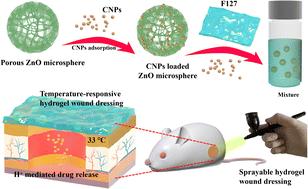
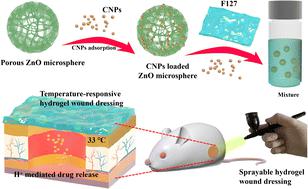
A solvothermal method and the subsequent heat treatment process were developed to fabricate hollow ZnO particles with hierarchical pores on a large scale. The as-obtained hollow, porous ZnO microspheres with tunable sizes, high specific surface areas, pH sensitivity, antibacterial properties, and high adsorption capacities showed significant advantages for drug delivery. Sprayable hydrogels containing hollow, porous ZnO microspheres and curcumin nanoparticles (CNPs) were prepared to accelerate wound healing. The water-dispersed CNPs promoted both the migration of fibroblasts and angiogenesis and an aqueous solution of Pluronic F127 (a temperature-sensitive phase-change hydrogel material) was shown to be an effective choice for medical dressings. The experimental data suggest that hollow, porous ZnO microspheres can be loaded with additional CNPs to achieve continuous long-term therapeutic effects.
期刊介绍:
Journal of Materials Chemistry A, B & C cover high quality studies across all fields of materials chemistry. The journals focus on those theoretical or experimental studies that report new understanding, applications, properties and synthesis of materials. Journal of Materials Chemistry A, B & C are separated by the intended application of the material studied. Broadly, applications in energy and sustainability are of interest to Journal of Materials Chemistry A, applications in biology and medicine are of interest to Journal of Materials Chemistry B, and applications in optical, magnetic and electronic devices are of interest to Journal of Materials Chemistry C.Journal of Materials Chemistry B is a Transformative Journal and Plan S compliant. Example topic areas within the scope of Journal of Materials Chemistry B are listed below. This list is neither exhaustive nor exclusive:
Antifouling coatings
Biocompatible materials
Bioelectronics
Bioimaging
Biomimetics
Biomineralisation
Bionics
Biosensors
Diagnostics
Drug delivery
Gene delivery
Immunobiology
Nanomedicine
Regenerative medicine & Tissue engineering
Scaffolds
Soft robotics
Stem cells
Therapeutic devices

 求助内容:
求助内容: 应助结果提醒方式:

 京公网安备 11010802042870号


