Dane W. deQuilettes, Jason J. Yoo, Roberto Brenes, Felix Utama Kosasih, Madeleine Laitz, Benjia Dak Dou, Daniel J. Graham, Kevin Ho, Yangwei Shi, Seong Sik Shin, Caterina Ducati, Moungi G. Bawendi, Vladimir Bulović
{"title":"在过氧化物薄膜中通过可调表面场减少重组","authors":"Dane W. deQuilettes, Jason J. Yoo, Roberto Brenes, Felix Utama Kosasih, Madeleine Laitz, Benjia Dak Dou, Daniel J. Graham, Kevin Ho, Yangwei Shi, Seong Sik Shin, Caterina Ducati, Moungi G. Bawendi, Vladimir Bulović","doi":"10.1038/s41560-024-01470-5","DOIUrl":null,"url":null,"abstract":"The ability to reduce energy loss at semiconductor surfaces through passivation or surface field engineering is an essential step in the manufacturing of efficient photovoltaic (PV) and optoelectronic devices. Similarly, surface modification of emerging halide perovskites with quasi-two-dimensional (2D) heterostructures is now ubiquitous to achieve PV power conversion efficiencies (PCEs) >25%, yet a fundamental understanding to how these treatments function is still generally lacking. Here we use a unique combination of depth-sensitive nanoscale characterization techniques to uncover a tunable passivation strategy and mechanism found in perovskite PV devices that were the first to reach the >25% PCE milestone. Namely, treatment with hexylammonium bromide leads to the simultaneous formation of an iodide-rich 2D layer along with a Br halide gradient that extends from defective surfaces and grain boundaries into the bulk three-dimensional (3D) layer. This interface can be optimized to extend the charge carrier lifetime to record values >30 μs and to reduce interfacial recombination velocities to values as low as <7 cm s−1. deQuilettes et al. show that hexylammonium bromide forms an iodide-rich 2D structure and bromide gradient at the surface of 3D perovskite, both of which limit interfacial charge and energy losses in perovskite solar cells.","PeriodicalId":19073,"journal":{"name":"Nature Energy","volume":"9 4","pages":"457-466"},"PeriodicalIF":60.1000,"publicationDate":"2024-02-28","publicationTypes":"Journal Article","fieldsOfStudy":null,"isOpenAccess":false,"openAccessPdf":"","citationCount":"0","resultStr":"{\"title\":\"Reduced recombination via tunable surface fields in perovskite thin films\",\"authors\":\"Dane W. deQuilettes, Jason J. Yoo, Roberto Brenes, Felix Utama Kosasih, Madeleine Laitz, Benjia Dak Dou, Daniel J. Graham, Kevin Ho, Yangwei Shi, Seong Sik Shin, Caterina Ducati, Moungi G. Bawendi, Vladimir Bulović\",\"doi\":\"10.1038/s41560-024-01470-5\",\"DOIUrl\":null,\"url\":null,\"abstract\":\"The ability to reduce energy loss at semiconductor surfaces through passivation or surface field engineering is an essential step in the manufacturing of efficient photovoltaic (PV) and optoelectronic devices. Similarly, surface modification of emerging halide perovskites with quasi-two-dimensional (2D) heterostructures is now ubiquitous to achieve PV power conversion efficiencies (PCEs) >25%, yet a fundamental understanding to how these treatments function is still generally lacking. Here we use a unique combination of depth-sensitive nanoscale characterization techniques to uncover a tunable passivation strategy and mechanism found in perovskite PV devices that were the first to reach the >25% PCE milestone. Namely, treatment with hexylammonium bromide leads to the simultaneous formation of an iodide-rich 2D layer along with a Br halide gradient that extends from defective surfaces and grain boundaries into the bulk three-dimensional (3D) layer. This interface can be optimized to extend the charge carrier lifetime to record values >30 μs and to reduce interfacial recombination velocities to values as low as <7 cm s−1. deQuilettes et al. show that hexylammonium bromide forms an iodide-rich 2D structure and bromide gradient at the surface of 3D perovskite, both of which limit interfacial charge and energy losses in perovskite solar cells.\",\"PeriodicalId\":19073,\"journal\":{\"name\":\"Nature Energy\",\"volume\":\"9 4\",\"pages\":\"457-466\"},\"PeriodicalIF\":60.1000,\"publicationDate\":\"2024-02-28\",\"publicationTypes\":\"Journal Article\",\"fieldsOfStudy\":null,\"isOpenAccess\":false,\"openAccessPdf\":\"\",\"citationCount\":\"0\",\"resultStr\":null,\"platform\":\"Semanticscholar\",\"paperid\":null,\"PeriodicalName\":\"Nature Energy\",\"FirstCategoryId\":\"88\",\"ListUrlMain\":\"https://www.nature.com/articles/s41560-024-01470-5\",\"RegionNum\":1,\"RegionCategory\":\"材料科学\",\"ArticlePicture\":[],\"TitleCN\":null,\"AbstractTextCN\":null,\"PMCID\":null,\"EPubDate\":\"\",\"PubModel\":\"\",\"JCR\":\"Q1\",\"JCRName\":\"ENERGY & FUELS\",\"Score\":null,\"Total\":0}","platform":"Semanticscholar","paperid":null,"PeriodicalName":"Nature Energy","FirstCategoryId":"88","ListUrlMain":"https://www.nature.com/articles/s41560-024-01470-5","RegionNum":1,"RegionCategory":"材料科学","ArticlePicture":[],"TitleCN":null,"AbstractTextCN":null,"PMCID":null,"EPubDate":"","PubModel":"","JCR":"Q1","JCRName":"ENERGY & FUELS","Score":null,"Total":0}
Reduced recombination via tunable surface fields in perovskite thin films
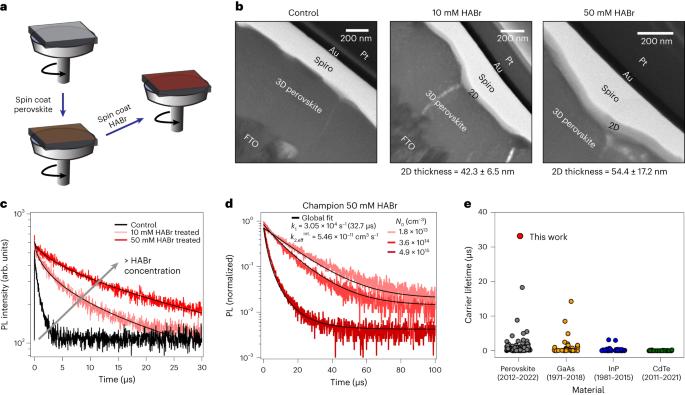
The ability to reduce energy loss at semiconductor surfaces through passivation or surface field engineering is an essential step in the manufacturing of efficient photovoltaic (PV) and optoelectronic devices. Similarly, surface modification of emerging halide perovskites with quasi-two-dimensional (2D) heterostructures is now ubiquitous to achieve PV power conversion efficiencies (PCEs) >25%, yet a fundamental understanding to how these treatments function is still generally lacking. Here we use a unique combination of depth-sensitive nanoscale characterization techniques to uncover a tunable passivation strategy and mechanism found in perovskite PV devices that were the first to reach the >25% PCE milestone. Namely, treatment with hexylammonium bromide leads to the simultaneous formation of an iodide-rich 2D layer along with a Br halide gradient that extends from defective surfaces and grain boundaries into the bulk three-dimensional (3D) layer. This interface can be optimized to extend the charge carrier lifetime to record values >30 μs and to reduce interfacial recombination velocities to values as low as <7 cm s−1. deQuilettes et al. show that hexylammonium bromide forms an iodide-rich 2D structure and bromide gradient at the surface of 3D perovskite, both of which limit interfacial charge and energy losses in perovskite solar cells.
Nature EnergyEnergy-Energy Engineering and Power Technology
CiteScore
75.10
自引率
1.10%
发文量
193
期刊介绍:
Nature Energy is a monthly, online-only journal committed to showcasing the most impactful research on energy, covering everything from its generation and distribution to the societal implications of energy technologies and policies.
With a focus on exploring all facets of the ongoing energy discourse, Nature Energy delves into topics such as energy generation, storage, distribution, management, and the societal impacts of energy technologies and policies. Emphasizing studies that push the boundaries of knowledge and contribute to the development of next-generation solutions, the journal serves as a platform for the exchange of ideas among stakeholders at the forefront of the energy sector.
Maintaining the hallmark standards of the Nature brand, Nature Energy boasts a dedicated team of professional editors, a rigorous peer-review process, meticulous copy-editing and production, rapid publication times, and editorial independence.
In addition to original research articles, Nature Energy also publishes a range of content types, including Comments, Perspectives, Reviews, News & Views, Features, and Correspondence, covering a diverse array of disciplines relevant to the field of energy.