Xiaoying Lin , Hongxin Xie , Yanfei Zhang , Xue Tian , Liwei Cui , Nianqiu Shi , Liming Wang , Jiating Zhao , Lihui An , Jing Wang , Bai Li , Yu-Feng Li
{"title":"纳米聚对苯二甲酸乙二醇酯对小鼠的毒性:肠梗阻、生长阻滞、肠道菌群失调和脂质代谢紊乱","authors":"Xiaoying Lin , Hongxin Xie , Yanfei Zhang , Xue Tian , Liwei Cui , Nianqiu Shi , Liming Wang , Jiating Zhao , Lihui An , Jing Wang , Bai Li , Yu-Feng Li","doi":"10.1016/j.fct.2022.113585","DOIUrl":null,"url":null,"abstract":"<div><p><span><span><span>Polyethylene terephthalate<span> (PET) are widely used in our daily life while they may be broken to smaller fractions as nano-sized PET (nPET) in the environment. The toxicity of nPET is still less studied. This work first evaluated the LD50 of different size of nPET (200 nm, S-nPET; 700 nm, B-nPET) in mice, then studied the health effects of single exposure to S/B-nPET at 200 mg/kg bw for 30 days. It was found that the LD50 was 266 mg/kg bw for S-nPET and 523 mg/kg bw for B-nPET, respectively, showing a size-dependent effect. S-nPET caused weight loss, cyst, intestinal obstruction, organ damage and mortality (40%), and perturbed gut </span></span>microbiome<span> and metabolome especially lipid metabolism, such as upregulated cholesterol, glycocholic, </span></span>propionic acid<span>, niacinamide, </span></span>ectoine<span> and xanthine<span>, and downregulated arachidonic acid, anserine, histamine, while B-nPET did not. Serological analysis found S-nPET brought more lipid metabolic immune and neurological damage than B-nPET, confirming the size-dependent effect. To the best of our knowledge, this is the first report on the systematic toxicity of nPET to mice. Further studies are warranted for life-long effects of nPET. The protocol applied in this work may also be used for the study of the health effects of other plastics.</span></span></p></div>","PeriodicalId":317,"journal":{"name":"Food and Chemical Toxicology","volume":"172 ","pages":"Article 113585"},"PeriodicalIF":3.5000,"publicationDate":"2023-02-01","publicationTypes":"Journal Article","fieldsOfStudy":null,"isOpenAccess":false,"openAccessPdf":"","citationCount":"2","resultStr":"{\"title\":\"The toxicity of nano polyethylene terephthalate to mice: Intestinal obstruction, growth retardant, gut microbiota dysbiosis and lipid metabolism disorders\",\"authors\":\"Xiaoying Lin , Hongxin Xie , Yanfei Zhang , Xue Tian , Liwei Cui , Nianqiu Shi , Liming Wang , Jiating Zhao , Lihui An , Jing Wang , Bai Li , Yu-Feng Li\",\"doi\":\"10.1016/j.fct.2022.113585\",\"DOIUrl\":null,\"url\":null,\"abstract\":\"<div><p><span><span><span>Polyethylene terephthalate<span> (PET) are widely used in our daily life while they may be broken to smaller fractions as nano-sized PET (nPET) in the environment. The toxicity of nPET is still less studied. This work first evaluated the LD50 of different size of nPET (200 nm, S-nPET; 700 nm, B-nPET) in mice, then studied the health effects of single exposure to S/B-nPET at 200 mg/kg bw for 30 days. It was found that the LD50 was 266 mg/kg bw for S-nPET and 523 mg/kg bw for B-nPET, respectively, showing a size-dependent effect. S-nPET caused weight loss, cyst, intestinal obstruction, organ damage and mortality (40%), and perturbed gut </span></span>microbiome<span> and metabolome especially lipid metabolism, such as upregulated cholesterol, glycocholic, </span></span>propionic acid<span>, niacinamide, </span></span>ectoine<span> and xanthine<span>, and downregulated arachidonic acid, anserine, histamine, while B-nPET did not. Serological analysis found S-nPET brought more lipid metabolic immune and neurological damage than B-nPET, confirming the size-dependent effect. To the best of our knowledge, this is the first report on the systematic toxicity of nPET to mice. Further studies are warranted for life-long effects of nPET. The protocol applied in this work may also be used for the study of the health effects of other plastics.</span></span></p></div>\",\"PeriodicalId\":317,\"journal\":{\"name\":\"Food and Chemical Toxicology\",\"volume\":\"172 \",\"pages\":\"Article 113585\"},\"PeriodicalIF\":3.5000,\"publicationDate\":\"2023-02-01\",\"publicationTypes\":\"Journal Article\",\"fieldsOfStudy\":null,\"isOpenAccess\":false,\"openAccessPdf\":\"\",\"citationCount\":\"2\",\"resultStr\":null,\"platform\":\"Semanticscholar\",\"paperid\":null,\"PeriodicalName\":\"Food and Chemical Toxicology\",\"FirstCategoryId\":\"97\",\"ListUrlMain\":\"https://www.sciencedirect.com/science/article/pii/S0278691522007839\",\"RegionNum\":3,\"RegionCategory\":\"医学\",\"ArticlePicture\":[],\"TitleCN\":null,\"AbstractTextCN\":null,\"PMCID\":null,\"EPubDate\":\"2022/12/22 0:00:00\",\"PubModel\":\"Epub\",\"JCR\":\"Q2\",\"JCRName\":\"FOOD SCIENCE & TECHNOLOGY\",\"Score\":null,\"Total\":0}","platform":"Semanticscholar","paperid":null,"PeriodicalName":"Food and Chemical Toxicology","FirstCategoryId":"97","ListUrlMain":"https://www.sciencedirect.com/science/article/pii/S0278691522007839","RegionNum":3,"RegionCategory":"医学","ArticlePicture":[],"TitleCN":null,"AbstractTextCN":null,"PMCID":null,"EPubDate":"2022/12/22 0:00:00","PubModel":"Epub","JCR":"Q2","JCRName":"FOOD SCIENCE & TECHNOLOGY","Score":null,"Total":0}
The toxicity of nano polyethylene terephthalate to mice: Intestinal obstruction, growth retardant, gut microbiota dysbiosis and lipid metabolism disorders
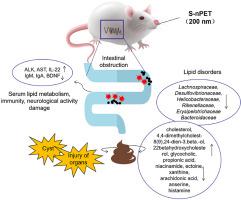
Polyethylene terephthalate (PET) are widely used in our daily life while they may be broken to smaller fractions as nano-sized PET (nPET) in the environment. The toxicity of nPET is still less studied. This work first evaluated the LD50 of different size of nPET (200 nm, S-nPET; 700 nm, B-nPET) in mice, then studied the health effects of single exposure to S/B-nPET at 200 mg/kg bw for 30 days. It was found that the LD50 was 266 mg/kg bw for S-nPET and 523 mg/kg bw for B-nPET, respectively, showing a size-dependent effect. S-nPET caused weight loss, cyst, intestinal obstruction, organ damage and mortality (40%), and perturbed gut microbiome and metabolome especially lipid metabolism, such as upregulated cholesterol, glycocholic, propionic acid, niacinamide, ectoine and xanthine, and downregulated arachidonic acid, anserine, histamine, while B-nPET did not. Serological analysis found S-nPET brought more lipid metabolic immune and neurological damage than B-nPET, confirming the size-dependent effect. To the best of our knowledge, this is the first report on the systematic toxicity of nPET to mice. Further studies are warranted for life-long effects of nPET. The protocol applied in this work may also be used for the study of the health effects of other plastics.
期刊介绍:
Food and Chemical Toxicology (FCT), an internationally renowned journal, that publishes original research articles and reviews on toxic effects, in animals and humans, of natural or synthetic chemicals occurring in the human environment with particular emphasis on food, drugs, and chemicals, including agricultural and industrial safety, and consumer product safety. Areas such as safety evaluation of novel foods and ingredients, biotechnologically-derived products, and nanomaterials are included in the scope of the journal. FCT also encourages submission of papers on inter-relationships between nutrition and toxicology and on in vitro techniques, particularly those fostering the 3 Rs.
The principal aim of the journal is to publish high impact, scholarly work and to serve as a multidisciplinary forum for research in toxicology. Papers submitted will be judged on the basis of scientific originality and contribution to the field, quality and subject matter. Studies should address at least one of the following:
-Adverse physiological/biochemical, or pathological changes induced by specific defined substances
-New techniques for assessing potential toxicity, including molecular biology
-Mechanisms underlying toxic phenomena
-Toxicological examinations of specific chemicals or consumer products, both those showing adverse effects and those demonstrating safety, that meet current standards of scientific acceptability.
Authors must clearly and briefly identify what novel toxic effect (s) or toxic mechanism (s) of the chemical are being reported and what their significance is in the abstract. Furthermore, sufficient doses should be included in order to provide information on NOAEL/LOAEL values.

 求助内容:
求助内容: 应助结果提醒方式:

 京公网安备 11010802042870号


