{"title":"Prevalence and characteristics of adult patients with adult-onset and childhood-onset food allergy.","authors":"Mongkhon Sompornrattanaphan, Suppachok Ajalasaereewong, Chamard Wongsa, Torpong Thongngarm, Piyaporn Chokevittaya, Irin Vichara-Anont, Kanyada Sirimaskasem, Jarujit Surapinij, Jomgriditip Laomoleethron, Sorawit Wihakhaphirom, Sirapat Haridravedh, Supassorn Limpiyakorn, Teerapat Paringkarn, Thanachit Krikeerati","doi":"10.12932/AP-210223-1548","DOIUrl":null,"url":null,"abstract":"<p><strong>Background: </strong>IgE-mediated food allergy (FA) affects health-related quality of life, and may cause life-threatening reactions. Few studies characterizing adult FA patients have been reported, especially first ever reaction (FER) in adult-onset.</p><p><strong>Objective: </strong>We describe the characteristics of adult FA patients, especially FER and compare these characteristics between childhood- and adult-onset FA.</p><p><strong>Methods: </strong>A cross-sectional study of all adult patients visiting the Allergy Clinic, Siriraj Hospital at the outpatient department between January 2009 to December 2019 was conducted. Demographic, clinical data, and first reaction in life data were collected. Adult-onset was defined as ≥ 18 years old.</p><p><strong>Results: </strong>Of 711 patients visiting the clinic, 174 (24.4%) were FA with a median age of 31.0 years (interquartile range 24.0, 44.0 years); 29.3% were male. FA patients had significantly higher prevalence of sensitization to cockroach compared with non-FA patients (67.4% vs. 56.3%); p = 0.016). The three most common food triggers were shellfish (68.0%), wheat (28.7%), and fruit and vegetables (10.0%). Before diagnosis, 56.7% (97/171) experienced at least 1 food-related anaphylaxis. Of the 166 patients compared on age of onset, 127 (76.5%) were adult-onset. In FER, patients with adult-onset had significantly more reactions to fruit and vegetables, more respiratory system involvement, and more other systems involvement [OR 8.95 (1.13, 1157); p = 0.034; OR 3.15 (95%CI 1.30, 8.25), p = 0.011; OR 10.8 (1.35, 1404), p = 0.019, respectively]. In sensitivity analysis, the cardiovascular system involvement was also significantly more common [OR 2.78 (1.05, 9.15); p = 0.038].</p><p><strong>Conclusions: </strong>Shellfish was the most common trigger foods in adult FA patients. In FER, anaphylaxis was common for adult-onset. Adult-onset FA patients also had more respiratory, cardiovascular, and other systems involvements than childhood-onset ones. FA awareness, early diagnosis, and proper management are encouraged. Further studies on the adult-onset food allergic patients are required.</p>","PeriodicalId":8552,"journal":{"name":"Asian Pacific journal of allergy and immunology","volume":" ","pages":"762-775"},"PeriodicalIF":2.1000,"publicationDate":"2025-12-01","publicationTypes":"Journal Article","fieldsOfStudy":null,"isOpenAccess":false,"openAccessPdf":"","citationCount":"0","resultStr":null,"platform":"Semanticscholar","paperid":null,"PeriodicalName":"Asian Pacific journal of allergy and immunology","FirstCategoryId":"3","ListUrlMain":"https://doi.org/10.12932/AP-210223-1548","RegionNum":4,"RegionCategory":"医学","ArticlePicture":[],"TitleCN":null,"AbstractTextCN":null,"PMCID":null,"EPubDate":"","PubModel":"","JCR":"Q3","JCRName":"ALLERGY","Score":null,"Total":0}
引用次数: 0
Abstract
Background: IgE-mediated food allergy (FA) affects health-related quality of life, and may cause life-threatening reactions. Few studies characterizing adult FA patients have been reported, especially first ever reaction (FER) in adult-onset.
Objective: We describe the characteristics of adult FA patients, especially FER and compare these characteristics between childhood- and adult-onset FA.
Methods: A cross-sectional study of all adult patients visiting the Allergy Clinic, Siriraj Hospital at the outpatient department between January 2009 to December 2019 was conducted. Demographic, clinical data, and first reaction in life data were collected. Adult-onset was defined as ≥ 18 years old.
Results: Of 711 patients visiting the clinic, 174 (24.4%) were FA with a median age of 31.0 years (interquartile range 24.0, 44.0 years); 29.3% were male. FA patients had significantly higher prevalence of sensitization to cockroach compared with non-FA patients (67.4% vs. 56.3%); p = 0.016). The three most common food triggers were shellfish (68.0%), wheat (28.7%), and fruit and vegetables (10.0%). Before diagnosis, 56.7% (97/171) experienced at least 1 food-related anaphylaxis. Of the 166 patients compared on age of onset, 127 (76.5%) were adult-onset. In FER, patients with adult-onset had significantly more reactions to fruit and vegetables, more respiratory system involvement, and more other systems involvement [OR 8.95 (1.13, 1157); p = 0.034; OR 3.15 (95%CI 1.30, 8.25), p = 0.011; OR 10.8 (1.35, 1404), p = 0.019, respectively]. In sensitivity analysis, the cardiovascular system involvement was also significantly more common [OR 2.78 (1.05, 9.15); p = 0.038].
Conclusions: Shellfish was the most common trigger foods in adult FA patients. In FER, anaphylaxis was common for adult-onset. Adult-onset FA patients also had more respiratory, cardiovascular, and other systems involvements than childhood-onset ones. FA awareness, early diagnosis, and proper management are encouraged. Further studies on the adult-onset food allergic patients are required.
期刊介绍:
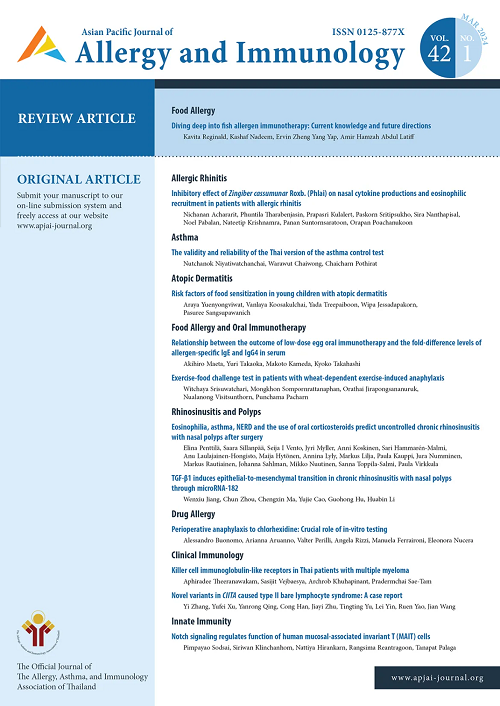
The Asian Pacific Journal of Allergy and Immunology (APJAI) is an online open access journal with the recent impact factor (2018) 1.747
APJAI published 4 times per annum (March, June, September, December). Four issues constitute one volume.
APJAI publishes original research articles of basic science, clinical science and reviews on various aspects of allergy and immunology. This journal is an official journal of and published by the Allergy, Asthma and Immunology Association, Thailand.
The scopes include mechanism, pathogenesis, host-pathogen interaction, host-environment interaction, allergic diseases, immune-mediated diseases, epidemiology, diagnosis, treatment and prevention, immunotherapy, and vaccine. All papers are published in English and are refereed to international standards.

 求助内容:
 应助结果提醒方式:


 京公网安备 11010802042870号


