Shah T Bashir, Angela R Baerwald, Melba O Gastal, Roger A Pierson, Eduardo L Gastal
{"title":"Dominant follicle growth patterns and associated endocrine dynamics in anovulatory and ovulatory waves in women.","authors":"Shah T Bashir, Angela R Baerwald, Melba O Gastal, Roger A Pierson, Eduardo L Gastal","doi":"10.1530/RAF-22-0131","DOIUrl":null,"url":null,"abstract":"<p><p>Growth patterns and associated endocrine profiles were compared between dominant anovulatory (ADF) and ovulatory follicles (OvF) developing from different waves within and between menstrual cycles in women. Follicular mapping profiles of 49 healthy women of reproductive age and blood samples were obtained every 1-3 days. Sixty-three dominant follicles were classified into wave 1 (W1ADF; n = 8) and wave 2 (W2ADF; n = 6) anovulatory follicles and wave 2 (W2OvF; n = 33) and wave 3 (W3OvF; n = 16) ovulatory follicles. Comparisons were made between W1ADF and W2ADF, W2ADF and W2OvF, and W2OvF and W3OvF. The waves were numbered 1, 2, or 3 based on when the waves emerged relative to the preceding ovulation. W1ADF emerged closer to the preceding ovulation, and W2ADF emerged in the late luteal or early follicular phase. The interval from emergence to maximum diameter was shorter for W2ADF than W1ADF and for W3OvF than W2OvF. Selection of W3OvF occurred at a smaller diameter compared to W2OvF. W1ADF regressed at a faster rate than W2ADF. Also, W1ADF were associated with lower mean FSH and higher mean estradiol than W2ADF. In contrast, W3OvF were associated with higher FSH and LH compared to W2OvF. However, W2OvF were associated with higher progesterone than W3OvF. This study contributes to the understanding of the physiologic mechanisms underlying selection of the dominant follicle, ovulation, and pathophysiology of anovulation in women, as well as optimization of ovarian stimulation protocols for assisted reproduction.</p>","PeriodicalId":21128,"journal":{"name":"Reproduction & Fertility","volume":" ","pages":""},"PeriodicalIF":0.0000,"publicationDate":"2023-06-21","publicationTypes":"Journal Article","fieldsOfStudy":null,"isOpenAccess":false,"openAccessPdf":"https://www.ncbi.nlm.nih.gov/pmc/articles/PMC10305562/pdf/","citationCount":"0","resultStr":null,"platform":"Semanticscholar","paperid":null,"PeriodicalName":"Reproduction & Fertility","FirstCategoryId":"1085","ListUrlMain":"https://doi.org/10.1530/RAF-22-0131","RegionNum":0,"RegionCategory":null,"ArticlePicture":[],"TitleCN":null,"AbstractTextCN":null,"PMCID":null,"EPubDate":"","PubModel":"","JCR":"","JCRName":"","Score":null,"Total":0}
引用次数: 0
Abstract
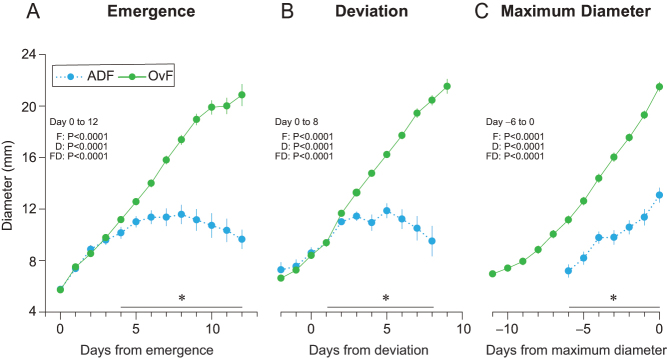
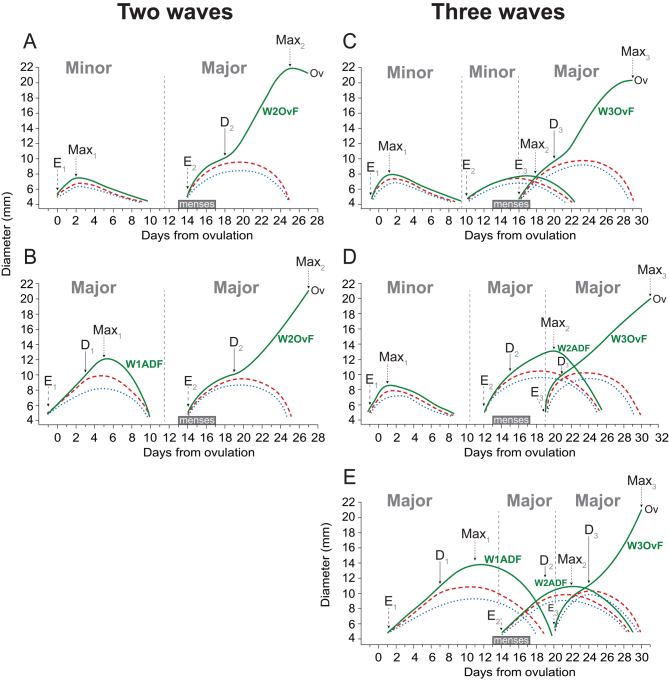
Growth patterns and associated endocrine profiles were compared between dominant anovulatory (ADF) and ovulatory follicles (OvF) developing from different waves within and between menstrual cycles in women. Follicular mapping profiles of 49 healthy women of reproductive age and blood samples were obtained every 1-3 days. Sixty-three dominant follicles were classified into wave 1 (W1ADF; n = 8) and wave 2 (W2ADF; n = 6) anovulatory follicles and wave 2 (W2OvF; n = 33) and wave 3 (W3OvF; n = 16) ovulatory follicles. Comparisons were made between W1ADF and W2ADF, W2ADF and W2OvF, and W2OvF and W3OvF. The waves were numbered 1, 2, or 3 based on when the waves emerged relative to the preceding ovulation. W1ADF emerged closer to the preceding ovulation, and W2ADF emerged in the late luteal or early follicular phase. The interval from emergence to maximum diameter was shorter for W2ADF than W1ADF and for W3OvF than W2OvF. Selection of W3OvF occurred at a smaller diameter compared to W2OvF. W1ADF regressed at a faster rate than W2ADF. Also, W1ADF were associated with lower mean FSH and higher mean estradiol than W2ADF. In contrast, W3OvF were associated with higher FSH and LH compared to W2OvF. However, W2OvF were associated with higher progesterone than W3OvF. This study contributes to the understanding of the physiologic mechanisms underlying selection of the dominant follicle, ovulation, and pathophysiology of anovulation in women, as well as optimization of ovarian stimulation protocols for assisted reproduction.
比较了女性在月经周期内和月经周期之间不同时期的显性无排卵(ADF)和排卵卵泡(OvF)的生长模式和相关内分泌特征。每隔1-3天采集49名健康育龄妇女的卵泡图谱和血液样本。63个显性卵泡分为1波(W1ADF, n = 8)和2波(W2ADF, n = 6)无排卵卵泡和2波(W2OvF, n = 33)和3波(W3OvF, n = 16)无排卵卵泡。比较W1ADF与W2ADF、W2ADF与W2OvF、W2OvF与W3OvF。根据波浪出现的时间相对于之前的排卵时间,这些波浪被编号为1、2或3。W1ADF在排卵前出现,而W2ADF在黄体晚期或卵泡早期出现。W2ADF的萌发至最大直径的时间间隔比W1ADF短,W3OvF的萌发至最大直径的时间间隔比W2OvF短。与W2OvF相比,W3OvF的选择发生在更小的直径上。W1ADF的回归速度比W2ADF快。此外,与W2ADF相比,W1ADF与较低的平均FSH和较高的平均雌二醇相关。相反,与W2OvF相比,W3OvF与更高的FSH和LH相关。然而,W2OvF比W3OvF与更高的黄体酮相关。本研究有助于理解优势卵泡选择、排卵和女性无排卵病理生理的生理机制,以及优化辅助生殖的卵巢刺激方案。



 求助内容:
 应助结果提醒方式:


 京公网安备 11010802042870号


