{"title":"Study on Calcination Catalysis and the Desilication Mechanism for Coal Gangue","authors":"Fengqin Liu*, Mingzhuang Xie, Guoqing Yu, Chaoyang Ke, Hongliang Zhao*","doi":"10.1021/acssuschemeng.1c03276","DOIUrl":null,"url":null,"abstract":"<p >Coal gangue is a solid waste discharged during coal mining, which not only occupies large land resources but also brings about certain risks to the environment. The alumina and silica minerals in coal gangue are the major resources and difficult to separate from each other, which hinders the resource utilization of coal gangue. The catalytic effect of various additives on the phase transformation process of coal gangue is studied in this paper to strengthen the separation of silica from alumina minerals and to increase the resource utilization rate of coal gangue. The study results show that the silica-containing minerals in coal gangue can be promoted to transform into mullite by alumina-based additives. The soluble active silica is released during phase transformation in the calcination process, which has a positive effect on the caustic desilication after calcination. The secondary aluminum dross has a positive catalytic effect on the active silica released during calcination. The alumina to silica ratio of the desilication product can be increased from 0.91 to 1.94 and the desilication rate can be increased from 42.99 to 56.16% by 6% secondary aluminum dross addition. The solid slag after desilication can be used to extract an alumina source for the synthesis of molecular sieve products with the silica source obtained by the desilication process so that the high-value resource utilization of coal gangue can be realized.</p>","PeriodicalId":25,"journal":{"name":"ACS Sustainable Chemistry & Engineering","volume":"9 30","pages":"10318–10325"},"PeriodicalIF":7.6000,"publicationDate":"2021-07-09","publicationTypes":"Journal Article","fieldsOfStudy":null,"isOpenAccess":false,"openAccessPdf":"https://sci-hub-pdf.com/10.1021/acssuschemeng.1c03276","citationCount":"18","resultStr":null,"platform":"Semanticscholar","paperid":null,"PeriodicalName":"ACS Sustainable Chemistry & Engineering","FirstCategoryId":"92","ListUrlMain":"https://pubs.acs.org/doi/10.1021/acssuschemeng.1c03276","RegionNum":1,"RegionCategory":"化学","ArticlePicture":[],"TitleCN":null,"AbstractTextCN":null,"PMCID":null,"EPubDate":"","PubModel":"","JCR":"Q1","JCRName":"CHEMISTRY, MULTIDISCIPLINARY","Score":null,"Total":0}
引用次数: 18
Abstract
Coal gangue is a solid waste discharged during coal mining, which not only occupies large land resources but also brings about certain risks to the environment. The alumina and silica minerals in coal gangue are the major resources and difficult to separate from each other, which hinders the resource utilization of coal gangue. The catalytic effect of various additives on the phase transformation process of coal gangue is studied in this paper to strengthen the separation of silica from alumina minerals and to increase the resource utilization rate of coal gangue. The study results show that the silica-containing minerals in coal gangue can be promoted to transform into mullite by alumina-based additives. The soluble active silica is released during phase transformation in the calcination process, which has a positive effect on the caustic desilication after calcination. The secondary aluminum dross has a positive catalytic effect on the active silica released during calcination. The alumina to silica ratio of the desilication product can be increased from 0.91 to 1.94 and the desilication rate can be increased from 42.99 to 56.16% by 6% secondary aluminum dross addition. The solid slag after desilication can be used to extract an alumina source for the synthesis of molecular sieve products with the silica source obtained by the desilication process so that the high-value resource utilization of coal gangue can be realized.
期刊介绍:
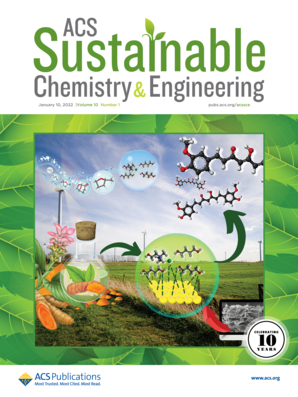
ACS Sustainable Chemistry & Engineering is a prestigious weekly peer-reviewed scientific journal published by the American Chemical Society. Dedicated to advancing the principles of green chemistry and green engineering, it covers a wide array of research topics including green chemistry, green engineering, biomass, alternative energy, and life cycle assessment.
The journal welcomes submissions in various formats, including Letters, Articles, Features, and Perspectives (Reviews), that address the challenges of sustainability in the chemical enterprise and contribute to the advancement of sustainable practices. Join us in shaping the future of sustainable chemistry and engineering.


 求助内容:
 应助结果提醒方式:


 京公网安备 11010802042870号


