{"title":"Preparation of N-Doped Supercapacitor Materials by Integrated Salt Templating and Silicon Hard Templating by Pyrolysis of Biomass Wastes","authors":"Shun Zhang, Ke Tian, Bin-Hai Cheng, Hong Jiang*","doi":"10.1021/acssuschemeng.7b00920","DOIUrl":null,"url":null,"abstract":"<p >For safe disposal and environmentally benign recycling, lignocellulosic biomass wastes are increasingly studied for use as precursors for the preparation of value-added porous carbon materials. However, conventional chemical vapor deposition is time consuming and difficult to perform on a large scale. Herein, we obtained nitrogen-doped porous carbon materials (NPCMs) with high supercapacitor performance by one-pot copyrolysis of a carbon precursor (wheat straw), nitrogen precursor (melamine), and salt templating (mixed salt of KCl/ZnCl<sub>2</sub> at 51:49). The NPCM with 7.78% nitrogen content exhibited an excellent gravimetric capacitance of 223.9 F g<sup>–1</sup>, which is mainly attributed to the increase in surface area by the activation of salt templating and the decrease in ion-transport resistance by N doping of the NPCM. The removal of silicon in pyrolysis products efficiently enhanced the capacitance of materials, but there was a negative effect on capacitance if the silicon was removed from feedstocks before pyrolysis. The post-removal of the silicon greatly increased the cycle stability of NPCMs and maintained 91.4% of capacitance after 10,000 CV tests. BET and XPS analyses indicate that the silicon can improve the pore structure and facilitate the formation of reactive nitrogen species (N-5 and N-6) by hard template and catalysis functions during pyrolysis, which is mainly responsible for the high performance of as-prepared NPCM. This study provides a facile method for synthesizing biomass-based NPCMs, especially to utilize biomass waste that contains high silicon content.</p>","PeriodicalId":25,"journal":{"name":"ACS Sustainable Chemistry & Engineering","volume":"5 8","pages":"6682–6691"},"PeriodicalIF":7.3000,"publicationDate":"2017-07-03","publicationTypes":"Journal Article","fieldsOfStudy":null,"isOpenAccess":false,"openAccessPdf":"https://sci-hub-pdf.com/10.1021/acssuschemeng.7b00920","citationCount":"90","resultStr":null,"platform":"Semanticscholar","paperid":null,"PeriodicalName":"ACS Sustainable Chemistry & Engineering","FirstCategoryId":"92","ListUrlMain":"https://pubs.acs.org/doi/10.1021/acssuschemeng.7b00920","RegionNum":1,"RegionCategory":"化学","ArticlePicture":[],"TitleCN":null,"AbstractTextCN":null,"PMCID":null,"EPubDate":"","PubModel":"","JCR":"Q1","JCRName":"CHEMISTRY, MULTIDISCIPLINARY","Score":null,"Total":0}
引用次数: 90
Abstract
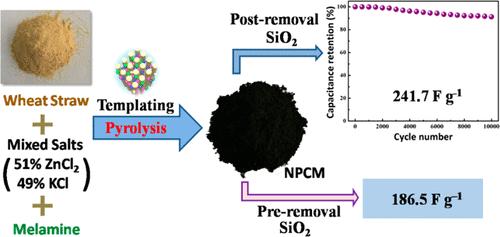
For safe disposal and environmentally benign recycling, lignocellulosic biomass wastes are increasingly studied for use as precursors for the preparation of value-added porous carbon materials. However, conventional chemical vapor deposition is time consuming and difficult to perform on a large scale. Herein, we obtained nitrogen-doped porous carbon materials (NPCMs) with high supercapacitor performance by one-pot copyrolysis of a carbon precursor (wheat straw), nitrogen precursor (melamine), and salt templating (mixed salt of KCl/ZnCl2 at 51:49). The NPCM with 7.78% nitrogen content exhibited an excellent gravimetric capacitance of 223.9 F g–1, which is mainly attributed to the increase in surface area by the activation of salt templating and the decrease in ion-transport resistance by N doping of the NPCM. The removal of silicon in pyrolysis products efficiently enhanced the capacitance of materials, but there was a negative effect on capacitance if the silicon was removed from feedstocks before pyrolysis. The post-removal of the silicon greatly increased the cycle stability of NPCMs and maintained 91.4% of capacitance after 10,000 CV tests. BET and XPS analyses indicate that the silicon can improve the pore structure and facilitate the formation of reactive nitrogen species (N-5 and N-6) by hard template and catalysis functions during pyrolysis, which is mainly responsible for the high performance of as-prepared NPCM. This study provides a facile method for synthesizing biomass-based NPCMs, especially to utilize biomass waste that contains high silicon content.
为了安全处理和环保回收,木质纤维素生物质废物越来越多地被研究用作制备增值多孔碳材料的前驱体。然而,传统的化学气相沉积既耗时又难以大规模进行。在此,我们通过碳前驱体(麦秸),氮前驱体(三聚氰胺)和盐模板(KCl/ZnCl2混合盐51:49)的一锅共解获得了具有高超级电容器性能的氮掺杂多孔碳材料(NPCMs)。含氮量为7.78%的NPCM具有223.9 F - 1的优良重量电容,这主要是由于盐模板活化增加了NPCM的表面积,N掺杂降低了NPCM的离子传输阻力。热解产物中硅的去除有效地增强了材料的电容,但如果在热解前从原料中去除硅,则对材料的电容有负面影响。去除硅后,大大提高了npcm的循环稳定性,并在10,000 CV测试后保持了91.4%的电容。BET和XPS分析表明,硅在热解过程中可以通过硬模板和催化作用改善孔隙结构,促进活性氮(N-5和N-6)的形成,这是制备的NPCM性能优异的主要原因。本研究为生物质基npcm的合成提供了一种简便的方法,特别是利用含硅量高的生物质废弃物。
期刊介绍:
ACS Sustainable Chemistry & Engineering is a prestigious weekly peer-reviewed scientific journal published by the American Chemical Society. Dedicated to advancing the principles of green chemistry and green engineering, it covers a wide array of research topics including green chemistry, green engineering, biomass, alternative energy, and life cycle assessment.
The journal welcomes submissions in various formats, including Letters, Articles, Features, and Perspectives (Reviews), that address the challenges of sustainability in the chemical enterprise and contribute to the advancement of sustainable practices. Join us in shaping the future of sustainable chemistry and engineering.

 求助内容:
求助内容: 应助结果提醒方式:

 京公网安备 11010802042870号


