Removal of Trace Uranium from Groundwaters Using Membrane Capacitive Deionization Desalination for Potable Supply in Remote Communities: Bench, Pilot, and Field Scale Investigations
Clare Bales, Andrew S. Kinsela, Christopher Miller, Yuan Wang, Yunyi Zhu, Boyue Lian and T. David Waite*,
{"title":"Removal of Trace Uranium from Groundwaters Using Membrane Capacitive Deionization Desalination for Potable Supply in Remote Communities: Bench, Pilot, and Field Scale Investigations","authors":"Clare Bales, Andrew S. Kinsela, Christopher Miller, Yuan Wang, Yunyi Zhu, Boyue Lian and T. David Waite*, ","doi":"10.1021/acs.est.3c03477","DOIUrl":null,"url":null,"abstract":"<p >The performance of membrane capacitive deionization (MCDI) desalination was investigated at bench, pilot, and field scales for the removal of uranium from groundwater. It was found that up to 98.9% of the uranium can be removed using MCDI from a groundwater source containing 50 μg/L uranium, with the majority (94.5%) being retained on the anode. Uranium was found to physiochemically adsorb to the electrode without the application of a potential by displacing chloride ions, with 16.6% uranium removal at the bench scale via this non-electrochemical process. This displacement of chloride did not occur during the MCDI adsorption phase with the adsorption of all ions remaining constant during a time series analysis on the pilot unit. For the scenarios tested on the pilot unit, the flowrate of the product water ranged from 0.15 to 0.23 m<sup>3</sup>/h, electrode energy consumption from 0.28 to 0.51 kW h/m<sup>3</sup>, and water recovery from 69 to 86%. A portion (13–53% on the pilot unit) of the uranium was found to remain on the electrodes after the brine discharge phase with conventional cleaning techniques unable to release this retained uranium. MCDI was found to be a suitable means to remove uranium from groundwater systems though with the need to manage the accumulation of uranium on the electrodes over time.</p>","PeriodicalId":36,"journal":{"name":"环境科学与技术","volume":"57 30","pages":"11345–11355"},"PeriodicalIF":12.2000,"publicationDate":"2023-07-18","publicationTypes":"Journal Article","fieldsOfStudy":null,"isOpenAccess":false,"openAccessPdf":"","citationCount":"1","resultStr":null,"platform":"Semanticscholar","paperid":null,"PeriodicalName":"环境科学与技术","FirstCategoryId":"1","ListUrlMain":"https://pubs.acs.org/doi/10.1021/acs.est.3c03477","RegionNum":1,"RegionCategory":"环境科学与生态学","ArticlePicture":[],"TitleCN":null,"AbstractTextCN":null,"PMCID":null,"EPubDate":"","PubModel":"","JCR":"Q1","JCRName":"ENGINEERING, ENVIRONMENTAL","Score":null,"Total":0}
引用次数: 1
Abstract
The performance of membrane capacitive deionization (MCDI) desalination was investigated at bench, pilot, and field scales for the removal of uranium from groundwater. It was found that up to 98.9% of the uranium can be removed using MCDI from a groundwater source containing 50 μg/L uranium, with the majority (94.5%) being retained on the anode. Uranium was found to physiochemically adsorb to the electrode without the application of a potential by displacing chloride ions, with 16.6% uranium removal at the bench scale via this non-electrochemical process. This displacement of chloride did not occur during the MCDI adsorption phase with the adsorption of all ions remaining constant during a time series analysis on the pilot unit. For the scenarios tested on the pilot unit, the flowrate of the product water ranged from 0.15 to 0.23 m3/h, electrode energy consumption from 0.28 to 0.51 kW h/m3, and water recovery from 69 to 86%. A portion (13–53% on the pilot unit) of the uranium was found to remain on the electrodes after the brine discharge phase with conventional cleaning techniques unable to release this retained uranium. MCDI was found to be a suitable means to remove uranium from groundwater systems though with the need to manage the accumulation of uranium on the electrodes over time.
期刊介绍:
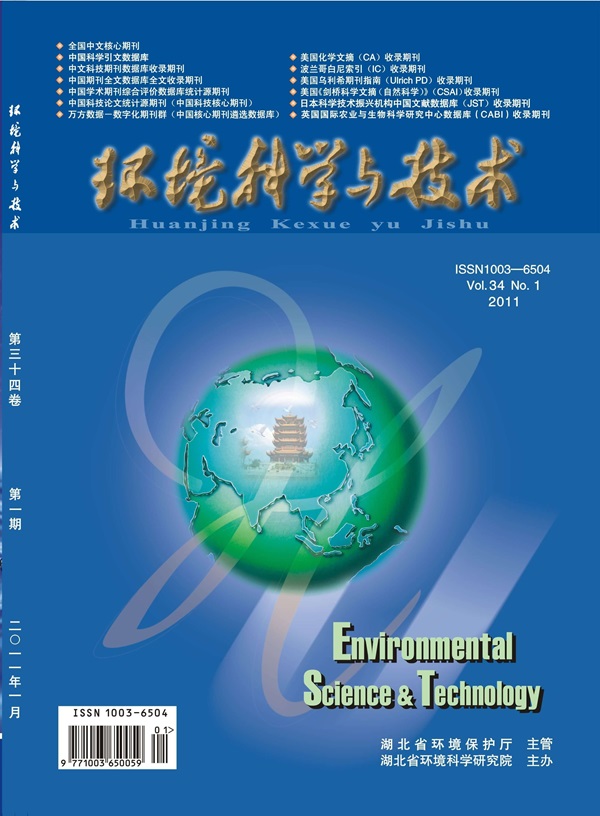
Environmental Science & Technology (ES&T) is a co-sponsored academic and technical magazine by the Hubei Provincial Environmental Protection Bureau and the Hubei Provincial Academy of Environmental Sciences.
Environmental Science & Technology (ES&T) holds the status of Chinese core journals, scientific papers source journals of China, Chinese Science Citation Database source journals, and Chinese Academic Journal Comprehensive Evaluation Database source journals. This publication focuses on the academic field of environmental protection, featuring articles related to environmental protection and technical advancements.


 求助内容:
 应助结果提醒方式:


 京公网安备 11010802042870号


